OSHA Restaurant Inspection Checklist
Interactive OSHA compliance checklist for restaurants covering kitchen safety, fire suppression, emergency exits, electrical, chemical storage, and employee training. Get your real-time compliance score and identify critical violations before inspectors arrive.
No credit card required• Instant access• 40+ OSHA inspection items
Restaurant OSHA Violation Statistics
Common violations restaurant owners must address
Interactive OSHA Restaurant Inspection Checklist
Check off each item your restaurant currently meets. Your compliance score updates in real-time.
Free Restaurant Workplace Safety Assessment
Request a free Workplace Safety Assessment for the work in your restaurant, also known as a workplace risk assessment for kitchen and dining-room staff. Send the form and our team will call you to arrange it. Identify job hazards, review existing controls and organize practical corrective actions across routine and nonroutine tasks.
Free assessment. No credit card required. Send the form and our team will call you to arrange it.
- Preparation and cutting
- Cooking and hot-liquid handling
- Dishwashing and cleaning
- Deliveries and cold storage
- Waste handling
- Equipment cleaning and servicing
- Service and public interaction
- Closing and nonroutine work
Request your free Workplace Safety Assessment
Six quick fields. Our team will call the number you give to arrange your free assessment.
- A call from our team to arrange your free assessment
- A review of your jobs, including cleaning and maintenance, and the controls that need attention
- Free printable job-hazard worksheets with your account
What happens after you send the form
- You send the form. No credit card is needed.
- Our team calls the phone number you give.
- Together we arrange your free Workplace Safety Assessment.
Meanwhile, you can print the job-hazard worksheet with your free account.
Kitchen and front-of-house jobs we help you review
| Job or task | Hazards to review |
|---|---|
| Preparation and cutting | Knives, slicers, moving parts, access and cleaning methods. |
| Cooking and hot-liquid handling | Hot surfaces, steam, oil, splashes and moving containers. |
| Dishwashing and cleaning | Wet floors, repetitive handling, heat and cleaning chemicals. |
| Deliveries and cold storage | Loads, difficult reaches, cold exposure and access. |
| Waste handling | Sharp objects, contaminated waste, spills and manual handling. |
| Equipment cleaning and servicing | Unexpected startup, electrical hazards and applicable isolation procedures. |
| Service and public interaction | Congestion, worker movement, aggression and communication. |
| Closing and nonroutine work | Reduced staffing, lone work, chemical tasks, security and emergencies. |
Use the job list as a starting point. Include workers, contractors and shifts that encounter different conditions. Add tasks or hazards that are missing, and keep unreviewed items open.
Include the rush period and closing shift
A dry, quiet kitchen before opening can hide recurring conditions during service. Ask cooks, dishwashers, cleaners and delivery workers where the work becomes difficult. Review product labels and manufacturer SDS for cleaning tasks. Check equipment instructions and applicable energy-control arrangements when workers clean, unblock or service powered equipment.
What the restaurant assessment looks at for each station
For each job, identify who could be injured or exposed, how the harm could occur and what controls are already in place. Consider the severity and likelihood of harm and the people exposed when prioritizing actions. Record the basis for the priority instead of treating a number as an OSHA pass.
Use the review to build a job-hazard summary and action list. Record additional controls, owners, target dates and how the result will be checked. Where information is missing, identify the verification or specialist input needed.
Restaurant Workplace Safety Assessment example
Grease and wash water collect near a fryer during closing. The team records the source, the route people use and the cleaning task. It reviews the source of the spill, the cleaning method and the work-area arrangement, assigns corrections and checks them during closing. Footwear may form part of the controls, but the recurring spill still needs attention.
Free. Tell us the jobs and the concern you want reviewed, and our team will call you.
What to gather before the kitchen review
Describe preparation, cooking, service, delivery and closing tasks. Bring the products used for cleaning, relevant equipment instructions, worker concerns and changes to staffing or layout. Include young or newly assigned workers when reviewing task suitability and training.
The free request starts the review process: our team calls the number you give to arrange the assessment. Describe the main concern and the work involved so that call can cover it. Address immediate serious dangers through the responsible people without waiting for the appointment.
Record each kitchen station on the job-hazard worksheet
Record the workplace, task, people exposed, existing controls and further actions. The accompanying hazard screen covers fifteen categories, including equipment, chemicals, physical demands, health exposures, work organization and emergencies. Add other job-specific hazards and record why a category does not apply. Review findings after relevant changes and verify actions under actual working conditions.
This is an employee occupational-safety assessment. Food hygiene, HACCP and health-department requirements need their own applicable processes.
Think of the worksheet as a kitchen version of an OSHA self-inspection checklist. OSHA’s Small Business Safety and Health Handbook describes self-inspection checklists as a starting point for identifying hazards, and this one applies that idea to stations, storage and closing duties. It is OSHAMap’s worksheet, not an OSHA form.
Free account needed. It opens a printable page; use your browser's Print or Save as PDF.
- Identified
- Not yet reviewed
- Not applicable + reason
- Machinery and energy
- Vehicles and mobile equipment
- Slips, trips and falls
- Electricity
- Chemicals
- Physical demands
- Noise and vibration
- Heat, cold and physical agents
- Biological hazards
- Fire and emergencies
- Restricted spaces
- Violence and lone work
- Work organization
- PPE gaps
- Additional job-specific hazards
Plus a job register and an additional-hazards field. A category left blank stays open; it never counts as a pass.
How do you do a workplace safety assessment for a restaurant kitchen?
Kitchens are easiest to review station by station, at the times the stations are actually busy. A practical order:
- Draw the kitchen as a simple plan: cook line, fryers, grill, prep tables, slicer, dish area, chemical storage, walk-ins, receiving door and exits.
- For each station, list who works there on each shift, including teenagers, trainees and anyone covering from front of house.
- Watch prep, the rush and closing, looking for burns, cuts and slips around fryer filtering, knife work under time pressure and late-night floor cleaning.
- Check the equipment against its instructions: guards on slicers and mixers, fryer filtering steps, hood and suppression service tags.
- Collect the safety data sheets for degreasers, sanitizers and oven cleaners, and check the way staff mix and store them.
- Rate each hazard, decide the fixes with the people on the line, and confirm them during the next rush rather than during a quiet afternoon.
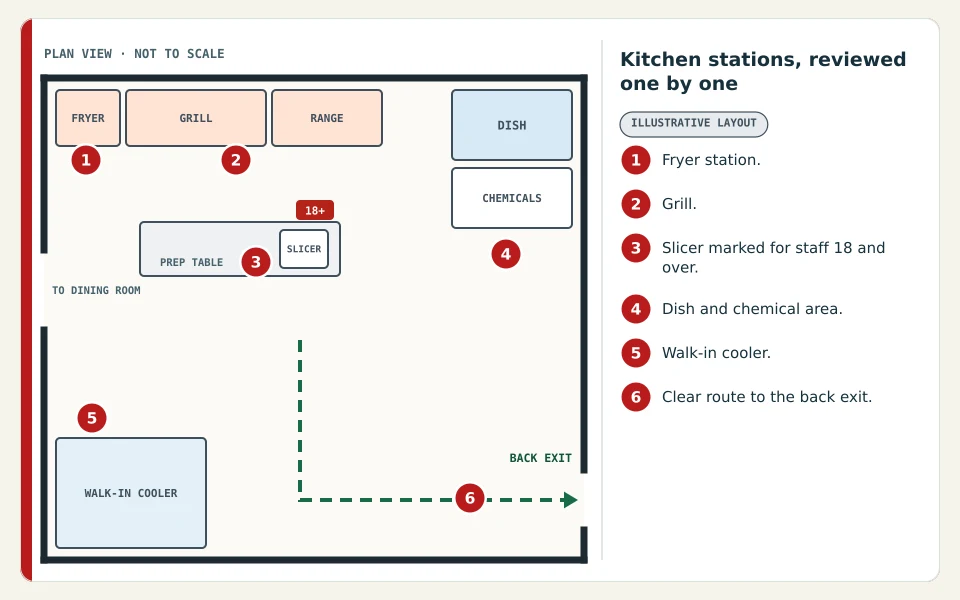
Which kitchen jobs can teenage employees do under federal law?
Federal child labor rules decide some kitchen controls outright, so a restaurant assessment should check who is assigned to each machine. The main federal limits:
| Task | Ages 14–15 | Ages 16–17 | Federal rule |
|---|---|---|---|
| Cooking on electric or gas grills with no open flame | Allowed | Allowed | 29 CFR 570.34(c) |
| Deep fryers that lower and raise the baskets automatically | Allowed | Allowed | 29 CFR 570.34(c) |
| Pressurized equipment such as pressure fryers, plus rotisseries, broilers and very high-temperature cookers | Not authorized | No federal order bars it; check state law | 29 CFR 570.34(c) |
| Operating, feeding, setting up or cleaning power-driven meat slicers, including for cheese, bread or vegetables | Prohibited | Prohibited | Hazardous Occupations Order 10, 29 CFR 570.61 |
| Operating or unloading balers and compactors | Prohibited | Prohibited; loading is allowed only for certain paper balers and box compactors that meet the listed safety conditions | Hazardous Occupations Order 12, 29 CFR 570.63 |
States can add their own limits on hours and tasks, so check your state labor department as well. Flag ages on the schedule so a short-staffed rush does not put the wrong person on a restricted machine.
Does California's indoor heat rule apply to restaurant kitchens?
It can. California's indoor heat illness standard (8 CCR 3396) covers indoor workplaces where the temperature reaches 82°F while employees are present. Brief exposure between 82°F and 95°F for under 15 minutes in an hour is excepted. Where it applies, the review should check:
- Fresh, suitably cool drinking water close to where people work (subsection (c)).
- A cool-down area that staff can use when they need to recover (subsection (d)).
- Emergency response procedures for heat illness (subsection (f)).
- Close observation of anyone newly assigned to a high-heat area while they acclimatize (subsection (g)).
- Heat illness training for staff and supervisors (subsection (h)).
- A written heat illness prevention plan, which may sit inside the Injury and Illness Prevention Program (subsection (i)).
The fuller requirements, including measuring and recording heat and installing controls under subsection (e), apply once the temperature or heat index reaches 87°F, or 82°F where staff wear clothing that restricts heat removal or work in a high radiant heat area, so take readings beside the fryers, ovens and grills rather than in the dining room.
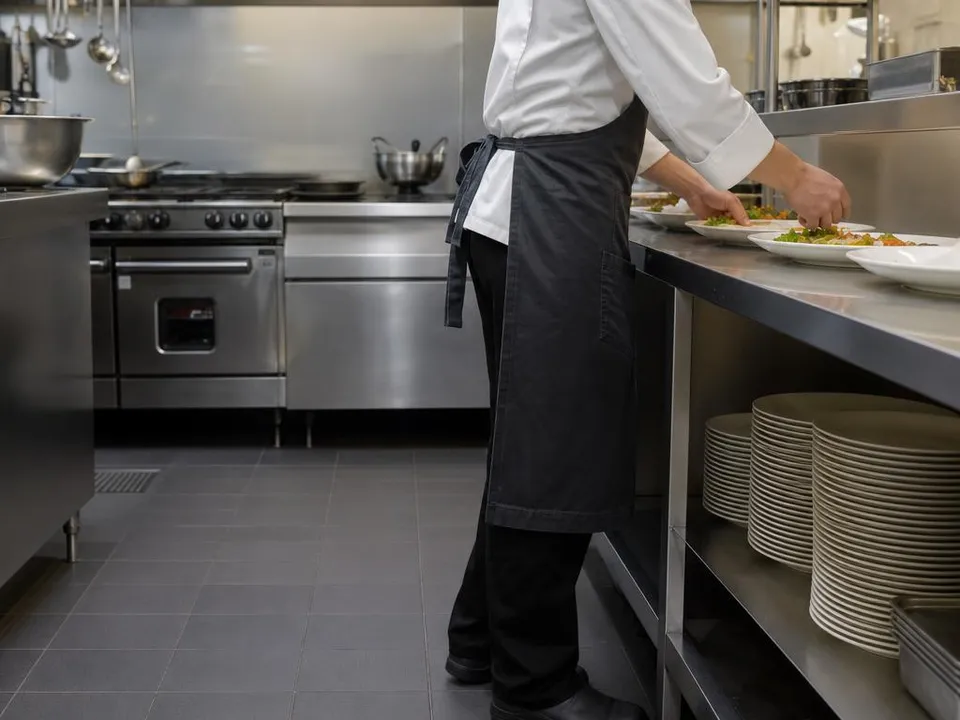
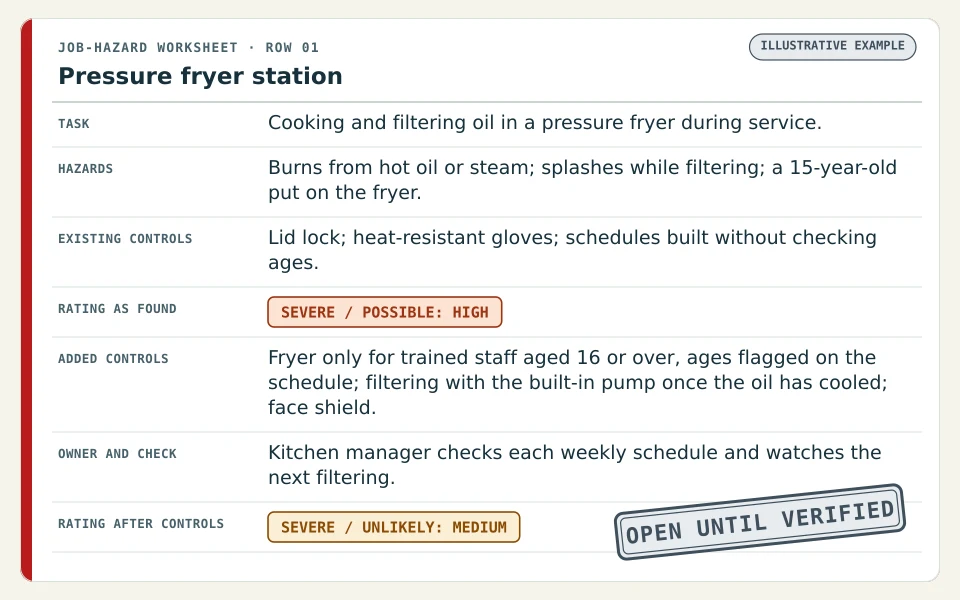
What does a restaurant safety assessment example look like for a pressure fryer?
A fictional chicken counter runs one pressure fryer. The worksheet entry below shows how the age rule becomes a control rather than a footnote.
| Worksheet field | Entry |
|---|---|
| Task | Cooking and filtering oil in a pressure fryer during lunch and dinner service. |
| Hazards | Burns from hot oil or steam if the lid is forced; splashes while filtering; a 15-year-old crew member put on the fryer during a rush. |
| Existing controls | Manufacturer's lid lock; heat-resistant gloves at the station; schedules built without checking ages. |
| Rating as found | Severe / Possible: High |
| Added controls | Fryer limited to trained staff aged 16 or over, with ages flagged on the schedule; filtering only with the built-in pump once the oil has cooled to the maker's stated temperature; face shield and long gloves for filtering. |
| Owner and check | Kitchen manager checks each weekly schedule and watches the next filtering; a trainer signs off each new fryer operator. |
| Rating after controls | Severe / Unlikely: Medium |
Keeping under-16s off the fryer is a legal limit, not just good practice, so the schedule check is written in as a control with a named owner.
When should a restaurant review its safety assessment?
Menus, equipment and crews turn over quickly in food service. Revisit the affected stations when:
- A new menu item brings a new cooking method, appliance or prep step.
- Equipment is added or replaced, such as a slicer, combi oven, fryer or dish machine.
- A new cleaning or sanitizing product arrives, so staff training and the safety data sheet file need updating.
- The restaurant starts hiring workers under 18 or moves them to new stations.
- Burns, cuts, slips or near misses repeat at one station.
- Summer heat, a hood problem or a remodel changes conditions on the line or the route to the exits.
Hotel kitchens, catering and other hospitality operations can find wider requirements in the hospitality safety guide.
Questions about the free restaurant Workplace Safety Assessment
Does this cover more than kitchen fire safety?
Yes. Review cuts, burns, slips, equipment, chemicals, lifting, repeated strain, public interaction and nonroutine tasks as relevant to your employees.
Can a cafeteria or hotel kitchen use it?
Yes. Adapt the job list to the actual equipment, staff and food-service operation.
Should cleaning products be included?
Yes. Identify the exact products and how workers use them. Record contact, exposure, storage and control questions using verified product information.
Does it replace a food hygiene inspection?
No. Its focus is employee safety. Keep food handling and public-health obligations in their applicable processes.
When does a kitchen task need a job hazard analysis (JHA)?
Use a job hazard analysis (JHA) for a single task with several risky steps, such as filtering fryer oil or cleaning a slicer. The Workplace Safety Assessment looks at all the restaurant’s jobs first, so you can see which tasks need that step-by-step review.
Tell us the jobs involved and the concerns you want reviewed. Our team will call you to arrange your free assessment.
Sources: OSHA restaurant worker safety; OSHA Hazard Communication; OSHA Small Business Safety and Health Handbook (self-inspection checklists); OSHA Job Hazard Analysis booklet; 29 CFR 570.34 occupations for 14- and 15-year-olds; 29 CFR 570.61 Hazardous Occupations Order 10; 29 CFR 570.63 Hazardous Occupations Order 12; Cal/OSHA 8 CCR 3396 indoor heat illness prevention.
Related tools for specific tasks
These go deeper on one task or hazard. They support the broader job review; they do not replace it.
- Workplace hazard identification guideFind hazards in work done in teams and alone.
- PPE hazard assessment formRecord the PPE review for a work area.
- Hazardous material risk assessmentGo deeper on chemical storage and use.
- Fire safety checklistWalk through exits, extinguishers and alarms.
- Toolbox talksShort briefings to share findings with the team.
Workplace Safety Assessment for other industries
Each guide lists common jobs, hazard prompts and a printable worksheet for that kind of workplace.
- Manufacturing Workplace Safety AssessmentProduction, setup, jam clearing, maintenance and shutdowns.
- Warehouse Workplace Safety AssessmentReceiving, forklifts, racking, picking, docks and battery charging.
- Retail and Grocery Workplace Safety AssessmentDeliveries, stocking, box cutting, checkout and spill response.
- Office Workplace Safety AssessmentScreen work, storage, equipment, reception and office moves.
- Healthcare Workplace Safety AssessmentPatient handling, sharps, disinfection, equipment and shift work.
- Auto Repair Workplace Safety AssessmentVehicle lifts, tires, batteries, solvents, exhaust and refinishing.
- Cleaning and Janitorial Workplace Safety AssessmentCleaning chemicals, wet floors, floor machines, waste and lone work.
- Hotel Workplace Safety AssessmentHousekeeping, laundry, kitchens, maintenance and guest contact.
Not sure what to look for first?Read the workplace hazard identification guide and checklist
Generate Your Restaurant Evacuation Map
Free registration • 5 floor-plan uploads/month • Up to 5 regenerations/upload • No credit card
Create Your Evacuation Map
See the safety plan from every angleWatch a sketch become a polished map, then step inside.Need to start from a rough layout?Sketch rooms and exits, then turn it into a clear safety map.

Drag & drop your floor plan here
or
PNG, JPG, HEIC, TIFF, BMP, SVG, AVIF, WebP, PDF, DOC, DOCX, PPT, PPTX, XLS, XLSX, ODT, ODP, ODS, DXF, DWG - Hand-drawn sketches work too!
No floor plan handy? Try the included floor plan with real AI generation — no upload needed. This may take a minute or longer.
Move, resize, and recolor every exit sign, route, and icon.
Create a free account to save and download in HD. No credit card required.FREE
Frequently Asked Questions
Is this evacuation map generator really free?
Yes — you can generate your first OSHA-aligned evacuation map draft completely free. Just upload a floor plan and our AI drafts a professional map in about 30 seconds. No credit card required.
Are the generated maps aligned with OSHA?
Our AI drafts maps that follow OSHA 29 CFR 1910.36–37 and NFPA 101 Life Safety Code standards. Every map includes clearly marked exits, fire extinguisher locations, assembly points, and directional evacuation arrows. Supervisor review is required before posting to your facility.
What file formats can I upload?
We accept PNG, JPG, GIF, WebP, BMP, TIFF, AVIF, HEIC, SVG, PDF, DOC/DOCX, PPT/PPTX, XLS/XLSX, ODT, ODP, ODS, DXF, and DWG floor plans. Office and CAD files are converted securely before processing; PDF uploads let you choose the source page.
How long does map generation take?
Most maps are generated in 20–40 seconds. Complex multi-floor plans may take slightly longer. You see the preview instantly — create a free account (no credit card) to download the file.
Can I edit the map after generation?
Yes — every generated map opens in a free drag-and-drop editor where you can move, resize, and recolor exit signs, routes, and equipment icons. Enterprise features like multi-floor support and branded maps are available on paid plans.
Is my floor plan data secure?
Yes. All uploads are encrypted in transit (TLS 1.3) and processed in secure cloud environments. We do not share your floor plans with third parties.
Top Restaurant-Specific OSHA Hazards
Areas that receive the most scrutiny during restaurant OSHA inspections
Grease Fires & Hood Systems
Kitchen hood suppression systems must be inspected semi-annually with current tags visible. Class K extinguishers are required within 30 feet of all cooking equipment using oils and fats.
Blocked Emergency Exits
The most dangerous violation: propping doors closed, storing boxes in exit paths, or chaining exits during business hours. This is often cited as a willful violation with fines up to $165,514.
Slip & Fall Hazards
Wet floors from dishwashing, spills, and mopping are the #1 cause of restaurant injuries. Non-slip mats, wet floor signs, and proper drainage are essential controls.
Chemical Mixing Hazards
Cleaning chemicals improperly stored near food, unlabeled spray bottles, and missing Safety Data Sheets are common HazCom violations in restaurants.
Electrical Near Water
GFCI protection is required near all sinks and wet areas. Frayed cords on kitchen equipment and overloaded circuits are frequently cited electrical violations.
Cut & Burn Injuries
Improper knife storage, lack of cut-resistant gloves, missing hot surface warnings, and absence of burn first aid procedures are common kitchen safety gaps.
OSHA Restaurant Inspection FAQ
Common questions about restaurant OSHA compliance
What does OSHA inspect in a restaurant?
OSHA inspectors evaluate restaurants for compliance across multiple areas: kitchen safety (slip/fall hazards, burns, cuts), fire suppression systems (hood systems, Class K extinguishers), emergency exits (unobstructed paths, illuminated signs, exit route width), electrical safety (GFCI outlets, proper wiring), chemical storage (HazCom compliance, SDS accessibility, proper labeling), and employee training documentation (Emergency Action Plans, fire extinguisher training, HazCom training). Restaurants are subject to both general industry standards under 29 CFR 1910 and any applicable state-specific regulations.
What are the most common OSHA violations in restaurants?
The most frequently cited OSHA violations in restaurants include: failure to maintain a written Emergency Action Plan (29 CFR 1910.38), inadequate Hazard Communication program for cleaning chemicals (29 CFR 1910.1200), blocked or locked emergency exits (29 CFR 1910.36-37), missing or expired fire extinguisher inspections (29 CFR 1910.157), lack of GFCI protection near water sources (29 CFR 1910.304), improper chemical storage near food items, and insufficient employee safety training documentation.
How often do OSHA inspections happen at restaurants?
OSHA does not have a fixed inspection schedule for restaurants. Inspections are typically triggered by: employee complaints or reports of unsafe conditions, serious workplace injuries or fatalities, referrals from other agencies (like health departments), targeted inspection programs for high-hazard industries, and follow-up inspections from previous violations. However, restaurants should always be inspection-ready as OSHA can arrive unannounced.
What OSHA fines can restaurants face?
As of 2025, OSHA penalties for restaurants include: Serious violations up to $16,550 per violation (common for blocked exits, missing fire extinguishers, no HazCom program), Willful violations up to $165,514 per violation (locked emergency exits, ignoring known hazards), Repeat violations up to $165,514 per violation, and Failure to Abate at $16,550 per day beyond the abatement date. Multiple violations can be cited simultaneously, making total fines substantial.
Do restaurants need a written Emergency Action Plan?
Yes. Under 29 CFR 1910.38, any employer with more than 10 employees must have a written Emergency Action Plan. Most restaurants exceed this threshold. The EAP must include evacuation procedures, exit route assignments, procedures for employees performing critical operations before evacuating (like shutting off gas), employee accountability methods after evacuation, and emergency contact information. The plan must be reviewed with each employee upon hiring and whenever it changes.
What fire safety equipment is required in restaurant kitchens?
Restaurant kitchens require: Class K fire extinguishers within 30 feet of all commercial cooking equipment (for grease/oil fires), ABC fire extinguishers in dining areas, storage rooms, and near electrical panels, a kitchen hood suppression system (Ansul/Amerex) with semi-annual inspections over all grease-producing cooking equipment, manual pull stations accessible near kitchen exits, and proper ventilation per NFPA 96. All equipment must have current inspection tags.
How do I prepare for an OSHA restaurant inspection?
To prepare for an OSHA restaurant inspection: 1) Complete a self-inspection using a comprehensive checklist covering all 6 key areas, 2) Ensure your written Emergency Action Plan is current and accessible, 3) Verify all fire extinguishers have current monthly inspection tags, 4) Confirm hood suppression system has semi-annual inspection tags, 5) Check all exits are unobstructed with working illuminated signs, 6) Organize Safety Data Sheets for all chemicals, 7) Gather employee training documentation, and 8) Post evacuation maps in visible locations.
What is the difference between OSHA and health department inspections?
OSHA inspections focus on employee workplace safety: slip/fall hazards, fire protection, chemical handling, electrical safety, exits, and training. Health department inspections focus on food safety and public health: food temperatures, cross-contamination, hygiene practices, pest control, and sanitation. However, there is overlap in areas like chemical storage (both agencies require proper separation from food), fire safety (health inspectors check for posted evacuation maps and suppression systems), and general cleanliness. Failing one inspection can trigger a referral to the other agency.
Get Your Restaurant OSHA-Ready Today
Use the free checklist and map generator to find and fix problems before an inspector arrives.
No credit card required. Register for 5 free floor-plan uploads/month with up to 5 regenerations/upload.
Related Tools You'll Find Useful
Free OSHA Safety Tools & Industry Solutions
Trusted by 7,500+ facilities — explore compliance tools for every industry
Important Legal Disclaimer
The Occupational Safety and Health Administration (OSHA) does not approve, endorse, recommend, or certify any commercial products or software. This platform is a compliance assistance tool only and is not affiliated with or endorsed by OSHA or any government agency.
All AI-generated evacuation maps, safety plans, and compliance documents must be reviewed, verified, and approved by a qualified safety professional, fire marshal, licensed engineer, or appropriate authority before being posted, distributed, or used for emergency planning purposes.
Employers retain full legal responsibility for workplace safety under the Occupational Safety and Health Act of 1970 (OSH Act). Users are solely responsible for ensuring compliance with all applicable local, state, and federal regulations. This software does not guarantee OSHA compliance.
This software does not constitute legal, safety consulting, engineering, or professional advice. Content is for informational purposes only. Users should consult qualified safety professionals and legal counsel for compliance guidance specific to their operations.
While we strive for accuracy, workplace safety regulations change frequently. We make no warranties regarding the accuracy, completeness, or current validity of any information. Users must independently verify all regulatory requirements applicable to their specific circumstances.
To the maximum extent permitted by law, OSHAMap, its owners, operators, affiliates, and licensors shall not be liable for any direct, indirect, incidental, special, consequential, or punitive damages arising from use of this service, including but not limited to workplace injuries, OSHA violations, regulatory fines, property damage, or any other losses.
Cost comparisons and savings estimates are based on industry averages for professional safety consultant fees and are provided for informational purposes only. Actual costs, savings, and results may vary significantly based on your specific situation.
By using OSHAMap, you acknowledge that you have read, understood, and agree to be bound by these terms. For complete terms, see our Terms of Service and Privacy Policy.
OSHAMap is not endorsed by OSHA. Review this checklist with a qualified safety professional and verify all requirements that apply to your workplace before use.