
Free Workplace Safety Assessment & OSHA Self-Inspection Checklist
Identify job hazards across your workplace with a free Workplace Safety Assessment from OSHAMap, also known as a workplace risk assessment. Send the short form and our team will call you to arrange it. We review routine work, maintenance, cleaning and other nonroutine tasks, then organize the controls and corrective actions that need attention.
Free assessment. No credit card required. Tell us your industry and the jobs you want reviewed; our team will call the number you give to arrange the assessment.
Request your free Workplace Safety Assessment
Six quick fields. Our team will call the number you give to arrange your free assessment.
- A call from our team to arrange your free assessment
- A review of your jobs, including cleaning and maintenance, and the controls that need attention
- Free printable job-hazard worksheets with your account
What happens after you send the form
- You send the form. No credit card is needed.
- Our team calls the phone number you give.
- Together we arrange your free Workplace Safety Assessment.
Meanwhile, you can print the job-hazard worksheet with your free account.
A workplace review built around the jobs people do
The assessment starts with work activities and the people exposed. It considers physical safety, health exposures, equipment, work organization and emergency conditions together. Use it to identify concerns, review existing controls and build a prioritized action list.
General industry includes many manufacturing and service workplaces. The standards that apply depend on the actual employer, work and jurisdiction. Construction, maritime and agriculture activities may fall under different provisions, including when they occur at a general-industry facility.
Choose your industry
Select manufacturing, warehousing, restaurants, retail, offices, healthcare, auto repair, cleaning or hotels below. Each guide includes common jobs, hazard prompts and an example. Other general-industry workplaces can request a review too: describe the actual work even if your industry is not listed. Add any role or task that is missing from the starter list.
- Manufacturing Workplace Safety AssessmentProduction, setup, jam clearing, maintenance and shutdowns.
- Warehouse Workplace Safety AssessmentReceiving, forklifts, racking, picking, docks and battery charging.
- Restaurant Workplace Safety AssessmentPrep, hot cooking, dishwashing, cold storage and closing shifts.
- Retail and Grocery Workplace Safety AssessmentDeliveries, stocking, box cutting, checkout and spill response.
- Office Workplace Safety AssessmentScreen work, storage, equipment, reception and office moves.
- Healthcare Workplace Safety AssessmentPatient handling, sharps, disinfection, equipment and shift work.
- Auto Repair Workplace Safety AssessmentVehicle lifts, tires, batteries, solvents, exhaust and refinishing.
- Cleaning and Janitorial Workplace Safety AssessmentCleaning chemicals, wet floors, floor machines, waste and lone work.
- Hotel Workplace Safety AssessmentHousekeeping, laundry, kitchens, maintenance and guest contact.
Not listed? Choose "Other general industry" in the request form and describe the work.
Job hazards included in the review
Equipment and energy
Machinery, pinch points, unexpected startup and stored energy.
Movement and access
Vehicles, loads, lifting, slips, trips, falls and ladders.
Chemical and health exposure
Chemicals, dust, fumes, noise, heat, cold and biological hazards.
Physical demands
Force, awkward posture, repetition, pushing, pulling and vibration.
Work organization
Shifts, workload, training, contractors, temporary workers and lone work.
Protection and emergencies
PPE, restricted spaces, fire, violence and emergency procedures.
OSHA’s Small Business Safety and Health Handbook provides self-inspection checklists as a starting point for identifying workplace hazards. Our full worksheet is an OSHA self-inspection checklist in that spirit for your own walk-through; it is OSHAMap’s worksheet, not an OSHA form. It includes fifteen hazard categories and an additional-hazards field. Mark each category as identified, not yet reviewed or not applicable, with a reason where appropriate. An unanswered question remains open rather than becoming a pass.
Free account needed.
- Identified
- Not yet reviewed
- Not applicable + reason
- Machinery and energy
- Vehicles and mobile equipment
- Slips, trips and falls
- Electricity
- Chemicals
- Physical demands
- Noise and vibration
- Heat, cold and physical agents
- Biological hazards
- Fire and emergencies
- Restricted spaces
- Violence and lone work
- Work organization
- PPE gaps
- Additional job-specific hazards
Plus a job register and an additional-hazards field. A category left blank stays open; it never counts as a pass.
How the free Workplace Safety Assessment works
- Send the form with your industry, state, phone number and the jobs you want reviewed.
- Our team calls the number you give to arrange your free assessment.
- List routine tasks and changes during setup, cleaning, maintenance or abnormal work.
- Identify who could be affected and describe existing controls.
- Review the concerns and the information that still needs verification.
- Build an action list with priorities, owners, target dates and follow-up checks.
Use relevant worker input, procedures, equipment instructions, product information and existing observations. The review can identify where specialist testing or a separate task assessment is needed. An immediate serious danger needs prompt action by the responsible people while an assessment request is pending.
What the assessment helps you document
Record the job or task, hazard, people exposed, existing controls and the basis for prioritizing action. Consider removing the hazard, substitution, engineering changes and work arrangements before relying only on PPE. Identify additional controls, the responsible person and how completion will be verified. Where information is missing, record the next assessment or measurement needed rather than guessing a safe condition.
Workplace example
A packing team reports repeated shoulder strain and near misses while moving stock. The assessment examines handling frequency, reach, loads, vehicle interaction and changes during busy periods. The team reviews storage, handling aids and the work sequence. Each correction has an owner and a verification step during actual work.
Free. Tell us the jobs and the concern you want reviewed, and our team will call you.
Start with the work that concerns your team
Request a free Workplace Safety Assessment for any general-industry workplace, or open the relevant industry worksheet. Include all relevant jobs, shifts and workers, and give a phone number where our team can reach you to arrange it. Review the record when processes, equipment, products or work arrangements change.
How do you do a workplace safety assessment, step by step?
OSHA's safety management guidance splits hazard identification into six action items. They suit any general-industry site, from a two-person print shop to a multi-building plant, and they give your own review a sensible order:
- Collect what you already know. Pull the injury and illness records, first-aid notes, near-miss reports, equipment manuals, safety data sheets and findings from any past inspections or insurer visits.
- Inspect the workplace for safety hazards. Walk every area during normal hours, including roofs, basements, yards and back storerooms.
- Identify health hazards. Note chemicals, dust, fumes, noise, heat, biological material and repetitive motion, and flag anything that needs measuring rather than judging by eye.
- Investigate incidents. Look at what went wrong in recent injuries and near misses, then search for the same conditions in other areas.
- Plan for emergencies and nonroutine work. Cover power failures, spills, fires, severe weather, maintenance shutdowns and jobs done only once a year.
- Characterize, control and prioritize. Rate each hazard, put interim protection on serious ones straight away, and give each permanent fix an owner.
Reading the injury records before the walkthrough pays off: they tell you which corners to slow down in.
What should a workplace self-inspection checklist include?
Whatever the industry, a walkthrough should confirm a handful of basics that federal rules spell out. Each line names the rule it comes from:
- Floors and walkways kept clean, orderly and, where feasible, dry; surfaces inspected regularly, with hazards corrected or guarded before anyone uses the area again (29 CFR 1910.22).
- Exit routes free of stock, furniture and other obstructions, even temporarily (29 CFR 1910.37(a)(3)).
- Flexible cords not used as a substitute for the fixed wiring of the building (29 CFR 1910.305(g)(1)(iv)(A)).
- Machine danger points such as points of operation, nip points and rotating parts guarded (29 CFR 1910.212(a)(1)).
- A written hazard communication program with a list of the hazardous chemicals on site (29 CFR 1910.1200(e)(1)).
- Eye or face protection where flying particles, liquids or chemical splashes are possible (29 CFR 1910.133(a)(1)), and quick-drench or eye-flushing facilities in the work area where corrosive materials can reach the eyes or body (29 CFR 1910.151(c)).
- A PPE hazard assessment for each work area, backed by a written certification that names the workplace, the person who did it and the date (29 CFR 1910.132(d)).
Treat the list as a minimum. The job-by-job review is where the hazards particular to your site come to light.
Workplace safety assessment, self-inspection checklist or JHA: which do you need?
Four names come up when you look for help with hazards at work. They overlap, but each one answers a different question:
| Name | What it looks at | Use it when |
|---|---|---|
| Workplace safety assessment | Every job at the site: the hazards, the people exposed, the controls in place and what still needs fixing | You want the whole operation reviewed and a list of fixes with owners and dates |
| Workplace risk assessment | The same review under another name, with each hazard rated by how severe and how likely the harm is | You need to rank hazards so the worst ones get fixed first |
| Self-inspection checklist | Fixed yes-or-no questions about conditions such as exits, floors, cords and guarding | You walk the site on a routine schedule and want no basic condition to slip past |
| Job hazard analysis (JHA) | One task split into its steps, with the hazard and the control for each step | A single task has several hazardous steps, such as a die change or clearing a jam |
They work best together: the assessment shows which tasks deserve a closer look, a JHA template takes those tasks apart step by step, and the checklist keeps the basics in view between reviews. OSHA's Small Business Safety and Health Handbook says small business employers should conduct routine workplace self-inspections, and it calls its own checklists a starting point for identifying workplace hazards rather than a way to assess compliance with OSHA standards.
Does OSHA require a written risk assessment?
Federal OSHA has no single general-industry rule titled "risk assessment". Instead, several standards each call for a specific assessment or written program, and the General Duty Clause reaches serious recognized hazards that no standard addresses. Examples:
| Requirement | Federal rule | What it asks for |
|---|---|---|
| General duty | OSH Act, Section 5(a)(1) | A workplace free from recognized hazards that are causing or are likely to cause death or serious physical harm. |
| PPE hazard assessment | 29 CFR 1910.132(d) | Assess the workplace for hazards that call for PPE, then verify the assessment in a written certification. |
| Hazard communication | 29 CFR 1910.1200(e)(1) | A written program covering labels, safety data sheets and training, plus a list of the hazardous chemicals present. |
| Emergency action plan | 29 CFR 1910.38(b)–(c) | Where a standard requires one: a written plan (oral for 10 or fewer employees) covering reporting, evacuation, critical operations, head counts, rescue duties and a contact for questions. |
| Hearing conservation | 29 CFR 1910.95(c)–(d) | Noise monitoring and a continuing program once exposures reach an 8-hour time-weighted average of 85 dBA. |
| Lockout/tagout | 29 CFR 1910.147(c)(6)(i) | An inspection of each energy control procedure at least once a year. |
Writing the job review down is still the simplest way to show those duties were thought through, and some states make a written program compulsory (see the state rules below).
How do you rate hazards in a workplace safety assessment?
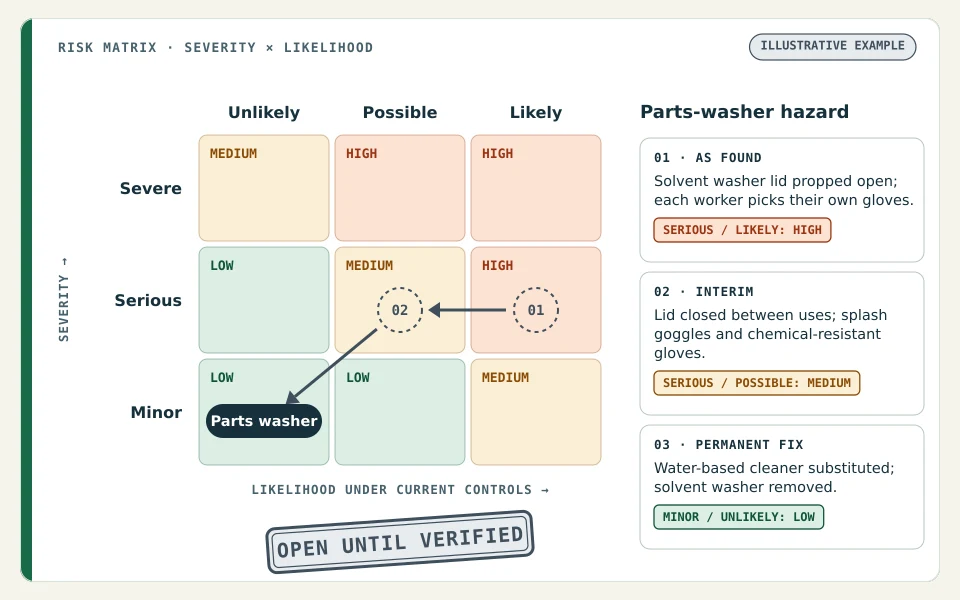
One simple method rates each hazard on two scales, how bad the harm could be and how likely it is under current conditions, then reads the priority off a grid. A three-by-three grid keeps it simple:
| Severity | Unlikely | Possible | Likely |
|---|---|---|---|
| Severe: death, amputation or permanent harm | Medium | High | High |
| Serious: medical treatment or lost work time | Low | Medium | High |
| Minor: first aid only | Low | Low | Medium |
Rate each hazard twice: as found, and again once the planned controls exist. The second rating should only count after someone has watched the control working during real work.
A grid sorts the to-do list; it does not prove a condition is acceptable. A Medium next to a severe outcome still deserves a date.
How does the hierarchy of controls work in a safety assessment example?
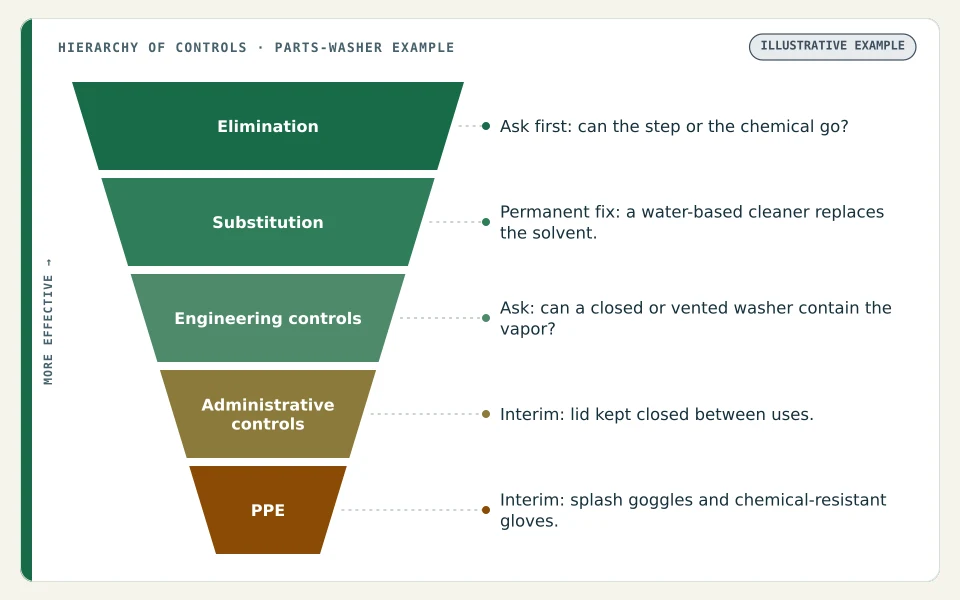
OSHA's hazard prevention guidance ranks controls from most to least effective: elimination, substitution, engineering controls, administrative controls and PPE. Here is how that plays out in one fictional worksheet entry for the parts-washing station of a small fabrication shop.
| Stage | Controls in place | Rating |
|---|---|---|
| As found | Solvent parts washer with the lid propped open; each worker picks their own gloves | Serious / Likely: High |
| Interim | Lid closed between uses; splash goggles and chemical-resistant gloves chosen from the safety data sheet | Serious / Possible: Medium |
| Permanent fix | Water-based cleaner substituted after a trial run and the solvent washer removed | Minor / Unlikely: Low |
The interim step leans on PPE and a work rule, which is why it is temporary. The permanent fix moves up the hierarchy to substitution, and the entry closes only after the new cleaner has been seen doing the job. For the wider picture in a shop like this one, see the metal fabrication safety guide.
Who should carry out a workplace safety assessment?
The employer owns the result, but the review works best as a small team effort. Who to involve:
- A lead who knows the operation and can approve spending, such as the owner, operations manager or safety coordinator.
- Workers from each job and shift, who know the shortcuts, workarounds and near misses that may not reach a report.
- Maintenance or facilities staff for energy sources, guarding, ventilation and building systems.
- Specialists when a question needs measuring or design work: noise or air sampling, structural or rack capacity, electrical systems.
- Outside help where it fits. OSHA's On-Site Consultation Program offers no-cost, confidential consultations, primarily for smaller businesses, delivered by consultants from state agencies or universities and kept separate from OSHA enforcement. Your workers' compensation insurer may also offer loss-control visits, so ask.

Which states require a written safety program?
Some states turn the assessment into a written program that covered employers must keep. Three examples:
- California: every employer needs a written Injury and Illness Prevention Program (8 CCR 3203), including inspections when the program is first set up, when new substances, processes or equipment bring a new hazard, and when the employer learns of a new or previously unrecognized hazard.
- Washington: employers need a written accident prevention program tailored to their workplace and its hazards (WAC 296-800-140), with a safety orientation for new workers.
- Minnesota: employers in the industries listed in Minnesota Rules 5208.1500 need a written A Workplace Accident and Injury Reduction (AWAIR) program (Minn. Stat. 182.653, subd. 8), reviewed and documented at least once a year.
Other states with their own job-safety agencies may add rules of their own, so check the agency for each state you operate in.
Questions about the free Workplace Safety Assessment
Which job hazards can I include?
Include relevant equipment, energy, vehicle, handling, chemical, health-exposure, access, work-organization and emergency concerns. Review routine jobs as well as cleaning, maintenance and other nonroutine work.
Does one checklist cover every possible hazard?
No fixed list can identify every site-specific condition. Start with the common categories, involve workers, add missing tasks and keep unresolved questions visible for follow-up.
Is OSHAMap’s free Workplace Safety Assessment an OSHA inspection?
No. OSHAMap is an independent service. The review and worksheets are not an OSHA inspection, government approval or compliance certification.
Can a small business request the assessment?
Yes. Describe the jobs performed, even when one person carries out several roles. The actual work determines the hazards that need attention.
What happens after I send the request?
Our team calls the phone number you give to arrange your free Workplace Safety Assessment. While you wait, your free account lets you print the job-hazard worksheet and start listing jobs, the people exposed and the controls you already have.
Is a Workplace Safety Assessment the same as a job hazard analysis (JHA)?
Not quite. A job hazard analysis (JHA) takes one task and breaks it into steps, naming the hazard and the control at each step. The Workplace Safety Assessment looks across the jobs at your site and shows which tasks deserve their own JHA.
Ask for your free Workplace Safety Assessment
Tell us your industry, your jobs and the concerns you want reviewed. Our team will call you to arrange your free assessment.
Sources: OSHA hazard identification and assessment; OSHA Small Business Safety and Health Handbook (self-inspection checklists); OSHA Job Hazard Analysis booklet; OSH Act Section 5 (general duty); OSHA hazard prevention and control; OSHA On-Site Consultation Program; 29 CFR 1910.22 walking-working surfaces; 29 CFR 1910.37 exit routes; 29 CFR 1910.38 emergency action plans; 29 CFR 1910.95 occupational noise; 29 CFR 1910.132 PPE general requirements; 29 CFR 1910.133 eye and face protection; 29 CFR 1910.147 hazardous energy; 29 CFR 1910.151 medical services and first aid; 29 CFR 1910.212 machine guarding; 29 CFR 1910.305 wiring methods; 29 CFR 1910.1200 hazard communication; Cal/OSHA 8 CCR 3203 injury and illness prevention program; WAC 296-800-140 accident prevention program; Minn. Stat. 182.653 (AWAIR); Minn. R. 5208.1500 AWAIR industries.
Related tools for specific tasks
These go deeper on one task or hazard. They support the broader job review; they do not replace it.
- Workplace hazard identification guideFind hazards in work done in teams and alone.
- Job hazard analysis templatesLook at one task step by step.
- PPE hazard assessment formRecord the PPE review for a work area.
- Hazardous material risk assessmentGo deeper on chemical storage and use.
- Pre-task plan templatePlan a nonroutine job before it starts.
- Construction JHA templateConstruction work follows different provisions.
Published by OSHAMap, a product of GetAgenticApps LLC · 131 Continental Dr, Suite 305, Newark, DE 19713, United States.
OSHAMap is an independent service and is not affiliated with OSHA or any government agency. The review and worksheets are not an OSHA inspection, government approval or compliance certification. Spotted something to correct? Contact us.
Free OSHA Safety Tools & Industry Solutions
Trusted by 7,500+ facilities — explore compliance tools for every industry