(775) 317-4488|Need help with your map? Call or chat with us!support@oshamap.comPartners & Joint Ventures

Free fire escape plan · machine shops

Free Fire Escape Plan for Machine Shops

A machine shop lines its CNC machines up in rows, with chip bins at the ends, coolant drums along a wall and pallets of bar stock by the door. A layout drawing or a photo of a sketch turns into a free draft marking the exits, the routes to them and a meeting point; the sections below on oil-mist fires, burning chips and crowded aisles are for checking it.

  • No sign-up to preview
  • Shop floor, office and QC lab
  • Phone photos of a layout work

This is a draft to check, not a fire inspection or an approval of your machines. Federal OSHA or your state plan and the local fire code set the rules, so walk every aisle before the map goes up.

Last reviewed: October 9, 2026 · Review with a qualified safety professional when required.
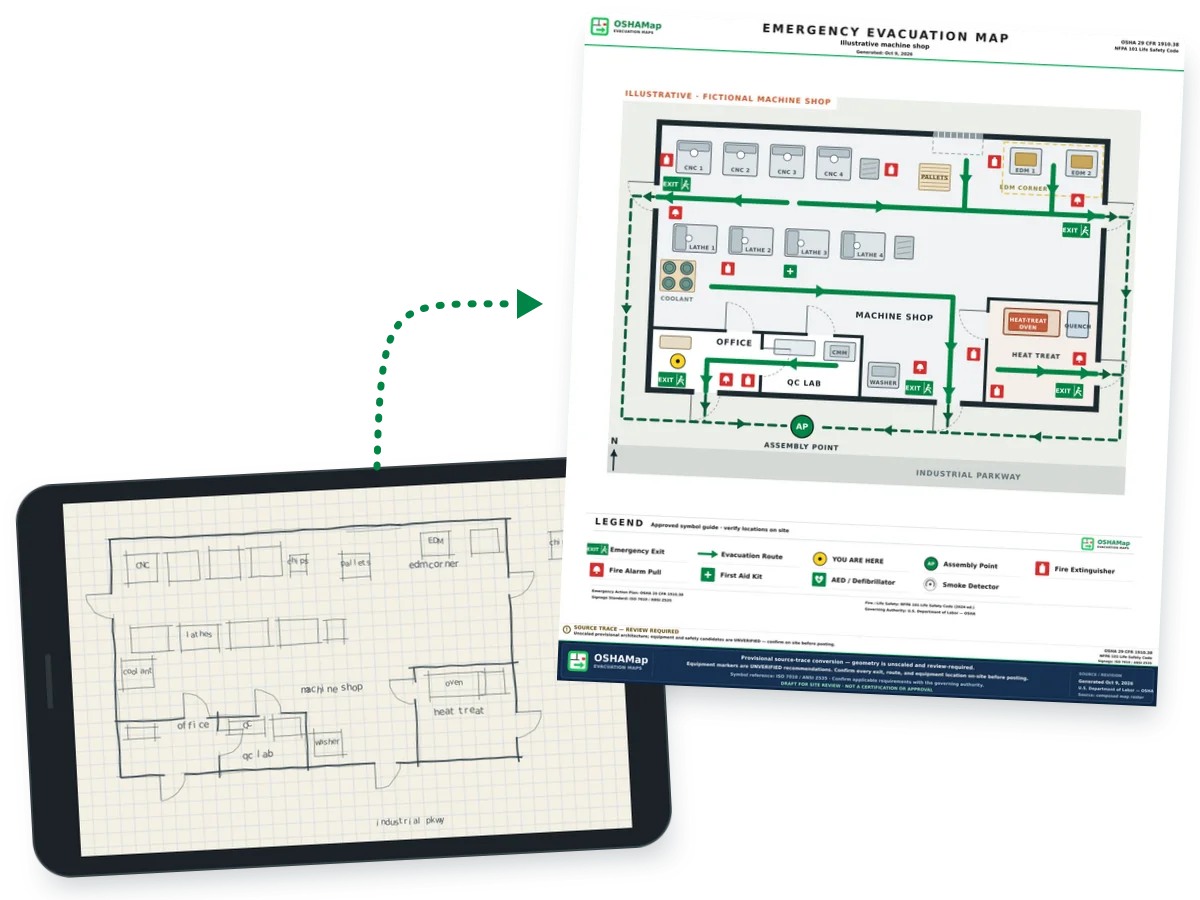
Illustration: a phone photo of a graph-paper sketch of a fictional machine shop with CNC machines, lathes, an EDM corner, chip bins, coolant drums and a heat-treat room, next to a fire escape plan draft with green routes to five doors and an assembly point out front
Illustration · fictional machine shop sketched on graph paper, not a customer plan

Oil machines and EDMs

Oil inside the machines: straight-oil cutting and EDM dielectric oil

Some of the oil in a machine shop never leaves the machines: straight cutting oil, the mist it leaves inside the enclosure and, on a sinker EDM that runs in oil, the tank the work sits in. Know which machines those are, mark them, and keep the right extinguisher within reach.

  • 1910.155(c)(9)

    Burning oil is a Class B fire

    OSHA’s definition of a Class B fire covers flammable or combustible liquids, flammable gases, greases and similar materials (29 CFR 1910.155(c)(9)). Cutting oil, way oil and EDM dielectric oil all fit that description, so the extinguisher you show beside these machines should be one rated for Class B fires.

  • 1910.157(d)(4)

    50 feet of travel, measured along the aisle

    Where employees are given extinguishers for Class B fires, the travel distance from the Class B hazard area to an extinguisher is 50 feet or less (29 CFR 1910.157(d)(4)). Measure the walk around the machines, the way someone would really go, not a straight line across them.

  • Sinker EDM

    Check the EDM manual first

    If your sinker EDM runs in dielectric oil, read what the maker’s manual says about the oil level over the work, the filters and any fire detection or automatic shutdown the machine has, and follow it. Keep the floor around the tank clear and show the machine on the posted map, so everyone knows where the oil is.

Where the oil sits, and what the map should show
Where it isOn the mapSource
Machines cutting with straight oilMark each one, with a Class B extinguisher no more than 50 feet of travel away.1910.157(d)(4)
The sinker EDM and its oil tankShow the machine and its tank, so nobody is surprised by where the oil is.The machine maker’s manual
Drums of cutting oil and coolantAgainst a wall outside the aisle; nothing is stored in an exit route, even for a day.1910.37(a)(3)
Cleanup solventIf it’s a flammable liquid, the storage cabinet it sits in holds no more than 60 gallons of Category 1, 2 or 3 liquids.1910.106(d)(3)(i)

Before you upload the layout

  • Note which machines cut with straight oil and which use water-based coolant.
  • Draw each EDM and its oil tank where they really sit.
  • Mark the oil and coolant drums and any mist collectors.
  • Put an extinguisher symbol by each group of oil machines on your sketch.

Machine rows and night shift

Open aisles between the machine rows, even with pallets waiting and a small crew on nights

Rows of machines make natural aisles, until a pallet of bar stock or a parts cart parks in one. The routes also have to work on the night shift, when a few operators may be the only people in the building.

Animation: a fictional machine shop. Routes are drawn along the aisle between a row of CNC machining centers and a row of lathes; a pallet parked in the aisle is crossed out; the EDM corner is ringed and an extinguisher appears beside it; the chip bins at the row ends are ringed and an extinguisher appears nearby; the heat-treat oven is ringed, an extinguisher appears across the room 15 to 50 feet away and the room gets its own route; the office and QC lab get a route to the front door; last come the exit signs, pull stations, extinguishers and the assembly point out front
Illustration · fictional machine shop. The aisles stay open and the oil, the chips and the oven each get an extinguisher; check your own shop.View static frame

What OSHA asks of the aisles

  • A pallet set down “just for now” still counts: no materials or equipment go in an exit route, permanently or temporarily, and the exit access can’t lead into a dead-end corridor (1910.37(a)(3)).
  • The exit access is never narrower than 28 inches anywhere along its length (1910.36(g)(2)).
  • When a forklift brings the stock in, the aisles it uses need safe clearance with nothing left in the way, and permanent aisles are marked (1910.176(a)).

What that means between machines

  • Give pallets of bar stock and finished parts a painted spot outside the aisle lines.
  • Park parts carts beside the machine they serve, never across a row end.
  • Roll chip bins back to their spot after each dump, not into the aisle.
  • Keep the place where each operator stands connected to an open aisle.
  1. Name a helper for every shiftThe employer designates and trains employees to help with a safe and orderly evacuation (29 CFR 1910.38(e)). If everyone you trained works days, the night crew has nobody, so pick someone on each shift.
  2. Test the alarm from the farthest machineAn alarm with a distinctive signal is required unless employees can promptly see or smell a fire in time to be warned (1910.37(e)). Two operators at opposite ends of a noisy shop may not, so test it at night with the machines running.
  3. Walk every new night hire through the mapThe plan is reviewed with each employee when it’s first written or when they’re first assigned to the job, when their duties under it change, and whenever the plan changes (29 CFR 1910.38(f)).

Keep the shift roster by the door

At night, the person who knows who is in the building may be the lead operator, not the office manager. Keep the shift roster where that person can grab it on the way out, so the head count at the meeting point is quick.

Assembly point · the generator

Upload your machine shop layout for a free draft

Use a floor plan, a PDF, a phone photo of a printed layout or a sketch on graph paper. Label the office, the QC lab, the shop floor and any EDM or heat-treat area, and draw every man door. The draft adds routes, exits, safety symbols and a meeting point; then you check the machine rows, the chip bins and the oven against the routes.

  • Label the machine rows and the EDM corner
  • Show the heat-treat room and its outside door
  • Mark which doors are man doors and which roll up
📊 5 Free Maps Left

Create Your Evacuation Map

See the safety plan from every angleWatch a sketch become a polished map, then step inside.Watch demo Need to start from a rough layout?Sketch rooms and exits, then turn it into a clear safety map.Draw your map
✏️
High ContrastUse dark ink on white paper. Bold lines help our AI detect walls accurately
📐
Top-Down AnglePhotograph from directly above — tilted angles distort the geometry
🏷️
Label RoomsWrite "Exit", "Storage", "Breakroom" etc. — our AI reads your labels for compliance
🔍
Full Floor PlanCapture the entire layout including all walls, doors, and exits — no cropping
🚪
Mark ExitsCircle or label exit doors with a red dot or "EXIT" text for best detection
💡
Good LightingAvoid shadows and glare — even lighting produces the sharpest results
📁

Drag & drop your floor plan here

or

PNG, JPG, HEIC, TIFF, BMP, SVG, AVIF, WebP, PDF, DOC, DOCX, PPT, PPTX, XLS, XLSX, ODT, ODP, ODS, DXF, DWG - Hand-drawn sketches work too!

or

No floor plan handy? Try the included floor plan with real AI generation — no upload needed. This may take a minute or longer.

Edit your map for free.
Move, resize, and recolor every exit sign, route, and icon.
Create a free account to save and download in HD. No credit card required.
FREE
🔒Your files are private: never shared, stored temporarily, deleted automatically.

Compliance Options

🔥 NEW✨

Customize Your Map

Add special requests for your safety map - tell our AI exactly what you need!

  • 🎯Add specific details like "Mark fire extinguisher near kitchen"
  • 📍Request specific zones: "Highlight assembly point in parking lot"
  • 🏥Add safety equipment: "Include AED location near reception"
0/2000

Quick Add:

Automatic (recommended)

Redraw the architecture from your floor plan first, then add editable safety markings. The original upload remains a reference, not the map background.

Frequently Asked Questions

Is this evacuation map generator really free?

Yes — you can generate your first OSHA-aligned evacuation map draft completely free. Just upload a floor plan and our AI drafts a professional map in about 30 seconds. No credit card required.

Are the generated maps aligned with OSHA?

Our AI drafts maps that follow OSHA 29 CFR 1910.36–37 and NFPA 101 Life Safety Code standards. Every map includes clearly marked exits, fire extinguisher locations, assembly points, and directional evacuation arrows. Supervisor review is required before posting to your facility.

What file formats can I upload?

We accept PNG, JPG, GIF, WebP, BMP, TIFF, AVIF, HEIC, SVG, PDF, DOC/DOCX, PPT/PPTX, XLS/XLSX, ODT, ODP, ODS, DXF, and DWG floor plans. Office and CAD files are converted securely before processing; PDF uploads let you choose the source page.

How long does map generation take?

Most maps are generated in 20–40 seconds. Complex multi-floor plans may take slightly longer. You see the preview instantly — create a free account (no credit card) to download the file.

Can I edit the map after generation?

Yes — every generated map opens in a free drag-and-drop editor where you can move, resize, and recolor exit signs, routes, and equipment icons. Enterprise features like multi-floor support and branded maps are available on paid plans.

Is my floor plan data secure?

Yes. All uploads are encrypted in transit (TLS 1.3) and processed in secure cloud environments. We do not share your floor plans with third parties.

What you get is a draft to check, not a finished plan. Stand at each machine row and at the oven, follow the route to a door, and fix anything a pallet or cart blocks before you post it.

Before and after

From a machine shop layout to a posted draft

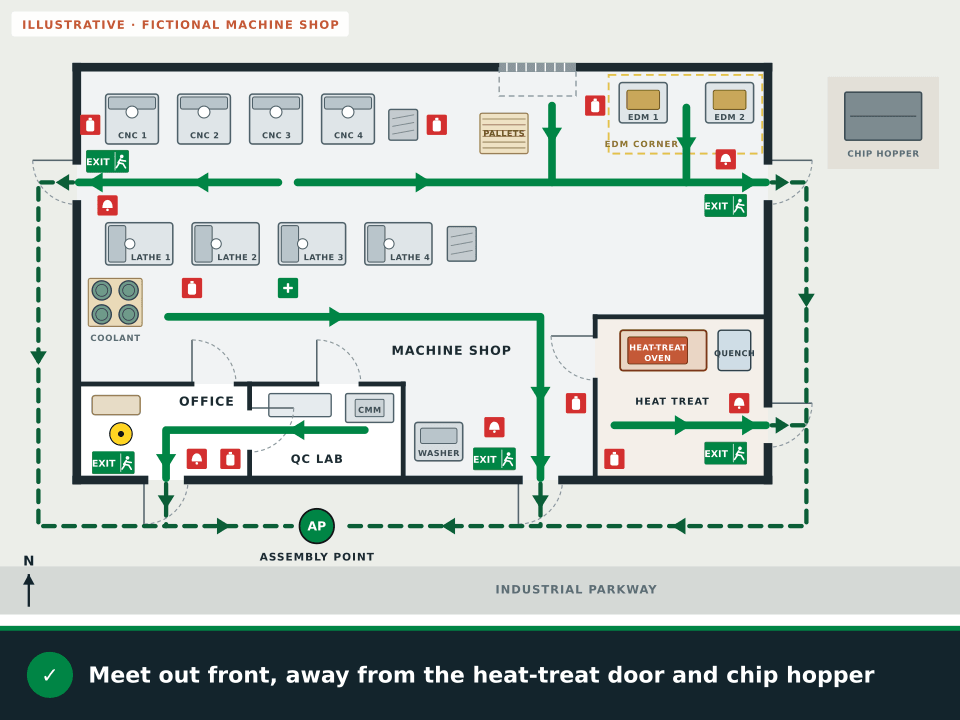
The plain plan shows the office, the QC lab and a shop floor with four machining centers, four lathes, two chip bins, coolant drums, a parts washer, an EDM corner and a walled heat-treat room with its own door. The draft adds routes to five doors, exit signs, extinguishers by the oil machines, the chips and the oven, and an assembly point out front.

Fictional plain floor plan of a machine shop with an office, a QC lab, a row of four CNC machining centers, a row of four lathes, two chip bins, coolant drums, pallets by a roll-up door, a parts washer, an EDM corner with two machines and a heat-treat room with an oven and a quench tank, but no routes or safety symbols
BeforeA plain floor plan of a fictional machine shop.
The same fictional machine shop as an illustrative fire escape plan draft with green routes along the aisle between the machine rows to the west and east doors, from the lathe row to the south shop door, from the EDM corner and the pallets to the main aisle, from the heat-treat room through its own door and from the office and QC lab to the front door, five exit signs, seven extinguishers, five alarm pull stations, first aid, a You are here marker in the office, an assembly point out front and a legend
After · illustrationDrawn for this page with OSHAMap’s map frame and symbols. The machine shop and its routes are fictional, not a customer plan or a generator result.

What the draft adds to a machine shop plan

  • Routes along the aisle between the machining centers and the lathes to the west and east doors
  • A route from the lathe row to the south shop door
  • A short route from the EDM corner to the main aisle
  • A separate route out of the heat-treat room through its own door
  • Extinguishers by the oil machines, the chip bin and the heat-treat oven
  • An assembly point out front, clear of the heat-treat door

Chips and chip bins

Magnesium and titanium chips: Class D metals with their own rules

When a job comes in magnesium or titanium, the chips it makes change what the bin, the daily cleanup and the nearest extinguisher have to be. Plan for that before the first part comes off the machine.

  • 1910.155(c)(11)

    Class D means burning metal

    OSHA defines a Class D fire as one involving combustible metals such as magnesium, titanium, zirconium, sodium, lithium and potassium (29 CFR 1910.155(c)(11)). A fire in a bin of these chips isn’t an oil fire, and an extinguisher meant for oil may not be the right one.

  • 1910.157(d)(6)

    Class D agent within 75 feet

    If you cut these metals often enough to make shavings, flakes or similar particles at least once every two weeks, OSHA wants Class D agent, in an extinguisher or another container, no more than 75 feet of travel from that work area (29 CFR 1910.157(d)(6)). Put its symbol on the map beside the machine that cuts them.

  • Chip bins

    Bins at the row end, sorted by metal

    Roll the chip bins to the end of the row, out of the aisle, and keep magnesium or titanium chips in their own marked bins, apart from steel and aluminum. On the posted map, show where the full bins wait for pickup.

What the 2021 International Fire Code says about magnesium scrap
RuleWhat it saysSource
Under the machines, every dayChips, turnings and other fine magnesium scrap are collected from the pans and spaces under the machines at least once each working day.IFC 2021 5906.5.8
Into a steel canThe scrap goes into a covered, vented steel container and is taken to an approved location.IFC 2021 5906.5.8
Kept apartMagnesium fines are stored separately from other combustible materials.IFC 2021 5906.4.1
A big pile of scrapMore than 50 cubic feet of fine magnesium scrap, which the code equates to six 55-gallon steel drums, is separated from other occupancies by 50 feet of open space or a fire barrier.IFC 2021 5906.4.2

If magnesium only comes in with the occasional customer job, update the posted map while that job runs, so the extra chip can and the Class D extinguisher are on it. Your city or state may use a different edition of the fire code, so check with the local fire marshal.

Heat treat and parts washers

Heat-treat ovens and parts washers: placement, the fuel shutoff and where the extinguisher goes

A heat-treat oven brings fuel, high heat and sometimes a quench tank into the shop, and a parts washer may hold a solvent that burns. Both belong on the map, away from the walking routes and from machines that throw oil mist.

Fire code rules for industrial ovens and furnaces (IFC 2021, chapter 30)
RuleWhat it saysSource
Away from mist and dustIndustrial ovens and furnaces are located so they don’t pose an ignition hazard to flammable vapors or mists or combustible dusts.IFC 2021 3003.3
Choosing the spotWhere the oven goes, the chance of fire from overheating or from escaping fuel gas or fuel oil, and of damage or injury from an explosion, are taken into account.IFC 2021 3003.2
The fuel shutoffAn approved manual fuel shutoff valve sits within 6 feet of the oven, unless an approved spot in the same general area is used, and it shows whether it’s open or closed.IFC 2021 3004.2 to 3004.3
Quench tanks and molten saltFor Class C and D ovens, fixed fire-extinguishing systems guard against hazards such as overheating, spilled molten salts or metals, quench tanks, burning hydraulic oil and escaping fuel; the user consults the fire code official on what’s needed.IFC 2021 3006.2
The portable extinguisherNo closer than 15 feet and no farther than 50 feet from the oven and its related equipment, or as NFPA 10 allows.IFC 2021 3006.3
Trained operatorsThe people who run, maintain and supervise the oven are thoroughly instructed and trained in its operation.IFC 2021 3007.3

The code sorts ovens into classes A to D. Ask the oven’s maker or your fire code official which class yours is before you plan around it.

On the map: the heat-treat area

  • Draw the oven, the quench tank and the fuel shutoff valve where they really are.
  • Put the extinguisher symbol in the 15-to-50-foot band, not right at the oven door.
  • Give the heat-treat room its own route to an outside door if it has one.
  • Keep the chip bins and the oil-mist machines on the far side of the shop from the oven.

On the map: the parts washer

  • Set the washer against a wall, outside the aisles.
  • Read Section 5 (fire-fighting measures) and Section 7 (handling and storage) of the solvent’s safety data sheet (OSHA QuickCard 3493).
  • If the solvent is a flammable liquid, store the spare drums where they don’t limit the use of exits, stairways or areas meant for safe egress (1910.106(d)(5)(i)).
  • Write the solvent’s name beside the washer on the map, so anyone checking the plan knows what’s in it.

Put the fuel shutoff on the posted map

An oven’s manual fuel shutoff only helps if people can find it fast. Mark the valve on the map, keep the floor in front of it clear, and show it to every operator during their oven training.

Questions

Machine shop fire escape plan FAQ

Is the machine shop fire escape plan really free?

Yes. You can preview a watermarked draft from a floor plan, a PDF, a phone photo or a graph-paper sketch without an account. Signing up free, with no credit card, adds 5 free floor-plan uploads per month, with up to 5 regenerations per upload and the editor; exports keep a draft mark until the posting review is finished.

What kind of extinguisher goes next to an EDM or an oil machine?

A fire in cutting oil or EDM dielectric oil is a Class B fire, which OSHA defines as one involving flammable or combustible liquids, flammable gases, greases and similar materials (29 CFR 1910.155(c)(9)). Where employees are given extinguishers for Class B fires, one has to be within 50 feet of travel (29 CFR 1910.157(d)(4)). Check the EDM maker’s manual and ask your extinguisher supplier for the exact type.

Do magnesium chips need special handling?

Under the 2021 International Fire Code, fine magnesium scrap is collected from under the machines at least once each working day, put in a covered, vented steel container and taken to an approved location (IFC 5906.5.8), and magnesium fines are kept apart from other combustible materials (IFC 5906.4.1). Your state or city may use a different edition, so check with the local fire marshal.

How far should the extinguisher be from a heat-treat oven?

The 2021 International Fire Code puts portable extinguishers for industrial ovens and their related equipment no closer than 15 feet and no farther than 50 feet, or as NFPA 10 allows (IFC 3006.3). Check which edition your jurisdiction has adopted.

Our night shift is only a few people. Does the plan change?

The routes don’t, but the people do. OSHA requires the employer to designate and train employees to help with an evacuation (29 CFR 1910.38(e)), so have someone on each shift, and review the plan with every new night hire when they start (29 CFR 1910.38(f)).

Can I upload a phone photo of our shop layout?

Yes. A phone photo of a printed layout or a sketch on graph paper works, as long as the walls and doors are readable. Take it straight on in good light, and label the machine rows, the EDM corner and the heat-treat room if you can.

Upload your machine shop layout and see a route from every machine row on a free draft.

Draft my machine shop plan