(775) 317-4488|Need help with your map? Call or chat with us!support@oshamap.com
🛡️

Safety Manager OSHA Evacuation Map Tools

Your Partner in Workplace Safety

Last reviewed: June 8, 2026 · Reviewed by OSHAMap Safety Editorial Team · Review with a qualified safety professional when required.

Streamline your OSHA compliance with professional evacuation maps.

Free preview • No credit card required

Safety Managers: turn a floor plan into a professional evacuation map draft

Upload a floor plan, sketch, PDF, or image and OSHAMap will generate an OSHA-aligned evacuation map draft in under 60 seconds. Review with a qualified safety professional before posting.

Book Free Map Review

Trusted by offices, warehouses, clinics, schools, hotels & manufacturing sites.

🏢Trusted by 7,500+ businesses nationwide🇺🇸Used in all 50 States🗺️Over 15,000 evacuation maps generated🔒Built on secure, encrypted infrastructureOSHA-aligned US standards

Evacuation Map Solutions for Safety Managers

Upload your floor plan and get a professional OSHA-aligned evacuation map in under 2 minutes

📊 5 Free Maps Left

Create Your Safety Manager Evacuation Map

✏️
High ContrastUse dark ink on white paper. Bold lines help our AI detect walls accurately
📐
Top-Down AnglePhotograph from directly above — tilted angles distort the geometry
🏷️
Label RoomsWrite "Exit", "Storage", "Breakroom" etc. — our AI reads your labels for compliance
🔍
Full Floor PlanCapture the entire layout including all walls, doors, and exits — no cropping
🚪
Mark ExitsCircle or label exit doors with a red dot or "EXIT" text for best detection
💡
Good LightingAvoid shadows and glare — even lighting produces the sharpest results
📁

Drag & drop your floor plan here

or

PNG, JPG, HEIC, TIFF, BMP, PDF - Hand-drawn sketches work too!

or

No floor plan handy? Generate an instant demo map — no upload needed.

Edit your map for free.
Move, resize, and recolor every exit sign, route, and icon.
Create a free account to save and download in HD. No credit card required.
FREE
🔒Your files are private: never shared, stored temporarily, deleted automatically.

Compliance Options

🔥 NEW

Customize Your Map

Add special requests for your safety map - tell our AI exactly what you need!

  • 🎯Add specific details like "Mark fire extinguisher near kitchen"
  • 📍Request specific zones: "Highlight assembly point in parking lot"
  • 🏥Add safety equipment: "Include AED location near reception"
0/2000

Quick Add:

Frequently Asked Questions

Is this evacuation map generator really free?

Yes — you can generate your first OSHA-aligned evacuation map draft completely free. Just upload a floor plan and our AI drafts a professional map in about 30 seconds. No credit card required.

Are the generated maps aligned with OSHA?

Our AI drafts maps that follow OSHA 29 CFR 1910.36–37 and NFPA 101 Life Safety Code standards. Every map includes clearly marked exits, fire extinguisher locations, assembly points, and directional evacuation arrows. Supervisor review is required before posting to your facility.

What file formats can I upload?

We accept JPG, PNG, and PDF floor plans. For best results, use a clear, high-resolution image of your floor plan with visible walls, doors, and rooms.

How long does map generation take?

Most maps are generated in 20–40 seconds. Complex multi-floor plans may take slightly longer. You can download your map immediately after generation.

Can I edit the map after generation?

The generated map is a high-resolution image you can download and print. For custom edits or enterprise features like multi-floor support and branded maps, check our pricing plans.

Is my floor plan data secure?

Yes. All uploads are encrypted in transit (TLS 1.3) and processed in secure cloud environments. We do not share your floor plans with third parties.

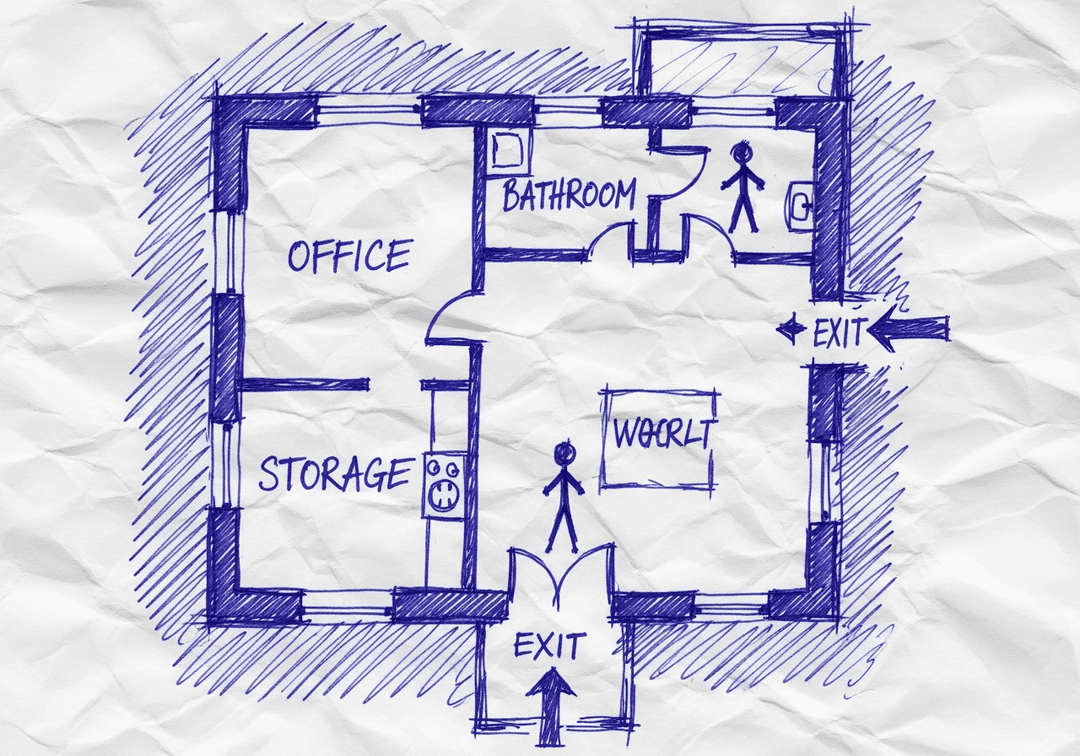
From Napkin Sketch to Professional Evacuation Map for Safety Managers

Designed for Safety Managers - Transform any floor plan into a compliant evacuation map in seconds

Works with photos, scans, PDFs, CAD files, or even hand-drawn napkin sketches

  • OSHA/NFPA-Aligned Draft
  • Instant Results (~30 sec)
  • Print-Ready (11x8.5" or 17x11")

Why Safety Managers Choose Our AI Map Generator

Do I need design skills to create an evacuation map?

No design skills are required. Our AI understands hand-drawn floor plans, smartphone photos, scanned blueprints, and PDF documents. Simply upload any representation of your facility layout and receive a professional-grade emergency evacuation map instantly.

Are the generated maps OSHA-aligned?

OSHAMap is designed to help users organize key evacuation-planning information commonly associated with OSHA 29 CFR 1910.38 — clearly marked exit routes, fire extinguisher locations within 75-foot travel distance, assembly points, YOU ARE HERE markers, and accessibility accommodations per ADA guidelines. Each draft must be reviewed and verified for the actual workplace by the employer, safety officer, or AHJ before posting.

Can I update my evacuation map after renovations?

Yes, unlimited revisions are included. If you renovate your office or add a new emergency exit, simply re-upload your updated floor plan and generate a new compliant map instantly. All free maps include unlimited regeneration so you always have current evacuation documentation.

What types of buildings can use this evacuation map generator?

Our generator works for any building type including warehouses, manufacturing plants, healthcare facilities, schools, retail stores, and office buildings. The AI adapts to any facility size and layout, generating appropriate exit routes, fire safety equipment placement, and assembly point locations.

Role-Specific Guidance

The Safety Manager's Strategic Guide to Evacuation Excellence

Tailored strategies and frameworks for Safety Managers managing workplace safety

Your Day with Safety in Mind

7:00 AM
Review overnight incident reports
Assess any impact on evacuation readiness
8:00 AM
Walk-through of high-risk areas
Verify evacuation routes are clear and equipment functional
10:00 AM
Contractor safety orientation
Cover evacuation procedures and assembly points
2:00 PM
Training session delivery
Emergency response refresher for department
4:00 PM
Metrics review and reporting
Track evacuation drill times and compliance rates

Stakeholder Management Matrix

Executive Leadership
Their Concern:Liability exposure and business continuity
Your Approach:Present ROI of safety investments and risk reduction metrics
Operations Management
Their Concern:Production impact of safety programs
Your Approach:Integrate safety into operational workflows to minimize disruption
Front-Line Workers
Their Concern:Personal safety and understanding of procedures
Your Approach:Clear, accessible training with hands-on practice
Regulatory Inspectors
Their Concern:Compliance with standards
Your Approach:Maintain audit-ready documentation and proactive self-inspections

Decision Framework

Budget constraints limit training frequency
Options:
  • Reduce training scope
  • Seek alternative funding
  • Implement peer-training model
💡Implement train-the-trainer programs to multiply training capacity without proportional cost increase
Production demands conflict with drill schedule
Options:
  • Postpone drill
  • Conduct partial drill
  • Negotiate timing
💡Conduct partial drills by shift to maintain readiness while minimizing production impact
New hazard identified mid-project
Options:
  • Immediate shutdown
  • Engineering controls
  • Administrative controls
💡Apply hierarchy of controls—engineering first, administrative as interim, PPE as last resort

Career Impact

Reduced incident rate by 25%
Estimated $500K in avoided costs and workers' comp savings
CSP certification and industry recognition
Achieved 100% drill participation
Demonstrated organizational safety culture to customers and insurers
Safety culture award and internal promotion
Zero OSHA citations during audit
Avoided $50K+ in potential fines and negative publicity
Executive recognition and budget increase

Common Mistakes to Avoid

Focusing on compliance over culture
Technical compliance without genuine safety engagement
Balance regulatory requirements with behavior-based safety programs
Neglecting near-miss reporting
Missing early warning signs before incidents occur
Create non-punitive reporting systems and celebrate near-miss identification
One-size-fits-all training
Training doesn't address role-specific hazards
Customize training by department and job function

Success Metrics for Safety Managers

Evacuation Time
Target: Under 3 minutes for full building
Timed drills quarterly with documentation
Training Completion
Target: 100% of employees current
LMS tracking with monthly reports
Near-Miss Reporting Rate
Target: 10+ reports per month
Reporting system analytics
Corrective Action Closure
Target: 90% within 30 days
Action tracking database

Professional Development Path

Incident Investigation
OSHA 6000 course or equivalent
Root cause analysis for effective corrective actions
Emergency Management
FEMA ICS-100/200 courses
Integration of facility plans with community response
Data Analytics
Safety metrics and dashboard training
Predictive safety analytics for proactive intervention
Field Guide

The Safety Manager's Evacuation Field Guide

If you own safety for a facility, the evacuation plan is not a poster you hang once and forget. It is a living system you have to defend twice: in front of an OSHA compliance officer who wants documentation, and in a real event where seconds and a clear assembly count decide whether everyone goes home. Most programs look fine on paper and fall apart the first time the map is walked against the actual building.

In practice, the failures repeat: maps drawn during construction and never re-walked after a wall moved or a department relocated; drills scheduled and pre-announced so the clock looks good but tells you nothing; assembly points chosen for convenience that sit downwind of the very hazard people are fleeing. None of these show up in a binder review. All of them show up at 2 a.m. during an alarm.

This guide is written for the person who is accountable, not the person filing the paperwork. It maps the six required elements of an OSHA Emergency Action Plan to the concrete actions a safety manager actually takes, gives you a 30/60/90-day plan to take a stale program to audit-ready, and sets benchmarks you can use to prove the program works — to leadership and to an inspector.

Written and reviewed by the OSHAMap safety team — last reviewed June 2026.

The 6 Required Elements of an OSHA Emergency Action Plan (29 CFR 1910.38)

Reporting emergencies29 CFR 1910.38(c)(1)

Procedures for reporting a fire or other emergency.

What you do: Document exactly how an alarm is raised on each shift (pull station, phone tree, supervisor) and confirm the path works when the front office is empty — nights, weekends, and skeleton crews are where reporting breaks down.

Evacuation procedures & route assignments29 CFR 1910.38(c)(2)

Procedures for emergency evacuation, including the type of evacuation and exit route assignments.

What you do: This is where the posted map earns its keep: assign primary and secondary routes per zone, mark them on a current diagram, and re-walk every route after any layout, occupancy, or process change.

Critical-operations shutdown29 CFR 1910.38(c)(3)

Procedures for employees who remain to operate critical plant operations before they evacuate.

What you do: Name the few roles allowed to delay egress to safe a process, cap how long they may stay, and brief them separately — an under-trained "stay-behind" is a fatality waiting to happen.

Headcount & accountability29 CFR 1910.38(c)(4)

Procedures to account for all employees after evacuation.

What you do: Define who sweeps each area, who owns the muster roster (including visitors and contractors), and how a missing person is escalated to incident command within the first minutes.

Rescue & medical duties29 CFR 1910.38(c)(5)

Procedures for employees performing rescue or medical duties.

What you do: Decide deliberately whether you have designated rescuers at all; if not, the plan must say employees evacuate and wait for responders, and training has to reinforce that line.

Contacts for plan details29 CFR 1910.38(c)(6)

The name or job title of every employee who may be contacted for more information about the plan.

What you do: Keep this list current — it is the first thing an inspector verifies and the first thing that goes stale after turnover.

30/60/90-Day Evacuation Readiness Plan

Days 1–30: Establish the baseline

Find out what is actually true today, not what the binder claims.

  • Locate the written EAP and confirm it exists in the workplace (required for 11+ employees under 1910.38(b)).
  • Walk every posted evacuation map against the real building and flag every route that no longer matches.
  • Run one unannounced drill and time both full evacuation and 100% headcount accountability — this is your honest starting number.
Days 31–60: Close the gaps

Fix what the baseline exposed.

  • Redraw maps to match the current layout, exits, extinguishers, and assembly points.
  • Assign and train floor wardens and sweepers by zone, with named backups for every shift.
  • Resolve the specific failures the drill surfaced — blocked exits, missing signage, downwind assembly points.
Days 61–90: Prove it works

Show measurable improvement and make it durable.

  • Run a second measured drill and document the improvement against your day-1 baseline.
  • Build an audit-ready binder: written EAP, dated maps, training records, drill logs, and corrective actions.
  • Set a recurring review cadence so the plan updates on every layout change and at least annually (1910.38(f)).

Benchmarks to Defend Your Program

Full-building evacuation time
Under ~3 minutes
A common practical target for typical occupancies; your real number depends on travel distance, occupant load, and mobility needs. Measure it, do not assume it.
Exit-access travel distance
≈ 200 ft (less for high-hazard)
NFPA 101 / IBC benchmark for business occupancies (often 250–300 ft when fully sprinklered); high-hazard occupancies are far shorter. Confirm the value for your occupancy class and AHJ.
Drill frequency
At least annually
Quarterly is typical for high-hazard operations, and healthcare, education, and residential occupancies often face more frequent code-driven requirements.
Map & EAP review cadence
On every change + annually
Per 1910.38(f), review whenever the plan, layout, or an employee’s responsibilities change — and re-walk routes, do not just re-read the document.
Headcount accountability
100% confirmed at assembly
Track time-to-full-accountability, including contractors and visitors; an unaccounted person is the metric that matters most in a real event.

Safety Manager FAQs

Does OSHA legally require a posted evacuation map?

OSHA 29 CFR 1910.38 requires a written Emergency Action Plan that includes evacuation procedures and exit route assignments — it does not name a "map" specifically. In practice, a posted floor diagram is the clearest way to satisfy route assignment and employee training, and many local fire codes and NFPA 101 do require posted diagrams. Treat the written plan as mandatory and the posted map as the standard, often-required way to deliver it.

What are the six required elements of an OSHA Emergency Action Plan?

Under 1910.38(c): (1) procedures for reporting an emergency; (2) evacuation procedures and exit route assignments; (3) procedures for employees who stay to operate critical operations; (4) procedures to account for all employees after evacuation; (5) procedures for rescue and medical duties; and (6) the names or job titles of people to contact about the plan.

How many employees trigger a written EAP?

An employer with more than 10 employees must keep the EAP in writing in the workplace and make it available to employees (1910.38(b)). An employer with 10 or fewer employees may communicate the plan orally — but written is still better practice for consistency and audit defense.

How often should a safety manager update the evacuation map?

Update it whenever the building layout, occupancy, exits, or process changes, and review the full EAP at least annually and whenever an employee’s emergency responsibilities change (1910.38(f)). The most reliable trigger is to re-walk routes after any renovation or department move rather than waiting for the annual review.

How do I prove our evacuation program actually works?

Measure it. Run drills and record two numbers — time to full evacuation and time to 100% headcount accountability — and track the trend. Layer in near-miss reporting volume, corrective-action closure rate, and a periodic map-accuracy audit. Documented, improving numbers are what satisfy both leadership and an inspector.

What is the difference between an Emergency Action Plan and a Fire Prevention Plan?

The Emergency Action Plan (1910.38) covers how people respond and get out during an emergency. The Fire Prevention Plan (1910.39) covers how you stop a fire from starting — listing major fire hazards, controlling fuel sources, and maintaining safeguards. Most facilities need both, and a safety manager owns the coordination between them.

Make Your Job Easier, Safety Manager

Stop wrestling with compliance. Generate professional evacuation maps in 2 minutes and focus on what matters.

Join thousands of Safety Managers streamlining safety compliance

Safety Hazards & Compliance Requirements

Safety Industry Focus

Primary Workplace Hazards

  • ⚠️Comprehensive hazard identification
  • ⚠️Multi-site compliance tracking
  • ⚠️Contractor safety oversight
  • ⚠️Regulatory change monitoring
  • ⚠️Incident investigation
  • ⚠️Training program gaps

Applicable OSHA Standards

29 CFR 1910.38
29 CFR 1910.132
29 CFR 1910.1200
29 CFR 1910.147

Emergency Scenarios to Plan For

  • 🚨Any emergency scenario
  • 🚨Audit preparation
  • 🚨Incident response
  • 🚨OSHA inspection

Special Considerations

  • 📋Cross-functional coordination
  • 📋Documentation requirements
  • 📋Audit-ready maps

Detailed Risk Assessment

CategoryRisk DescriptionMitigation StrategyOSHA Reference
Regulatory ComplianceKeeping up with changing OSHA standardsSubscription services, training, professional networksVarious
DocumentationIncomplete or outdated evacuation plansRegular reviews, version control, annual updates29 CFR 1910.38
Training GapsEmployees unaware of evacuation proceduresRegular drills, new hire orientation, refreshers29 CFR 1910.38
Contractor SafetyVisitors and contractors unfamiliar with layoutVisitor orientation, escort policies, contractor packets29 CFR 1910.38

Applicable Facility Types

IndustrialOfficeWarehouseConstruction SiteMulti Site
⚠️ OSHA COMPLIANCE ALERT

Safety Manager OSHA Compliance Alert

Over 52,548 OSHA violations issued nationally. Average penalty: $16,550 per serious violation.

🔍31,822Annual Inspections
⚠️52,548Violations
💰$189.4MTotal Penalties
💀5,486Fatalities
🚨

OSHA Penalty Structure - Know Your Risk

Other-than-SeriousUp to $16,131Per violation
Serious ViolationUp to $16,131Per violation
Willful / RepeatUp to $161,323Per violation
Failure to Abate$16,131/dayAfter citation deadline

Avoid costly penalties with compliant evacuation maps

⚠️

Top OSHA Violations in nationwide

Is your facility compliant?

🗺️

Missing Evacuation Maps = OSHA Violation

29 CFR 1910.38 requires emergency action plans with posted evacuation routes. Generate compliant maps in minutes.

Don't Wait for an OSHA Inspection

Get Your your area Evacuation Map Today

Professional, OSHA-aligned maps generated in minutes. Avoid penalties up to $161,323 per violation.

View Pricing
✓ OSHA-Aligned✓ Print Ready✓ AI-Powered✓ Used by 47,000+ Businesses

Safety Manager Safety Compliance Challenges

As a Safety Manager, you face unique challenges. OSHAMap helps you overcome them.

😓Keeping up with regulations
😓Budget constraints
😓Employee buy-in

Safety Manager Emergency Planning Responsibilities

OSHA compliance

We make this easier with professional, compliant evacuation maps

Training programs

We make this easier with professional, compliant evacuation maps

Incident investigation

We make this easier with professional, compliant evacuation maps

OSHA Compliance Tools for Safety Managers

⏱️

Save Time

Generate maps in under 2 minutes instead of waiting weeks for consultants

💰

Save Money

Skip the $500-$2,000 consultant fees per map

Stay Compliant

Drafts designed around OSHA 29 CFR 1910.38 — human review required before posting

📋

Audit Ready

Impress inspectors with professional documentation

Works Across All Industries

"As a Safety Manager, I used to spend hours coordinating with safety consultants. Now I can generate professional evacuation maps instantly. It's a game-changer for compliance."

— A fellow Safety Manager

Trusted by Businesses Nationwide

Safety Managers across all 50 states use OSHAMap

Free Account Benefits

Create an Account to Unlock

📋

Map History Vault

Never lose a map again

🔄

Unlimited Regeneration

Perfect your evacuation plans

📊

Compliance Dashboard

Stay audit-ready 24/7

🤖

AI Recommendations

Proactive compliance insights

👥

Team Collaboration

Unified safety management

🔔

OSHA Alerts

Never miss an update

📥

Bulk Downloads

Save hours of work

🏆

Priority Support

Expert guidance included

No credit card required

STEP 1 OF 2

Get Free OSHA Compliance Resources

Enter your email to receive free checklists, guides, and compliance tips

256-bit encrypted
No spam, ever
Unsubscribe anytime

By continuing, you agree to our Privacy Policy

🔓 Free Account Bonus

Unlock 1 Free File Upload + 5 Regenerations

Create your free account in seconds and get instant access to professional, OSHA-aligned evacuation maps.

What You Get When You Register:

  • 1 Free File Upload + 5 Regenerations - Professional maps ready for printing
  • No Watermarks - Clean, presentation-ready evacuation maps
  • Personal Dashboard - Manage all your maps in one place
  • Save & Revisit Anytime - Access your maps from any device
  • OSHA-Aligned - Meets 29 CFR 1910.38 requirements
15,000+Maps Generated
100%Compliant
Sample Output
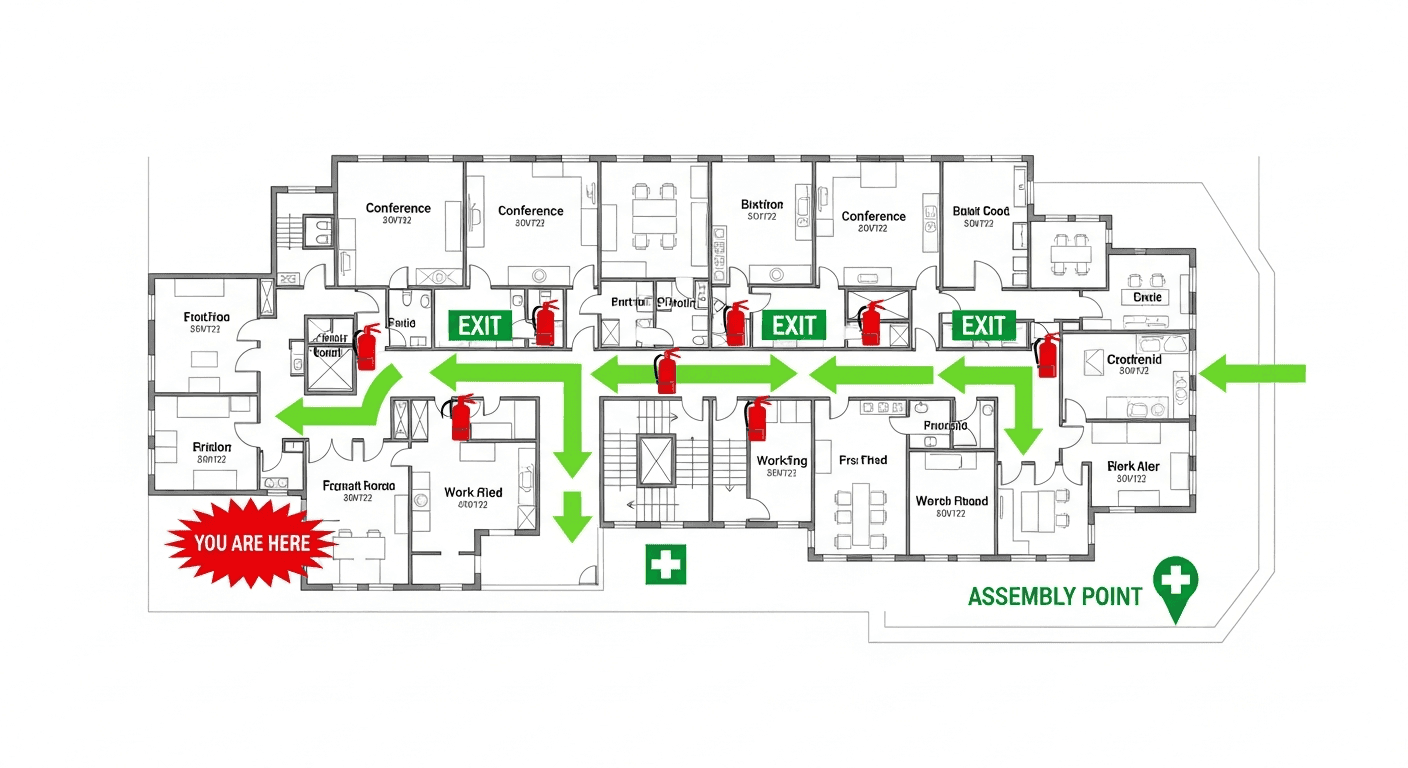
Sample Safety Manager OSHA-aligned evacuation floor plan showing emergency exits, fire extinguisher locations, and assembly points
🧯 Fire Extinguishers🚪 Exit Routes📍 You Are Here

No credit card required • Takes 30 seconds • Instant access

Ready to Simplify Your OSHA Compliance?

Join hundreds of Safety Managers who trust OSHAMap for their evacuation maps.