Fire Exit Plan — Free AI Generator
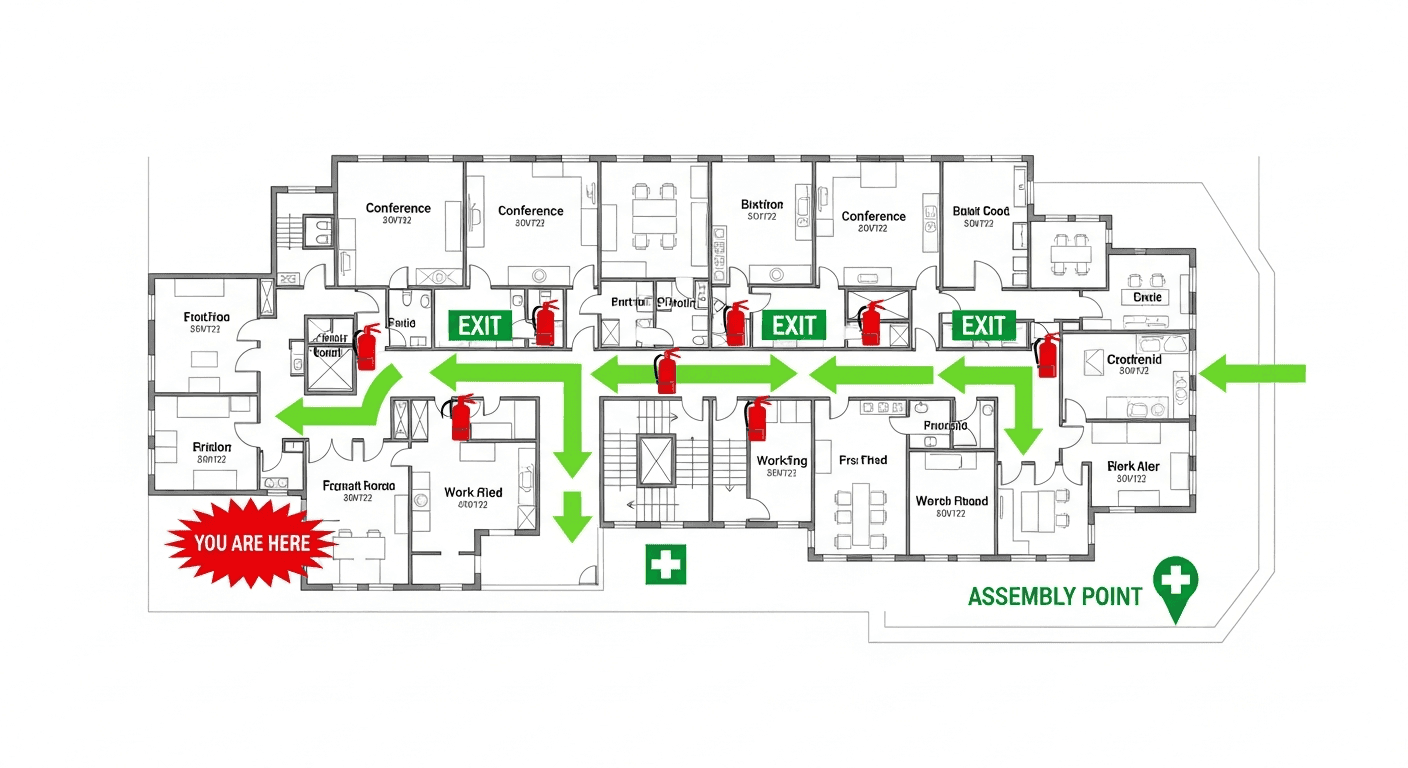
Create professional fire exit plans in seconds. Upload any floor plan or hand sketch and get OSHA-compliant fire exit routes, extinguisher locations, pull stations, and assembly points — print-ready and fire marshal approved.
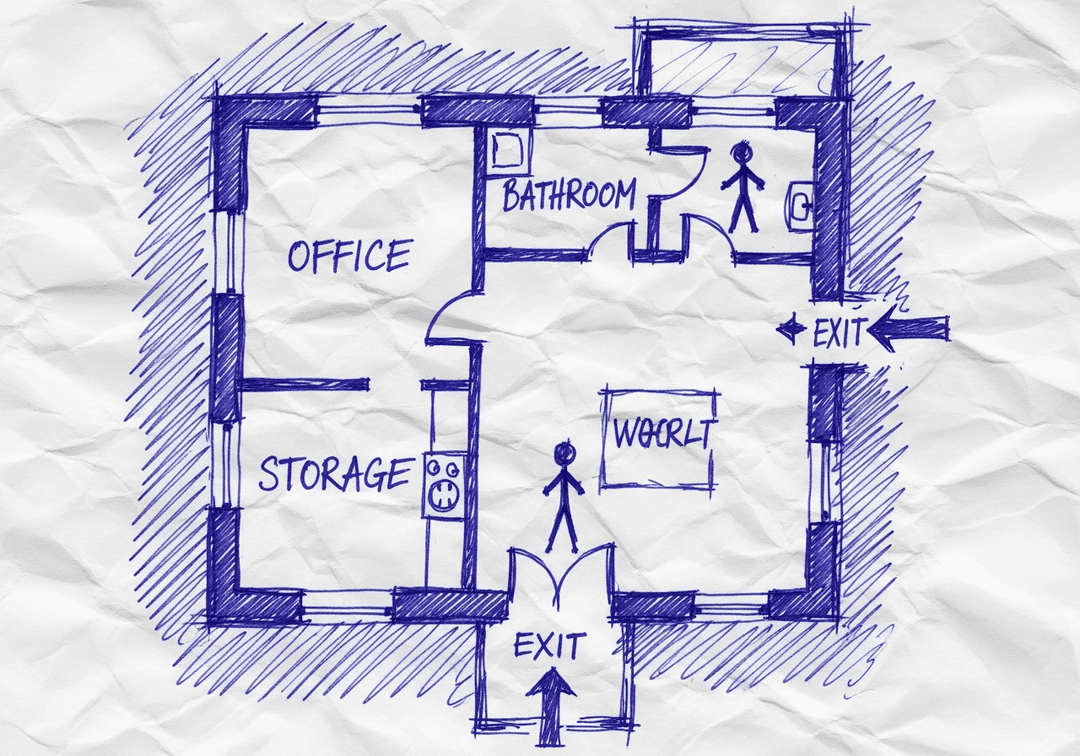
No design skills needed. Hand-drawn sketches accepted.
What is a Fire Exit Plan?
A fire exit plan is a visual floor plan diagram that shows all fire exits, evacuation routes, fire safety equipment, and assembly points within a building. It is a critical component of your Emergency Action Plan required by OSHA 29 CFR 1910.38 and serves as the primary tool occupants use to navigate to safety during a fire emergency.
Fire Exit Locations
Every fire exit clearly marked with standard symbols and directional arrows pointing toward the nearest exit
Fire Safety Equipment
Extinguishers (with class type), pull stations, fire hose cabinets, and sprinkler control valves
Evacuation Routes
Primary and secondary paths from every room to fire exits, with color-coded route differentiation
Assembly Points
Designated outdoor gathering locations at least 50 feet from the building for post-evacuation headcount
Professional Maps for Every Industry
Our AI creates OSHA-compliant maps tailored to your specific industry requirements
Restaurant Evacuation Map
Kitchen hood suppression, grease fire routes, and customer/employee exits clearly marked
Free preview • OSHA compliant • Print-ready in 30 seconds
Free Fire Exit Plan Generator
Upload your floor plan or sketch. Get an OSHA-compliant fire exit plan in seconds.
Fire Exit Plan Legal Requirements
Federal standards that govern fire exit documentation in commercial buildings
29 CFR 1910.36
Design & Construction of Exit Routes
- Exit routes must be permanent parts of the workplace
- Minimum ceiling height of 7 feet 6 inches for exit routes
- Exit access must be at least 28 inches wide at all points
- Exit discharge must lead directly outside to a public way
- Doors swing in direction of exit travel (rooms with 50+ occupants)
- Fire-resistant construction for exit enclosures (1-hour minimum)
29 CFR 1910.37
Maintenance & Operational Features
- Exit routes kept free of obstructions at all times
- EXIT signs illuminated and clearly visible from 100 feet
- Emergency lighting during power failure (90-minute minimum)
- Fire exit doors unlocked from inside during work hours
- No explosive or highly flammable materials near exit routes
- Fire retardant coatings maintained on exit enclosures
NFPA 101
Life Safety Code — Fire Exit Standards
- Minimum two means of egress from every occupied floor
- Maximum travel distance: 200 ft (unsprinklered) / 250 ft (sprinklered)
- Dead-end corridors limited to 20 ft (50 ft with sprinklers)
- Exit signage visible from any direction of egress travel
- 1 foot-candle minimum illumination along egress paths
- Corridor width based on occupant load (44 inches minimum)
Non-Compliance Penalties (2026)
OSHA violations for missing or inadequate fire exit documentation can result in penalties up to $16,991 per violation for serious violations and up to $170,181 per violation for willful or repeated violations. Fire marshals may issue additional citations and can order building closure until compliance is achieved.
Fire Exit Plans by Building Type
Every commercial building needs a fire exit plan — requirements vary by industry
Restaurants & Kitchens
Commercial kitchen exits, Class K extinguisher locations, hood suppression systems, and customer evacuation routes.
Manufacturing
Equipment shutdown procedures, hazardous material zones, LOTO stations, and multiple egress routes from production areas.
Warehouses
Dock exits, rack aisle egress, forklift zones, and clear path requirements through storage areas.
Hotels & Hospitality
Guest room door-back plans, floor-specific stairwell assignments, and multi-language evacuation notices.
Retail Stores
Customer-facing exit wayfinding, stockroom exit routes, and shopping center coordination plans.
Schools & Education
Classroom-specific routes, student assembly accountability, and fire drill documentation requirements.
Office Buildings
Multi-tenant coordination, floor warden stations, stairwell pressurization, and after-hours procedures.
Healthcare Facilities
Patient movement protocols, Code Red procedures, smoke compartment evacuation, and defend-in-place strategies.
Construction Sites
Temporary egress routes, hot work zones, perimeter exits, and equipment staging area fire exit plans.
Create Your Fire Exit Plan in 4 Steps
From sketch to print-ready fire exit plan in under 60 seconds
Upload Floor Plan
Hand sketch, CAD file, PDF, or photo. Our AI accepts any format and analyzes your building layout automatically.
AI Detects Fire Exits
All exterior doors, stairwells, and means of egress are identified. Fire safety equipment is mapped.
Routes Generated
Primary and secondary evacuation routes calculated with OSHA-compliant directional arrows and safety symbols.
Download & Post
Print-ready fire exit plan for immediate posting at required locations throughout your facility.
Fire Exit Plan FAQs
Common questions about fire exit requirements and compliance
What is a fire exit plan?
A fire exit plan is a documented strategy showing how building occupants should evacuate during a fire emergency. It includes floor plan diagrams with marked fire exits, primary and secondary evacuation routes, fire extinguisher and pull station locations, assembly points, and 'You Are Here' markers. Fire exit plans are required by OSHA under 29 CFR 1910.38 and by NFPA 101 Life Safety Code for all commercial buildings.
What must a fire exit plan include?
A compliant fire exit plan must include: (1) All fire exit locations clearly marked with standard symbols, (2) Primary and secondary evacuation routes with directional arrows pointing toward exits, (3) Fire extinguisher locations with type classifications, (4) Fire alarm pull station locations, (5) 'You Are Here' orientation markers, (6) ADA-accessible evacuation routes and areas of refuge, (7) Outdoor assembly point designations, (8) Emergency contact information, and (9) Building name, floor number, and date of last update.
How many fire exits does my building need?
The International Building Code (IBC) Chapter 10 requires: 1 exit for spaces with 1-49 occupants, 2 exits for 50-500 occupants, 3 exits for 501-1,000 occupants, and 4 exits for over 1,000 occupants. Fire exits must be remotely located (minimum 1/3 of the building's diagonal distance apart) and lead directly to a public way. Additional exits may be required based on travel distance limits and occupancy hazard classification.
What is the difference between a fire exit plan and a fire escape plan?
The terms are largely interchangeable and refer to the same concept: a plan showing how to safely exit a building during a fire. 'Fire exit plan' typically refers to commercial building documentation required by OSHA and fire codes, while 'fire escape plan' is more commonly used in residential contexts. Both should include exit routes, meeting points, and safety equipment locations.
How often should fire exit plans be updated?
Fire exit plans should be updated immediately after any building modifications that affect exit routes, fire safety equipment locations, or occupancy changes. At minimum, NFPA recommends annual review and update. After renovations, tenant moves, equipment relocations, or fire code inspection findings, plans must be updated and re-posted. All employees should be retrained on any changes.
What are the OSHA requirements for fire exit signs?
Under OSHA 29 CFR 1910.37 and NFPA 101: EXIT signs must be posted at every required exit doorway and wherever the direction of exit travel is not immediately apparent. Signs must have letters at least 6 inches high with 3/4-inch stroke width, be visible from at least 100 feet, remain illuminated at all times, and have battery backup providing 90 minutes of emergency illumination. Directional arrows are required when the exit direction is not obvious.
What are the penalties for not having a fire exit plan?
OSHA can issue penalties up to $16,991 per serious violation and $170,181 per willful or repeated violation (2026 rates) for missing or inadequate emergency action plans that include fire exit procedures. Fire marshals can issue separate citations ranging from $500 to $5,000 per day. Buildings may also be ordered to cease operations until compliance is achieved.
Can I create a fire exit plan from a hand-drawn sketch?
Yes. Our AI-powered fire exit plan generator can transform hand-drawn sketches, photos of floor plans, PDFs, or CAD exports into professional, OSHA-compliant fire exit plans. Simply upload your sketch showing walls, doors, and major features, select your building type, and receive a print-ready fire exit plan with all required safety elements in under 60 seconds.
Get Your Fire Exit Plan Today
Don't risk an OSHA citation or fire marshal violation. Create your professional, print-ready fire exit plan now — free and compliant with all federal standards.
Free to start — No credit card required — Print-ready in 30 seconds
Important Legal Disclaimer
The Occupational Safety and Health Administration (OSHA) does not approve, endorse, recommend, or certify any commercial products or software. This platform is a compliance assistance tool only and is not affiliated with or endorsed by OSHA or any government agency.
All AI-generated evacuation maps, safety plans, and compliance documents must be reviewed, verified, and approved by a qualified safety professional, fire marshal, licensed engineer, or appropriate authority before being posted, distributed, or used for emergency planning purposes.
Employers retain full legal responsibility for workplace safety under the Occupational Safety and Health Act of 1970 (OSH Act). Users are solely responsible for ensuring compliance with all applicable local, state, and federal regulations. This software does not guarantee OSHA compliance.
This software does not constitute legal, safety consulting, engineering, or professional advice. Content is for informational purposes only. Users should consult qualified safety professionals and legal counsel for compliance guidance specific to their operations.
While we strive for accuracy, workplace safety regulations change frequently. We make no warranties regarding the accuracy, completeness, or current validity of any information. Users must independently verify all regulatory requirements applicable to their specific circumstances.
To the maximum extent permitted by law, OSHAMap, its owners, operators, affiliates, and licensors shall not be liable for any direct, indirect, incidental, special, consequential, or punitive damages arising from use of this service, including but not limited to workplace injuries, OSHA violations, regulatory fines, property damage, or any other losses.
Cost comparisons and savings estimates are based on industry averages for professional safety consultant fees and are provided for informational purposes only. Actual costs, savings, and results may vary significantly based on your specific situation.
By using OSHAMap, you acknowledge that you have read, understood, and agree to be bound by these terms. For complete terms, see our Terms of Service and Privacy Policy.