(775) 317-4488|Need help with your map? Call or chat with us!support@oshamap.comPartners & Joint Ventures

Free fire escape plan · lawn care companies

Free Fire Escape Plan for Lawn Care Companies

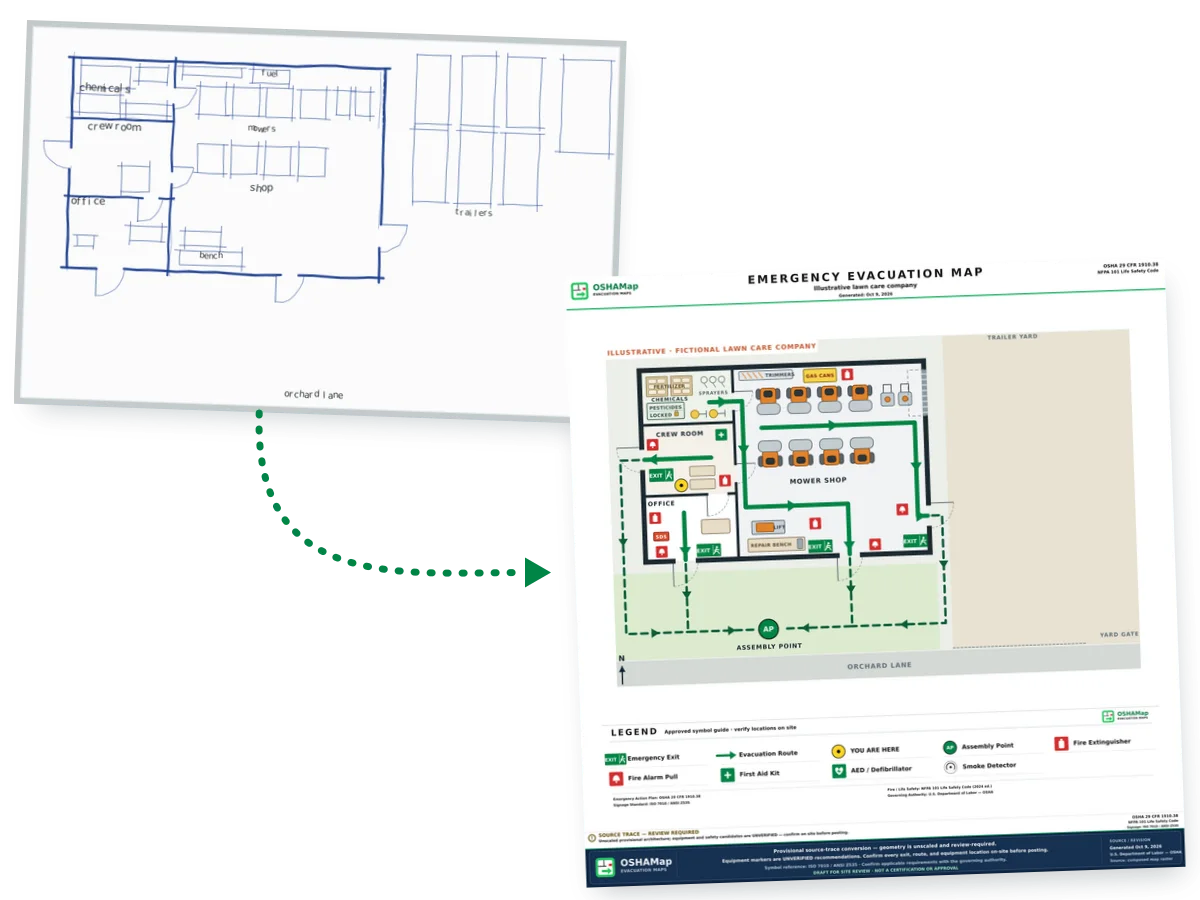
A lawn care company runs out of a shop full of zero-turn and walk-behind mowers, a bench where small engines get fixed, a locked room of fertilizer and pesticides, a crew room and an office, with trucks and trailers lining up outside every morning. Even a phone picture of the shop drawn on a whiteboard works: the free draft adds exits, routes and a meeting point, and the fuel, chemical-room and morning-lineup notes below help you check it.

  • No sign-up to preview
  • Shop, crew room, chemical room and office
  • Whiteboard photos work

This is a draft to check, not a fire inspection or an approval of how you store fuel, pesticides or fertilizer. Federal OSHA or your state plan, the product labels and the local fire code set the rules, so walk the routes with the mowers parked before the map goes up.

Last reviewed: October 9, 2026 · Review with a qualified safety professional when required.
Illustration: a whiteboard drawing of a fictional lawn care company with a chemical room, a crew room, an office, a mower shop and a trailer yard, and the draft fire escape plan made from it: green routes out four doors to an assembly point on the front lawn
Illustration · fictional lawn care company drawn on a whiteboard, not a customer plan

Fuel and the repair bench

Mower fuel and the small-engine repair bench: where the gas cans live and where mowers get filled

A mower shop handles gasoline all day: cans go out on the trailers in the morning and come back half full at night, and the repair bench drains tanks and pulls carburetors between jobs. Put the fuel cabinet, the fill-up spot and the bench on the map, then check that none of them sits between a crew and a door.

  1. Fill mowers outside, engines offPick one fill-up spot out in the yard, away from the shop doors, the trailer lane and the walk to the meeting point, and mark it on the map. Shut the engine off and let it cool before the cap comes off; that’s plain shop practice rather than a quoted rule, and the drawing above puts the spot at the far side of the yard.
  2. Cans back in the cabinet at nightA flammable storage cabinet holds no more than 60 gallons of Category 1, 2 or 3 flammable liquids, or 120 gallons of Category 4 (29 CFR 1910.106(d)(3)(i)). Section 2 of each product’s safety data sheet gives its category, so count the cans that come back off the trailers against the limit for what’s in them.
  3. Drain the tank before the benchSmall-engine repair means fuel lines come off and carburetors come apart. Drain the tank into a closed container before a mower goes up on the lift, wipe up spills right away, and point the grinder’s sparks away from both the fuel cabinet and the rag can.
  4. Name the bench in the fire prevention planWhere a fire prevention plan is required, it names the major fire hazards and how they’re stored and handled, the ignition sources, how flammable waste is kept from piling up and who looks after each (29 CFR 1910.39(c)). The bench, the fuel cabinet and the rag can all belong on that list.
Animation: a fictional lawn care company with an office, a crew room, a chemical room, a mower shop and a trailer yard. First the office gets a route out the front door and the crew room one out its west door; next, routes run from the chemical room through the shop to the south door and between the mower rows to the east man door; the fuel cabinet is ringed and a fill-up spot appears out in the yard; the chemical room is ringed with the words keep apart; walk-behind mowers lined up in the aisle are crossed out as blocking the east route; painted lane lines appear around the parked trucks and trailers; a training box lists walking each route, hearing the alarm, finding the meeting spot and training in words the crew understands; finally an assembly point appears on the front lawn
Illustration · fictional lawn care company. Fuel in the cabinet, chemicals locked apart, a clear aisle and spring crews walked through; check your own shop.View static frame
Fuel, oil and sparks in a mower shop
In the shopOn the mapSource
The yellow fuel cabinetDraw it against a wall away from every door, and count what goes back into it each night against its limit.1910.106(d)(3)(i)
The fill-up spotMark it outside, clear of the doors, the trailer lane and the meeting point.Plain planning advice
The repair bench and grinderWhere employees are meant to use extinguishers, hang one rated for Class B fires no more than 50 feet of travel from the bench.1910.157(d)(4)
Oily rags and drained fuelGive them a closed container by the bench and a person who empties it on a schedule.1910.39(c)
Product data sheetsKeep them where the crew can reach them; Section 7 covers safe storage, including what each product must be kept away from.OSHA QuickCard 3493

Walk out from the lift with a mower on it

The tightest spot in a mower shop is beside the lift and the bench, with a mower up in the air and a deck on the floor. Walk from there to both shop doors and move whatever narrows the way.

Fertilizer and pesticides

Fertilizer and pesticides in their own locked room, apart from the fuel, with a list firefighters can use

Bags of fertilizer, jugs of herbicide and the sprayers that apply them sit in the same building as the mowers and the gas. Give the chemicals a room or a cabinet of their own on the map, keep it away from the fuel cabinet, and make sure the fire department can find out quickly what’s inside.

  • Product labels

    The label sets the storage rule

    For pesticides in small containers, 55-gallon drums or smaller, EPA regulates storage through the specific instructions on each label; some states add their own rules (EPA lists Maine, New Hampshire, North Carolina and Washington), and local fire, building and zoning codes can add more (EPA, requirements for pesticide storage).

  • EPA storage advice

    Locked up, in the original jug

    EPA’s advice is to keep pesticides in a locked cabinet in a well-ventilated utility area if you can, always in the original labeled container and never poured into a soft drink bottle, never near food or animal feed, and to store flammable liquids far from ignition sources, a lawn mower among them (EPA, storing pesticides safely).

  • 1910.36(d)(1)

    Locked against entry, not against exit

    Exit route doors open from the inside without keys, tools or special knowledge (29 CFR 1910.36(d)(1)), and no exit route may pass through a room that can be locked (1910.37(a)(3)). Lock the chemical room to keep people out, never to keep someone in, and run the shop routes around it.

What firefighters will want to know about the chemical room
What to have readyWhySource
The chemical room and the fuel cabinet marked on the posted mapFirefighters arriving at the shop can see where both are before anyone opens a door.Plain planning advice
Safety data sheets by the front doorSection 5 of each sheet covers how a fire involving that product is fought.OSHA QuickCard 3493
A one-time submittal of data sheets or a listIf you must keep data sheets and hold a hazardous chemical at or above EPA’s thresholds, they go to the state and local emergency planning committees and the local fire department.EPCRA section 311
An inventory every March 1The same facilities file a yearly Tier I or Tier II inventory with those three groups.EPCRA section 312
The thresholds10,000 pounds for most hazardous chemicals; for extremely hazardous substances, 500 pounds or the threshold planning quantity, whichever is lower.EPA

Keep fertilizer and fuel on separate sides of a wall

Nothing in this guide sets a distance between fertilizer and gasoline, so read Section 7 of each data sheet for what it must be kept away from, and ask the fire marshal what your local code requires. In the drawing, the chemicals have their own walls and door, and the fuel cabinet stands out in the shop.

Whether a fertilizer or pesticide counts toward EPA’s reporting thresholds depends on exemptions EPA spells out, so check EPA’s page before assuming either way.

Assembly point · the generator

Upload your lawn care shop layout for a free draft

Use a floor plan, a PDF, a phone photo or a picture of a whiteboard drawing. Label the office, the crew room, the chemical room and the mower shop, draw every man door, and sketch where the trailers line up. Once the draft shows routes, exits, safety symbols and a meeting point, compare its routes with the mower rows, the fuel cabinet and the chemical room.

  • Label the chemical room and the fuel cabinet
  • Show where mowers and trailers park
  • Draw every man door as well as the roll-up
📊 5 Free Maps Left

Create Your Evacuation Map

See the safety plan from every angleWatch a sketch become a polished map, then step inside.Watch demo Need to start from a rough layout?Sketch rooms and exits, then turn it into a clear safety map.Draw your map
✏️
High ContrastUse dark ink on white paper. Bold lines help our AI detect walls accurately
📐
Top-Down AnglePhotograph from directly above — tilted angles distort the geometry
🏷️
Label RoomsWrite "Exit", "Storage", "Breakroom" etc. — our AI reads your labels for compliance
🔍
Full Floor PlanCapture the entire layout including all walls, doors, and exits — no cropping
🚪
Mark ExitsCircle or label exit doors with a red dot or "EXIT" text for best detection
💡
Good LightingAvoid shadows and glare — even lighting produces the sharpest results
📁

Drag & drop your floor plan here

or

PNG, JPG, HEIC, TIFF, BMP, SVG, AVIF, WebP, PDF, DOC, DOCX, PPT, PPTX, XLS, XLSX, ODT, ODP, ODS, DXF, DWG - Hand-drawn sketches work too!

or

No floor plan handy? Try the included floor plan with real AI generation — no upload needed. This may take a minute or longer.

Edit your map for free.
Move, resize, and recolor every exit sign, route, and icon.
Create a free account to save and download in HD. No credit card required.
FREE
🔒Your files are private: never shared, stored temporarily, deleted automatically.

Compliance Options

🔥 NEW✨

Customize Your Map

Add special requests for your safety map - tell our AI exactly what you need!

  • 🎯Add specific details like "Mark fire extinguisher near kitchen"
  • 📍Request specific zones: "Highlight assembly point in parking lot"
  • 🏥Add safety equipment: "Include AED location near reception"
0/2000

Quick Add:

Automatic (recommended)

Redraw the architecture from your floor plan first, then add editable safety markings. The original upload remains a reference, not the map background.

Frequently Asked Questions

Is this evacuation map generator really free?

Yes — you can generate your first OSHA-aligned evacuation map draft completely free. Just upload a floor plan and our AI drafts a professional map in about 30 seconds. No credit card required.

Are the generated maps aligned with OSHA?

Our AI drafts maps that follow OSHA 29 CFR 1910.36–37 and NFPA 101 Life Safety Code standards. Every map includes clearly marked exits, fire extinguisher locations, assembly points, and directional evacuation arrows. Supervisor review is required before posting to your facility.

What file formats can I upload?

We accept PNG, JPG, GIF, WebP, BMP, TIFF, AVIF, HEIC, SVG, PDF, DOC/DOCX, PPT/PPTX, XLS/XLSX, ODT, ODP, ODS, DXF, and DWG floor plans. Office and CAD files are converted securely before processing; PDF uploads let you choose the source page.

How long does map generation take?

Most maps are generated in 20–40 seconds. Complex multi-floor plans may take slightly longer. You see the preview instantly — create a free account (no credit card) to download the file.

Can I edit the map after generation?

Yes — every generated map opens in a free drag-and-drop editor where you can move, resize, and recolor exit signs, routes, and equipment icons. Enterprise features like multi-floor support and branded maps are available on paid plans.

Is my floor plan data secure?

Yes. All uploads are encrypted in transit (TLS 1.3) and processed in secure cloud environments. We do not share your floor plans with third parties.

Treat the result as a draft to check rather than a finished plan: with the mowers parked, walk out from the crew room, the chemical room and the shop, clear whatever is in the way, then post it.

Before and after

A lawn care company’s layout, then the draft with routes and symbols

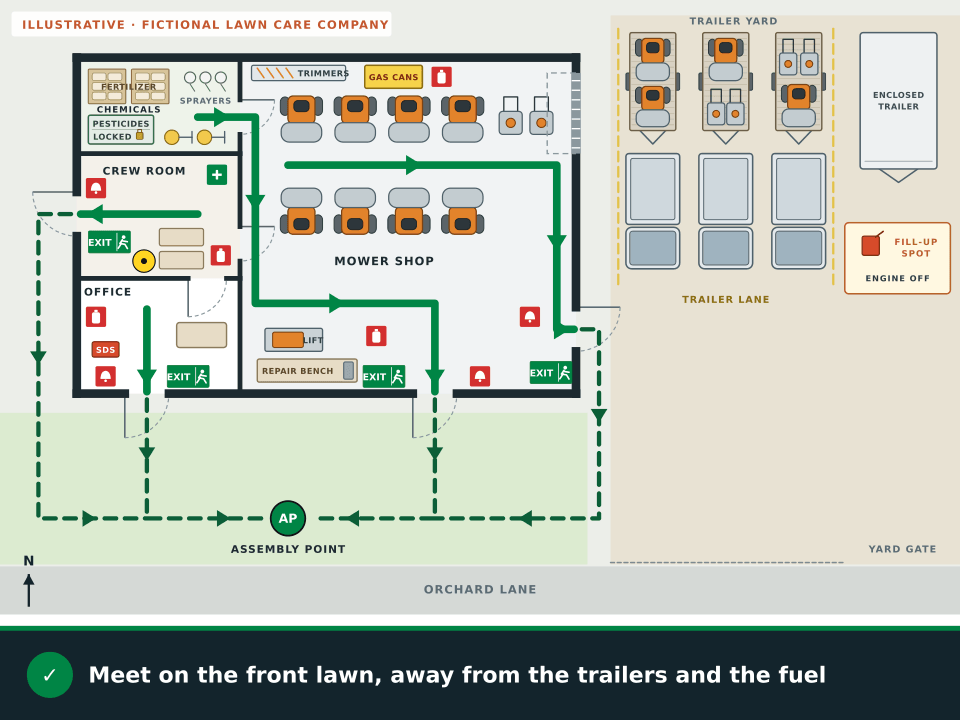
The plain plan shows a chemical room with fertilizer pallets, a locked pesticide cabinet, backpack sprayers and spreaders, a crew room with tables, an office with a desk and the data sheet binder, and a mower shop with a trimmer rack, a fuel cabinet, two rows of zero-turn mowers, walk-behind mowers, a lift and a repair bench. Over that, the draft lays routes to the front door, the crew room’s west door, the shop’s south door and its east man door, sets out exit signs, first aid, alarm pulls and extinguishers, and puts the assembly point on the front lawn.

Fictional plain floor plan of a lawn care company with a chemical room holding fertilizer pallets, a locked pesticide cabinet, backpack sprayers and spreaders, a crew room with tables, an office with a desk and a data sheet binder, and a mower shop with a trimmer rack, a fuel cabinet, eight zero-turn mowers, two walk-behind mowers, a lift and a repair bench, next to a trailer yard and Orchard Lane, but no routes or safety symbols
BeforeA plain floor plan of a fictional lawn care company.
That fictional lawn care company again, now as an illustrative fire escape plan draft: green routes run out the office’s front door and the crew room’s west door, from the chemical room across the shop to the south door, and between the mower rows to the east man door, then outside to an assembly point on the front lawn; four each of exit signs, extinguishers and alarm pull stations, plus a You are here marker in the crew room, first aid and a legend
After · illustrationMade for this page from OSHAMap’s map frame and approved symbols. The shop, the chemical room and the mowers are invented for the illustration, not a customer’s plan or a generator output.

Added on top of the lawn care shop layout

  • A route from the office desk to the front door on the lawn side
  • A route from the crew room out its own west door
  • A route from the chemical room through the shop to the south door
  • A second shop route between the mower rows to the east man door
  • Extinguishers in the office and the crew room, by the fuel cabinet and by the repair bench
  • An assembly point on the front lawn, away from the trailer yard

The morning lineup

The morning rush: mowers rolling out, trailers loading and every crew in the building at once

For an hour each morning the shop is at its most crowded: mowers come off the rows, trimmers come off the rack, trailers back up to the building and every crew is inside at the same time. Plan for that hour, because an alarm then finds the most people inside and the most in their way.

In the shop aisle

  • Mowers lined up in the aisle while a trailer gets hitched are equipment in an exit route, which isn’t allowed even for a few minutes (1910.37(a)(3)).
  • Stage the next load on the parking rows or out in the trailer lane, never in the aisle between the rows.
  • Paint the aisle edges so a new hire can see where a mower can’t stop.

Outside the doors

  • Each exit leads straight outside or to a street, walkway or open space big enough for everyone coming out (1910.36(c)). A trailer parked across a man door leaves the people behind it nowhere to go.
  • Load trailers in a marked lane away from the man doors, so a crew can still get out while the last trailer is hitched.
  • Park trucks so they can pull straight out without reversing past a door.

Counting crews

  • The written plan says how everyone is accounted for after leaving (1910.38(c)(4)). During the rush, that means knowing which crews have already pulled out.
  • Keep a sign-out board by the office door and take it to the meeting point.
  • Choose a meeting point away from the trailer lane and the fill-up spot, so nobody crosses a moving trailer to reach it.

Run one drill during loading

A drill in the middle of the day, with the shop empty, tells you little. Run one while the rows are emptying and the trailers are backed up, and watch for mowers left in the aisle and crews who head for their trucks instead of the meeting point.

Fire trucks need a way in as well, so keep the yard gate and the lane in front of it clear while trailers are loading.

Spring hires

Training seasonal crews each spring, in words every new hire understands

If your crew list grows every spring, some of those hires start the same week the season opens. The plan only works if each new person learns the routes, the alarm and the meeting point before their first day on a mower.

  • 1910.38(f)

    Before the first day on a mower

    The plan is reviewed with each employee when it’s first written or when the employee is first assigned to the job, when their duties under it change and whenever the plan itself changes (29 CFR 1910.38(f)). For a spring hire, that’s the first morning, not the first slow week in July.

  • OSHA training policy, 2010

    In words the crew understands

    OSHA’s 2010 policy statement says training its standards require has to be given in a way employees understand, using a language and vocabulary they understand, and that telling employees who can’t read to read the training materials doesn’t meet the obligation (OSHA training policy statement).

  • 1910.38(b)

    Past 10 employees, write it down

    With 10 or fewer employees, the plan may be shared by word of mouth; above that, it’s written down, kept at the workplace and available for employees to read (29 CFR 1910.38(b)). If spring hiring takes you past 10, plan on writing it down.

  • 1910.157(g)

    If crews are meant to use extinguishers

    Where extinguishers are provided for employees to use, the employer runs an education program on using them when an employee is first hired and at least once a year after that (1910.157(g)(1)–(2)).

A new hire’s first-morning walk-through

  • Walk the route out of the crew room and both shop routes, door to door.
  • Hear the alarm once, so the sound means something the first time it goes off for real.
  • Stand at the meeting point on the front lawn and learn who counts heads.
  • See the fuel cabinet, the chemical room and the extinguishers, and learn which ones the crew may use.
  • Go over it with someone who speaks the new hire’s language, if that isn’t English.
Jobs to hand out before the season starts
JobWhy it’s on the planSource
An evacuation helper for each crewThe employer designates and trains people to help with a safe and orderly evacuation.1910.38(e)
A named contact for questionsThe plan gives the name or job title of each person employees can ask about it.1910.38(c)(6)
Someone who knows the alarmThe alarm needs a distinctive signal, unless employees can promptly see or smell a fire in time to be warned.1910.37(e)

Late hires get the same walk-through, because the plan review is tied to the day a person starts the job, not to the start of the season.

Questions

Lawn care company fire escape plan FAQ

Is the lawn care company fire escape plan free?

There’s no charge to begin: send a whiteboard photo, a floor plan, a PDF or a phone picture and a watermarked preview appears, no sign-up required. Opening a free account, no card needed, adds 5 free floor-plan uploads per month, with up to 5 regenerations per upload, along with the editor. Downloads keep a draft mark until the posting review is done.

Where should the gas cans go on a lawn care shop map?

In a flammable storage cabinet away from the doors, drawn where it really stands. OSHA limits one cabinet to 60 gallons of Category 1, 2 or 3 flammable liquids or 120 gallons of Category 4 (29 CFR 1910.106(d)(3)(i)), and Section 2 of each data sheet gives the category. Fill mowers at one marked spot outside.

Can pesticides be stored in the same room as mower fuel?

EPA regulates storage of pesticides in small containers through each label’s storage instructions, and its storage advice is to keep flammable liquids far from ignition sources such as a lawn mower. Give the chemicals a locked room or cabinet of their own, follow every label and ask the fire marshal about local code limits.

Do we have to report our chemicals to the fire department?

Possibly. Under EPCRA sections 311 and 312, facilities that must keep safety data sheets and hold a hazardous chemical at or above EPA’s thresholds (10,000 pounds for most; 500 pounds or less for extremely hazardous substances) send the sheets or a list, then a yearly inventory by March 1, to the state and local emergency planning committees and the local fire department. Exemptions exist, so check EPA’s page.

When should a seasonal crew member learn the evacuation routes?

When they start. OSHA requires the plan to be reviewed with each employee when they’re first assigned to the job, when their duties under it change and when the plan changes (29 CFR 1910.38(f)), and OSHA’s training policy calls for a language and vocabulary the employee understands.

Does a lawn care company with a small year-round crew need a written plan?

It depends on the headcount. An employer with 10 or fewer employees may share the plan by word of mouth; with more than 10, it has to be written, kept at the workplace and available to employees (29 CFR 1910.38(b)). If spring hiring takes you past 10, plan on writing it down.

Upload your mower shop layout and get a free draft with routes from the crew room, the chemical room and the shop.

Start my lawn care draft