
Free Cleaning and Janitorial Workplace Safety Assessment
Request a free Workplace Safety Assessment for the work performed by your cleaning team, also called a janitorial workplace risk assessment. Send the form and our team will call you to arrange it. Identify job hazards, review existing controls and organize practical corrective actions across routine and nonroutine tasks.
Free assessment. No credit card required. Send the form and our team will call you to arrange it.
- Product preparation and use
- Mopping and wet work
- Floor machines and powered tools
- Waste and restroom cleaning
- Moving carts and supplies
- High or difficult-access cleaning
- Lone work and client interaction
- New sites or nonroutine jobs
Request your free Workplace Safety Assessment
Six quick fields. Our team will call the number you give to arrange your free assessment.
- A call from our team to arrange your free assessment
- A review of your jobs, including cleaning and maintenance, and the controls that need attention
- Free printable job-hazard worksheets with your account
What happens after you send the form
- You send the form. No credit card is needed.
- Our team calls the phone number you give.
- Together we arrange your free Workplace Safety Assessment.
Meanwhile, you can print the job-hazard worksheet with your free account.
Cleaning crew jobs we help you review at client sites
| Job or task | Hazards to review |
|---|---|
| Product preparation and use | Exact chemical identity, dilution instructions, contact and incompatible products. |
| Mopping and wet work | Slips, work around other people and repeated movements. |
| Floor machines and powered tools | Moving parts, electricity, equipment condition and servicing. |
| Waste and restroom cleaning | Sharps, contaminated material, lifting and appropriate handling arrangements. |
| Moving carts and supplies | Push or pull force, awkward handling, stairs and repeated loading. |
| High or difficult-access cleaning | Access method, reach, falling objects and task-specific requirements. |
| Lone work and client interaction | Communication, security, violence concerns and emergency response. |
| New sites or nonroutine jobs | Unfamiliar products, restricted areas, process equipment and shared responsibilities. |
Use the job list as a starting point. Include workers, contractors and shifts that encounter different conditions. Add tasks or hazards that are missing, and keep unreviewed items open.
Assess the client site as well as the product
The same cleaning task can change when performed near operating equipment, on stairs or after other staff have left. Identify who controls the premises and how hazards are communicated between the cleaning employer and client. Product information matters, but the assessment also needs to address equipment, handling, access, exposure and work organization. Add unusual cleaning jobs rather than treating every site as identical.
What the cleaning assessment looks at for each site and task
For each job, identify who could be injured or exposed, how the harm could occur and what controls are already in place. Consider the severity and likelihood of harm and the people exposed when prioritizing actions. Record the basis for the priority instead of treating a number as an OSHA pass.
Use the review to build a job-hazard summary and action list. Record additional controls, owners, target dates and how the result will be checked. Where information is missing, identify the verification or specialist input needed.
Cleaning and janitorial Workplace Safety Assessment example
A night-cleaning crew is asked to clean an unfamiliar area beside operating equipment using a new product. The supervisor records the task, product identity, equipment interface and lone-work arrangements. The employers clarify responsibilities and verify the work method before using the normal office-cleaning procedure as the basis for the job.
Free. Tell us the jobs and the concern you want reviewed, and our team will call you.
What to gather before reviewing your cleaning crews
Describe your client sites, shifts, products, machines, waste tasks and access methods. Bring manufacturer SDS and instructions, relevant worker reports and any new or unusual requests from clients. Include communication and emergency arrangements for lone workers.
The free request starts the review process: our team calls the number you give to arrange the assessment. Describe the main concern and the work involved so that call can cover it. Address immediate serious dangers through the responsible people without waiting for the appointment.
Record each client site and cleaning task on the worksheet
Record the workplace, task, people exposed, existing controls and further actions. The accompanying hazard screen covers fifteen categories, including equipment, chemicals, physical demands, health exposures, work organization and emergencies. Add other job-specific hazards and record why a category does not apply. Review findings after relevant changes and verify actions under actual working conditions.
Specialist entry, industrial cleaning, biological exposure or other high-hazard tasks may need separate assessments and trained personnel.
Crews can carry the worksheet as an OSHA self-inspection checklist for each client site. OSHA’s Small Business Safety and Health Handbook treats self-inspection checklists as a starting point for identifying hazards; this worksheet follows that idea and is not an OSHA form.
Free account needed. It opens a printable page; use your browser's Print or Save as PDF.
- Identified
- Not yet reviewed
- Not applicable + reason
- Machinery and energy
- Vehicles and mobile equipment
- Slips, trips and falls
- Electricity
- Chemicals
- Physical demands
- Noise and vibration
- Heat, cold and physical agents
- Biological hazards
- Fire and emergencies
- Restricted spaces
- Violence and lone work
- Work organization
- PPE gaps
- Additional job-specific hazards
Plus a job register and an additional-hazards field. A category left blank stays open; it never counts as a pass.
How do you do a workplace safety assessment for a cleaning or janitorial company?
A cleaning crew works in buildings it does not control, and the work can run after hours. The assessment has to cover both the company's own practices and each client site:
- List the services you sell (offices, schools, medical suites, restrooms, floor care, windows, post-construction cleans) and the products and machines each one uses.
- For each client site, record who to call about building hazards, the alarm and lock-up routine, where the exits and first-aid supplies are, and any areas the crew must not enter.
- Note when people work alone, at night or in empty buildings, and how they check in and get help.
- Watch the real tasks at a sample of sites: mixing chemicals, emptying trash, cleaning restrooms, using ladders, and running floor machines.
- Collect the safety data sheets for every product, including any the client supplies, and compare them with how crews actually dilute and store them.
- Rate the hazards, agree the fixes with crew leads, and re-check at a different site so you know the fix travels.
How should a janitorial company manage cleaning chemical hazards?
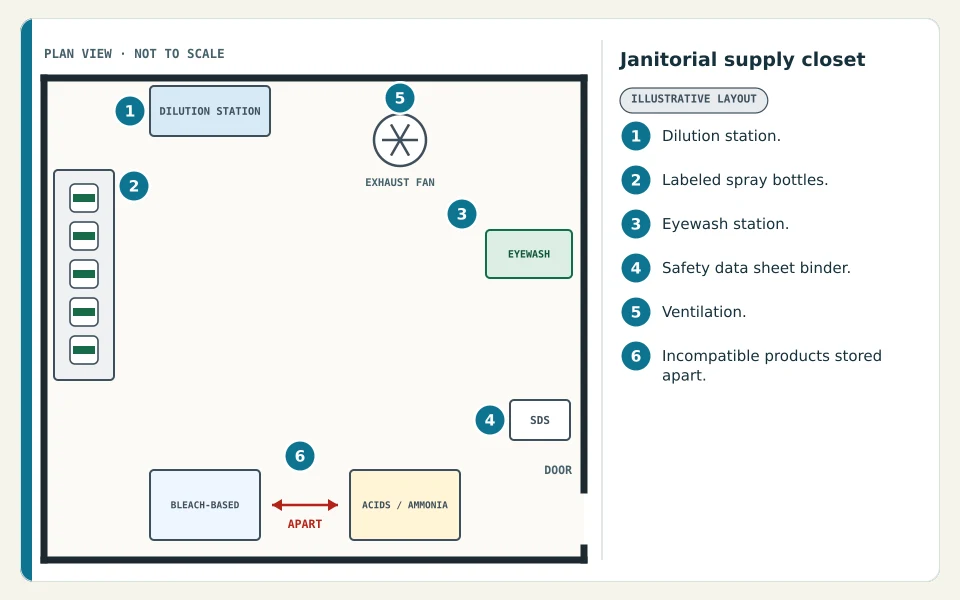
Cleaning products are a central hazard for janitorial crews. Federal hazard communication and first-aid rules point to these checks:
- Secondary containers such as spray bottles filled at the dilution station carry a workplace label naming the product and its hazards (29 CFR 1910.1200(f)(6)).
- The only unlabeled containers are portable ones filled from a labeled container for the immediate use of the person who filled them (29 CFR 1910.1200(f)(8)).
- Safety data sheets can be reached by crews during every shift at every site, whether on paper in the supply closet or on a phone (29 CFR 1910.1200(g)(8)).
- Crews are trained on the products in their work area when they start and whenever a new chemical hazard arrives (29 CFR 1910.1200(h)(1)).
- Where corrosive products such as some drain openers, oven cleaners or floor strippers are used, there is a way to drench or flush eyes and body within the work area (29 CFR 1910.151(c)).
- Products whose safety data sheets warn against mixing, such as chlorine bleach and ammonia-based cleaners, are stored and used apart.
A closed dilution system that dispenses ready-to-use product means crews handle less concentrate, so there are fewer chances for a splash.
Do janitors need bloodborne pathogens training?
It depends on the work. The federal bloodborne pathogens standard applies where there is occupational exposure, defined as reasonably anticipated skin, eye, mucous membrane or parenteral contact with blood or other potentially infectious materials from the employee's duties (29 CFR 1910.1030(b)). So check whether exposure is reasonably anticipated for each crew, for example:
- Cleaning exam rooms, restrooms or waste areas in medical and dental offices.
- Emptying trash where needles or blood-soaked materials could turn up.
- Being assigned to clean up blood or body fluids after an incident.
Where exposure is reasonably anticipated, the standard's requirements follow, including an exposure control plan, training, protective equipment and the hepatitis B vaccination series made available to those employees (29 CFR 1910.1030(f)(1)). Even where it is not, a few rules are worth adopting: broken glass that may be contaminated is never picked up by hand but with a brush and dustpan, tongs or forceps (29 CFR 1910.1030(d)(4)(ii)(D)), and crews report any needle they find instead of handling it.
What state rules apply to janitorial companies?
Two states have rules aimed at janitorial work, much of which is done alone:
- California: the Property Services Workers Protection Act set up a registration program for janitorial service employers with the Labor Commissioner, along with in-person sexual violence and harassment prevention training every two years. The Labor Commissioner lists the qualified organizations for that training.
- Washington: a property services contractor that employs isolated employees (janitors who work alone) must adopt a sexual harassment policy, train managers, supervisors and those employees, provide a resource list and a panic button for each, and document the training (RCW 49.60.515). Each year it also reports to the state the policy date, how many people were trained, and for each work location the number of janitorial workers and the total hours worked.
Lone work at night is a hazard in its own right, so record how crews check in, what a panic button connects to, and who responds.
How would a cleaning safety assessment rate stripping and refinishing floors?
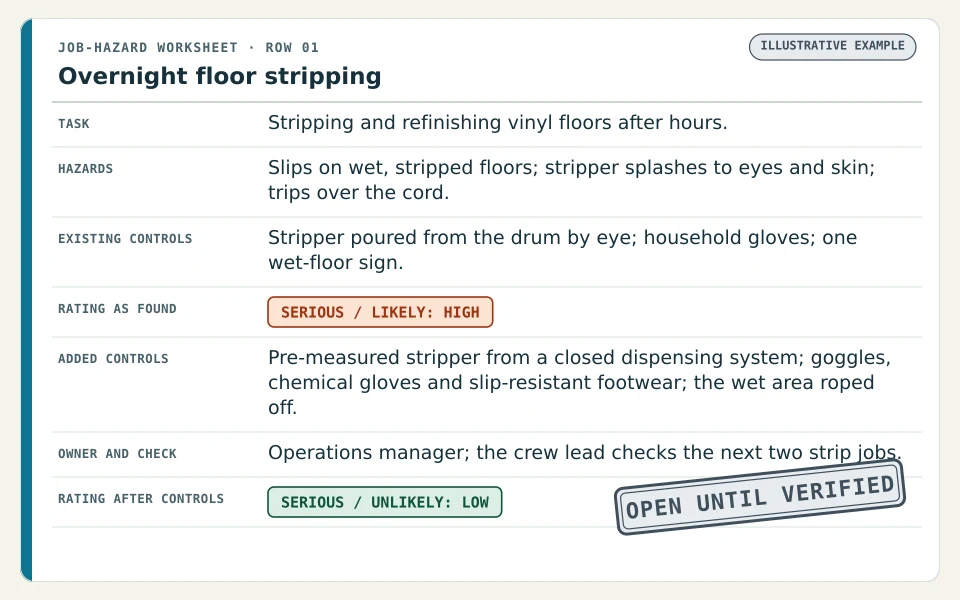
A fictional contract cleaner strips and refinishes vinyl floors in a client's office building overnight. The entry below rates the job before and after changes.
| Worksheet field | Entry |
|---|---|
| Task | Stripping and refinishing vinyl floors with a floor machine after hours. |
| Hazards | Slips on stripped, wet floors; chemical splashes to the eyes and skin from stripper concentrate; trips over the machine cord. |
| Existing controls | Stripper poured from the drum by eye into a bucket; household gloves; one wet-floor sign per corridor. |
| Rating as found | Serious / Likely: High |
| Added controls | Pre-measured stripper from a closed dispensing system; goggles, chemical gloves and slip-resistant footwear as the safety data sheet calls for; work in sections with the wet area roped off; cords routed behind the operator; a portable eyewash bottle until the site has a flushing station. |
| Owner and check | Operations manager orders the supplies; the crew lead checks the set-up at the start of the next two strip jobs. |
| Rating after controls | Serious / Unlikely: Low |
If the stripper is corrosive, a squeeze bottle may not meet the quick-drench requirement on its own, so check the product's safety data sheet. Building owners can find wider site issues in the commercial buildings safety guide.
Questions about the free Workplace Safety Assessment
Is a cleaning Workplace Safety Assessment only about chemicals?
No. Include slips, lifting, repetition, machines, electricity, sharps, access, lone work and client-site conditions as relevant.
Do green cleaning products remove the need for review?
No. Review the actual product information and how workers use it. A green label does not establish safe exposure or task conditions.
Should each client site be considered?
Yes. Review relevant differences in premises, equipment, people, access and responsibilities. A reusable template needs site-specific information.
Can the worksheet authorize confined-space entry?
No. Space evaluation, entry controls, training and rescue arrangements must follow the applicable separate requirements.
Does floor stripping need a job hazard analysis (JHA)?
Floor stripping, high dusting and restroom deep cleans each involve several steps, which suits a job hazard analysis (JHA). The Workplace Safety Assessment reviews the crew’s work across sites and shows which of those tasks need one.
Ask for your free Workplace Safety Assessment
Tell us the jobs involved and the concerns you want reviewed. Our team will call you to arrange your free assessment.
Sources: OSHA cleaning-industry hazards; OSHA and NIOSH cleaning chemicals; OSHA Small Business Safety and Health Handbook (self-inspection checklists); OSHA Job Hazard Analysis booklet; 29 CFR 1910.1200 hazard communication; 29 CFR 1910.151 medical services and first aid; 29 CFR 1910.1030 bloodborne pathogens; California janitorial sexual violence and harassment prevention training; RCW 49.60.515 isolated employees.
Related tools for specific tasks
These go deeper on one task or hazard. They support the broader job review; they do not replace it.
Workplace Safety Assessment for other industries
Each guide lists common jobs, hazard prompts and a printable worksheet for that kind of workplace.
- Manufacturing Workplace Safety AssessmentProduction, setup, jam clearing, maintenance and shutdowns.
- Warehouse Workplace Safety AssessmentReceiving, forklifts, racking, picking, docks and battery charging.
- Restaurant Workplace Safety AssessmentPrep, hot cooking, dishwashing, cold storage and closing shifts.
- Retail and Grocery Workplace Safety AssessmentDeliveries, stocking, box cutting, checkout and spill response.
- Office Workplace Safety AssessmentScreen work, storage, equipment, reception and office moves.
- Healthcare Workplace Safety AssessmentPatient handling, sharps, disinfection, equipment and shift work.
- Auto Repair Workplace Safety AssessmentVehicle lifts, tires, batteries, solvents, exhaust and refinishing.
- Hotel Workplace Safety AssessmentHousekeeping, laundry, kitchens, maintenance and guest contact.
Published by OSHAMap, a product of GetAgenticApps LLC · 131 Continental Dr, Suite 305, Newark, DE 19713, United States.
OSHAMap is an independent service and is not affiliated with OSHA or any government agency. The review and worksheets are not an OSHA inspection, government approval or compliance certification. Spotted something to correct? Contact us.