
Free Retail Workplace Safety Assessment
Request a free Workplace Safety Assessment for the work in your store, sometimes called a retail workplace risk assessment. Send the form and our team will call you to arrange it. Identify job hazards, review existing controls and organize practical corrective actions across routine and nonroutine tasks.
Free assessment. No credit card required. Send the form and our team will call you to arrange it.
- Receiving deliveries
- Stocking and merchandising
- Opening packaging
- Checkout and customer service
- Stockrooms and powered equipment
- Cleaning and spill response
- Food counters or specialist departments
- Opening, closing and security
Request your free Workplace Safety Assessment
Six quick fields. Our team will call the number you give to arrange your free assessment.
- A call from our team to arrange your free assessment
- A review of your jobs, including cleaning and maintenance, and the controls that need attention
- Free printable job-hazard worksheets with your account
What happens after you send the form
- You send the form. No credit card is needed.
- Our team calls the phone number you give.
- Together we arrange your free Workplace Safety Assessment.
Meanwhile, you can print the job-hazard worksheet with your free account.
Stockroom, sales-floor and checkout jobs we help you review
| Job or task | Hazards to review |
|---|---|
| Receiving deliveries | Vehicle interfaces, loads, dock access and temporary stock. |
| Stocking and merchandising | Reaching, ladders, lifting, falling stock and changing aisle layouts. |
| Opening packaging | Cutting tools, sharp edges, waste and repetitive handling. |
| Checkout and customer service | Repetition, reach, workstation arrangement and public interaction. |
| Stockrooms and powered equipment | Congestion, storage, moving equipment and authorized use. |
| Cleaning and spill response | Wet surfaces, cleaning products and work around customers. |
| Food counters or specialist departments | Hot surfaces, cutting equipment, cold rooms or other department-specific tasks. |
| Opening, closing and security | Reduced staffing, lone work, aggression, access and emergencies. |
Use the job list as a starting point. Include workers, contractors and shifts that encounter different conditions. Add tasks or hazards that are missing, and keep unreviewed items open.
Assess work behind the sales floor
Employees can move between a stockroom, delivery area, shop floor and service counter during one shift. Record the handling and access arrangements at each point. Grocery departments may add cutting, cooking or refrigerated tasks. Ask workers about repeated force and difficult reaches, then check whether the proposed change improves the task rather than relying on one lifting instruction.
What the store assessment looks at for each task
For each job, identify who could be injured or exposed, how the harm could occur and what controls are already in place. Consider the severity and likelihood of harm and the people exposed when prioritizing actions. Record the basis for the priority instead of treating a number as an OSHA pass.
Use the review to build a job-hazard summary and action list. Record additional controls, owners, target dates and how the result will be checked. Where information is missing, identify the verification or specialist input needed.
Retail and grocery Workplace Safety Assessment example
Heavy replenishment items are stored above shoulder height and employees repeatedly use an unsuitable access method during busy periods. The assessment records the product, frequency and workers affected. The team reviews storage height, replenishment methods and suitable access arrangements, then checks the change while restocking is underway.
Free. Tell us the jobs and the concern you want reviewed, and our team will call you.
What to gather before the store review
List departments, delivery methods, stocking routines and public-facing tasks. Include seasonal displays, temporary workers, lone opening or closing work and any powered equipment. Bring reports of difficult handling or repeated strain and details of recent merchandising changes.
The free request starts the review process: our team calls the number you give to arrange the assessment. Describe the main concern and the work involved so that call can cover it. Address immediate serious dangers through the responsible people without waiting for the appointment.
Record stockroom and sales-floor tasks on the worksheet
Record the workplace, task, people exposed, existing controls and further actions. The accompanying hazard screen covers fifteen categories, including equipment, chemicals, physical demands, health exposures, work organization and emergencies. Add other job-specific hazards and record why a category does not apply. Review findings after relevant changes and verify actions under actual working conditions.
A worker-safety assessment does not certify product, food or customer-service compliance. Specialist departments may need additional task assessments.
Store managers who know the self-inspection checklists in OSHA’s Small Business Safety and Health Handbook, which it presents as a starting point for identifying hazards, will recognize the format: this worksheet works as an OSHA self-inspection checklist for the stockroom, sales floor and checkout, although it is not an OSHA form.
Free account needed. It opens a printable page; use your browser's Print or Save as PDF.
- Identified
- Not yet reviewed
- Not applicable + reason
- Machinery and energy
- Vehicles and mobile equipment
- Slips, trips and falls
- Electricity
- Chemicals
- Physical demands
- Noise and vibration
- Heat, cold and physical agents
- Biological hazards
- Fire and emergencies
- Restricted spaces
- Violence and lone work
- Work organization
- PPE gaps
- Additional job-specific hazards
Plus a job register and an additional-hazards field. A category left blank stays open; it never counts as a pass.
How do you complete a workplace safety assessment for a retail store?
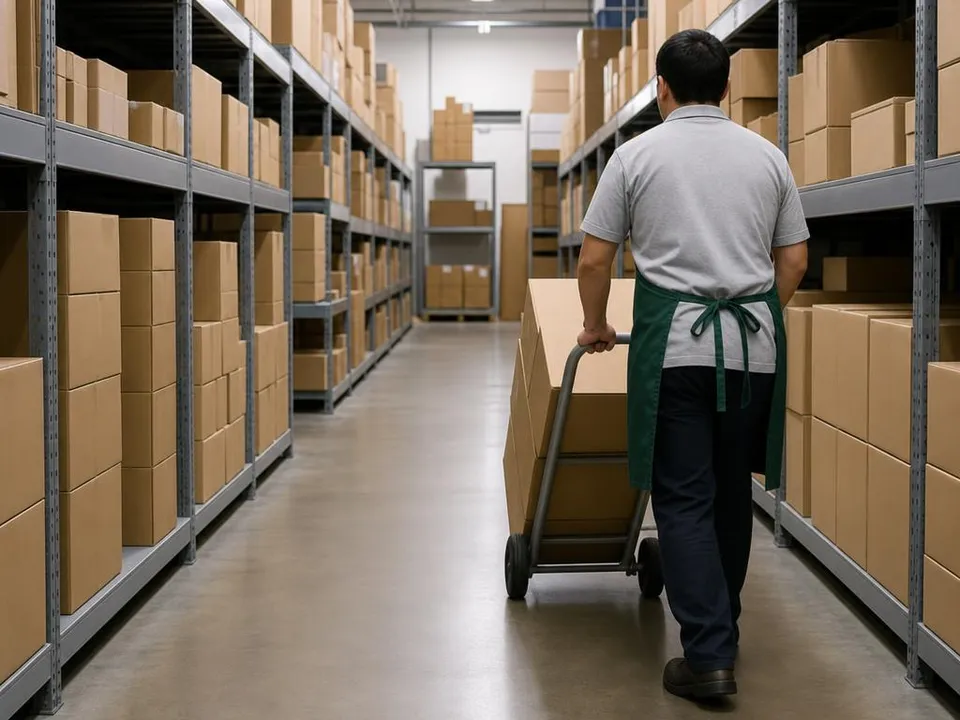
Customers see the sales floor, but receiving, stocking and cleaning happen behind it too. Cover the whole store in this order:
- Walk the back of house first: receiving door, stockroom, baler or compactor, break room and the route staff use to take out trash.
- Follow a delivery from the truck to the shelf, noting each lift, ladder climb, carton cut and pallet move along the way.
- Review the sales floor during trading hours and again during overnight or early-morning restocking, when ladders and pallet jacks are out among the aisles.
- Stand at each register and look at what staff can and cannot see: the door, the parking area, blind aisles and the cash drop.
- Check opening and closing routines, cash handling and who works alone, especially late at night.
- Rate the hazards, agree fixes with the store team, and check them again during the next busy weekend or holiday stock build.
What makes a retail store more exposed to robbery and violence?
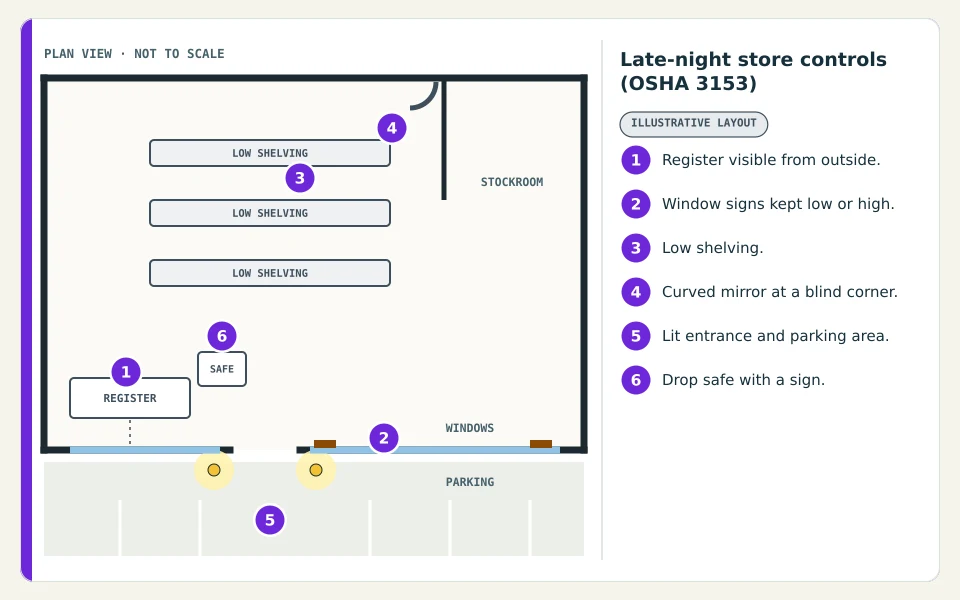
OSHA's recommendations for late-night retail establishments (OSHA 3153) name five risk factors to look for:
- The exchange of money, which makes staff targets for robbery.
- Solo work and isolated work sites.
- The sale of alcohol.
- Poorly lit stores and parking areas.
- No staff training in recognizing and managing escalating hostile and aggressive behavior.
The same publication lists environmental controls worth checking on the walk: window signs kept low or high so the register can be seen from outside, low shelving for clear sightlines, curved mirrors at blind spots, good outdoor and indoor lighting, video surveillance, door detectors that alert staff when someone comes in, and drop safes with signs stating that cashiers have limited access to cash.
Which states require retail workplace violence prevention plans?
There is no federal OSHA workplace violence standard for retail, but several states have their own rules:
- California: since July 1, 2024, employers need a written workplace violence prevention plan, a violent incident log, and training when the plan is first established and every year after (Labor Code 6401.9), unless an exemption applies. The plan is reviewed at least annually, when a deficiency becomes apparent and after a violent incident. The small-site exemption needs fewer than 10 employees present at any time and no public access, so a store that is open to shoppers does not fit it.
- New York: the Retail Worker Safety Act covers employers with 10 or more retail employees in the state. They must adopt a retail workplace violence prevention policy, hand it out at hiring and every year, and train staff at hiring, then yearly at 50 or more retail employees or every two years below that. From January 1, 2027, retail employers with 500 or more employees in New York must also provide silent response buttons and training on them.
- Washington: when a retailer's janitors or security guards work by themselves, RCW 49.60.515 calls for a sexual harassment policy, training for managers, supervisors and those workers, a resource list, and a panic button for each isolated worker.
Where a state plan is required, link it to the safety assessment so the violence hazards found on the walk feed straight into the plan's controls.
How would a retail safety assessment rate opening cartons with box cutters?
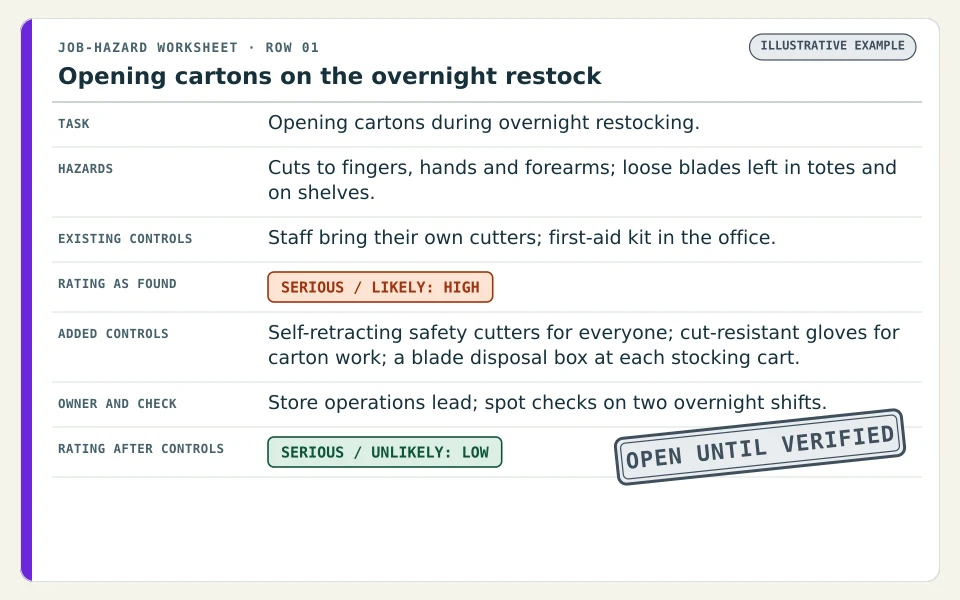
A fictional grocery store restocks overnight. The night crew opens cartons all shift, so carton cutting gets its own worksheet entry.
| Worksheet field | Entry |
|---|---|
| Task | Opening cartons on the sales floor and in the stockroom during overnight restocking. |
| Hazards | Cuts to fingers, hands and forearms from fixed-blade knives; loose blades left in totes and on shelves. |
| Existing controls | Staff bring their own cutters; first-aid kit in the office. |
| Rating as found | Serious / Likely: High |
| Added controls | Self-retracting safety cutters issued to everyone; cut-resistant gloves for carton work; a blade disposal box at each stocking cart; a short demonstration at the start of the shift. |
| Owner and check | Store operations lead; spot checks of totes and shelves on two overnight shifts and a monthly look at the first-aid log. |
| Rating after controls | Serious / Unlikely: Low |
The tool swap is the main control because it takes the exposed blade out of the task. The gloves stay as a backup, which is why both appear in the entry.
Which OSHA rules should a store safety assessment check?
Federal general-industry standards apply to stores just as they do to plants. Rules to have in hand for a store walk:
| Area | Federal rule | What to look for |
|---|---|---|
| Exits | 29 CFR 1910.37(a)(3) | Overstock, displays and returns carts kept out of exit routes, including during seasonal peaks. |
| Floors | 29 CFR 1910.22 | Spills and damaged flooring corrected, or the area guarded, before people use it again. |
| Stacking | 29 CFR 1910.176(b) | Stockroom tiers stable and limited in height. |
| Ladders | 29 CFR 1910.23(b)(10) | Rolling and step ladders checked before first use on each shift. |
| Cleaning chemicals | 29 CFR 1910.1200(e)(1) | A written program and chemical list for the products staff use, not only those on the shelves. |
| Seasonal displays | 29 CFR 1910.305(g)(1)(iv)(A) | Extension cords not standing in for permanent wiring. |
| Balers and compactors | 29 CFR 570.63 | Under-18 staff kept off them, apart from the narrow loading exception. |
For a broader look at store requirements, see the retail safety guide.
Questions about the free Workplace Safety Assessment
Can a small shop use the assessment?
Yes. Include all relevant jobs, even when one employee handles deliveries, stocking, checkout and cleaning.
Does it include employee interaction with customers?
Include relevant violence, aggression, lone-working and response concerns alongside the physical work.
Should seasonal displays be reviewed?
Yes. Review changes that affect storage stability, handling, sight lines, work access or emergency routes.
Is manual handling only about item weight?
No. Consider frequency, posture, reach, carrying distance, push or pull force and the equipment available for the actual task.
Does breaking down a delivery need a job hazard analysis (JHA)?
It can. A job hazard analysis (JHA) follows one task, such as breaking down a mixed pallet delivery, step by step. The Workplace Safety Assessment reviews the store’s jobs together and shows where a JHA would help.
Ask for your free Workplace Safety Assessment
Tell us the jobs involved and the concerns you want reviewed. Our team will call you to arrange your free assessment.
Sources: OSHA retail grocery ergonomics guidance; OSHA ergonomics; OSHA Small Business Safety and Health Handbook (self-inspection checklists); OSHA Job Hazard Analysis booklet; OSHA 3153 late-night retail recommendations; California Labor Code 6401.9 workplace violence prevention; New York Retail Worker Safety Act; NYSDOL Retail Worker Safety Act FAQ; RCW 49.60.515 isolated employees; 29 CFR 1910.37 exit routes; 29 CFR 1910.22 walking-working surfaces; 29 CFR 1910.176 materials handling and storage; 29 CFR 1910.23 ladders; 29 CFR 1910.1200 hazard communication; 29 CFR 1910.305 wiring methods; 29 CFR 570.63 Hazardous Occupations Order 12.
Related tools for specific tasks
These go deeper on one task or hazard. They support the broader job review; they do not replace it.
Workplace Safety Assessment for other industries
Each guide lists common jobs, hazard prompts and a printable worksheet for that kind of workplace.
- Manufacturing Workplace Safety AssessmentProduction, setup, jam clearing, maintenance and shutdowns.
- Warehouse Workplace Safety AssessmentReceiving, forklifts, racking, picking, docks and battery charging.
- Restaurant Workplace Safety AssessmentPrep, hot cooking, dishwashing, cold storage and closing shifts.
- Office Workplace Safety AssessmentScreen work, storage, equipment, reception and office moves.
- Healthcare Workplace Safety AssessmentPatient handling, sharps, disinfection, equipment and shift work.
- Auto Repair Workplace Safety AssessmentVehicle lifts, tires, batteries, solvents, exhaust and refinishing.
- Cleaning and Janitorial Workplace Safety AssessmentCleaning chemicals, wet floors, floor machines, waste and lone work.
- Hotel Workplace Safety AssessmentHousekeeping, laundry, kitchens, maintenance and guest contact.
Published by OSHAMap, a product of GetAgenticApps LLC · 131 Continental Dr, Suite 305, Newark, DE 19713, United States.
OSHAMap is an independent service and is not affiliated with OSHA or any government agency. The review and worksheets are not an OSHA inspection, government approval or compliance certification. Spotted something to correct? Contact us.