
Free Warehouse Workplace Safety Assessment
Request a free Workplace Safety Assessment for the work in your warehouse; you may know it as a workplace risk assessment. Send the form and our team will call you to arrange it. Identify job hazards, review existing controls and organize practical corrective actions across routine and nonroutine tasks.
Free assessment. No credit card required. Send the form and our team will call you to arrange it.
- Receiving and unloading
- Forklift and vehicle movement
- Storage and racking
- Order picking and replenishment
- Packing and dispatch
- Battery charging or fueling
- Conveyors and maintenance
- Cleaning and shift changes
Request your free Workplace Safety Assessment
Six quick fields. Our team will call the number you give to arrange your free assessment.
- A call from our team to arrange your free assessment
- A review of your jobs, including cleaning and maintenance, and the controls that need attention
- Free printable job-hazard worksheets with your account
What happens after you send the form
- You send the form. No credit card is needed.
- Our team calls the phone number you give.
- Together we arrange your free Workplace Safety Assessment.
Meanwhile, you can print the job-hazard worksheet with your free account.
Dock, aisle and storage jobs we help you review
| Job or task | Hazards to review |
|---|---|
| Receiving and unloading | Trailer movement, dock edges, unstable loads and workers near vehicles. |
| Forklift and vehicle movement | Crossings, blind spots, reversing, visibility and people entering travel routes. |
| Storage and racking | Damage, falling stock, load changes and access for inspection. |
| Order picking and replenishment | Reaching, lifting, repeated handling, ladders or elevated equipment. |
| Packing and dispatch | Cutting tools, repeated movements, congestion and handling loads. |
| Battery charging or fueling | Chemical contact, electrical hazards, ignition and task instructions. |
| Conveyors and maintenance | Moving parts, unexpected startup, access and energy control. |
| Cleaning and shift changes | Spills, temporary storage, reduced visibility and changing traffic patterns. |
Use the job list as a starting point. Include workers, contractors and shifts that encounter different conditions. Add tasks or hazards that are missing, and keep unreviewed items open.
Assess the warehouse during actual work
Walkthrough conditions can change when deliveries arrive or a shift changes. Review crossings, dock interfaces and temporary storage during the relevant activity. Keep truck examinations and operator training in their own applicable processes. Review handling frequency as well as the weight of one item, and refer rack design or capacity questions to appropriate qualified people.
What the warehouse assessment looks at for each task
For each job, identify who could be injured or exposed, how the harm could occur and what controls are already in place. Consider the severity and likelihood of harm and the people exposed when prioritizing actions. Record the basis for the priority instead of treating a number as an OSHA pass.
Use the review to build a job-hazard summary and action list. Record additional controls, owners, target dates and how the result will be checked. Where information is missing, identify the verification or specialist input needed.
Warehouse Workplace Safety Assessment example
Pickers cross a vehicle route to reach a temporary packing station. The assessment records when this happens and who uses the crossing. The team considers relocating the station, separating routes and any interim arrangements. Verification occurs during a delivery period so the team can see whether the change works when the area is busy.
Free. Tell us the jobs and the concern you want reviewed, and our team will call you.
What to gather before the warehouse review
Describe shifts, handling equipment, storage layout, receiving peaks and manual handling tasks. Bring worker concerns, relevant traffic arrangements, equipment records and recent changes. Include agency workers and visiting drivers in the review where relevant.
The free request starts the review process: our team calls the number you give to arrange the assessment. Describe the main concern and the work involved so that call can cover it. Address immediate serious dangers through the responsible people without waiting for the appointment.
Record receiving, picking and dispatch tasks on the worksheet
Record the workplace, task, people exposed, existing controls and further actions. The accompanying hazard screen covers fifteen categories, including equipment, chemicals, physical demands, health exposures, work organization and emergencies. Add other job-specific hazards and record why a category does not apply. Review findings after relevant changes and verify actions under actual working conditions.
A facility review does not authorize a forklift, establish rack capacity or replace required equipment examinations.
OSHA’s Small Business Safety and Health Handbook treats self-inspection checklists as a starting point for identifying workplace hazards. This worksheet gives docks, aisles and charging areas the same kind of OSHA self-inspection checklist to fill in on the floor, but it is not an OSHA form.
Free account needed. It opens a printable page; use your browser's Print or Save as PDF.
- Identified
- Not yet reviewed
- Not applicable + reason
- Machinery and energy
- Vehicles and mobile equipment
- Slips, trips and falls
- Electricity
- Chemicals
- Physical demands
- Noise and vibration
- Heat, cold and physical agents
- Biological hazards
- Fire and emergencies
- Restricted spaces
- Violence and lone work
- Work organization
- PPE gaps
- Additional job-specific hazards
Plus a job register and an additional-hazards field. A category left blank stays open; it never counts as a pass.
How do you carry out a workplace safety assessment in a warehouse?
Warehouses change shape by the hour, so the order of the review matters as much as the checklist. One way to run it:
- Split the building into zones: yard, dock doors, receiving and staging, racking aisles, pick faces, packing, battery charging, offices and break areas.
- Follow a single pallet from the trailer to dispatch and note every hand-off between people, forklifts, conveyors and pallet jacks.
- Schedule part of the walk for the inbound peak and a shift change, when traffic and temporary storage are at their worst.
- At each zone, look at vehicle and pedestrian contact, load stability, falls from docks and ladders, and how often people lift, reach or twist.
- Talk to operators and pickers about near misses: blind corners, rushed trailers and pallets left in walkways may never have made it into a report.
- Rate the findings, separate people from vehicles first where the risk is highest, and recheck the fixes during the next peak.
What should a warehouse safety inspection checklist cover in each zone?
A zone-by-zone checklist keeps the walk honest. Each line below traces back to a federal rule:
| Zone | What to check | Federal rule |
|---|---|---|
| Trailers at the dock | Trailer brakes set and rear wheels chocked before a forklift boards. | 29 CFR 1910.178(k)(1) |
| Dockboards | Portable dockboards secured in place; chocks or sand shoes stop the vehicle moving while anyone is on the board; handholds for carrying it. | 29 CFR 1910.26(c)–(e) |
| Aisles and doorways | Room for equipment at docks, doors and turns; aisles kept clear; permanent aisles marked. | 29 CFR 1910.176(a) |
| Stacked storage | Tiered loads stacked, blocked or interlocked and limited in height so they cannot slide or collapse. | 29 CFR 1910.176(b) |
| Forklifts | Each truck examined before use at least daily, or after every shift when it runs around the clock; defects reported and fixed. | 29 CFR 1910.178(q)(7) |
| Forklift operators | A performance evaluation for every operator at least once every three years. | 29 CFR 1910.178(l)(4)(iii) |
| Battery charging | A designated area with means to flush and neutralize spilled electrolyte, fire protection, protection from truck damage and ventilation. | 29 CFR 1910.178(g) |
| Ladders | Used only for their designed purpose and inspected before first use in each shift. | 29 CFR 1910.23(b)(9)–(10) |
| Exit routes | No pallets, cages or carts parked in an exit route, not even briefly. | 29 CFR 1910.37(a)(3) |
Rack capacity, anchoring and repair questions belong with the rack maker or another qualified person; the walk only records damage and overloading for them to judge.

How do you keep forklifts and pedestrians apart in a warehouse?
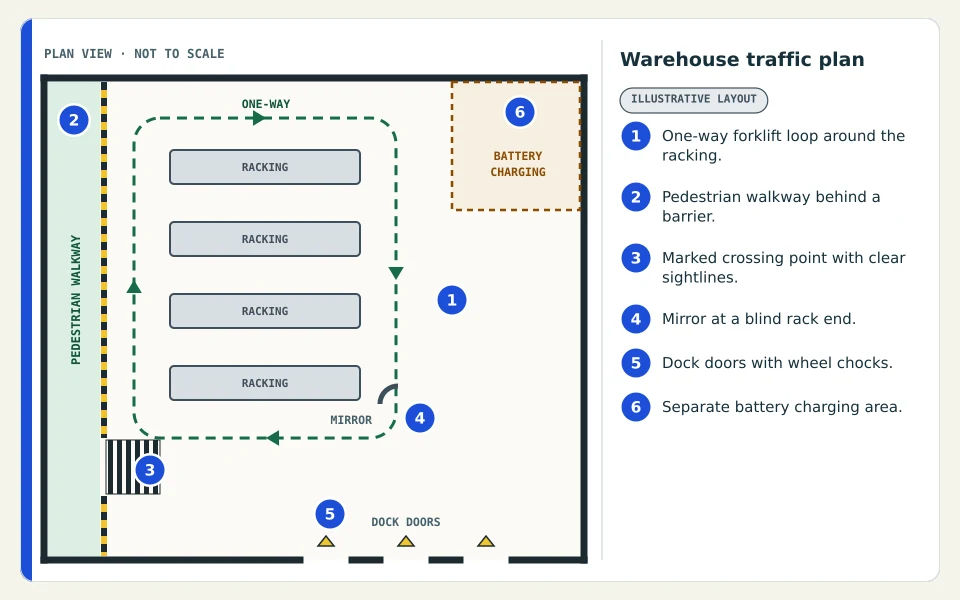
Separation beats reminders. A traffic plan drawn on the floor layout can combine several of these measures:
- One-way forklift loops wherever the aisle layout allows, so trucks meet head-on less often.
- Marked pedestrian walkways with physical barriers where foot traffic runs alongside a busy truck route.
- A small number of designated crossing points with clear sightlines, instead of crossings wherever people choose.
- Mirrors and lighting at blind rack ends and doorways, plus horn and slow-down rules at intersections.
- No-go zones around the dock while trailers are loaded, with drivers kept in a waiting area.
- Packing stations, printers and break areas placed so people reach them without walking through truck aisles.
Test the plan during a delivery peak. A walkway that people skip because it is longer than the truck aisle is a design problem, not a discipline problem. The warehousing safety guide covers wider site requirements, and yard and loading issues overlap with the transportation guide.
How would a warehouse safety assessment rate hand-unloading a floor-loaded trailer?
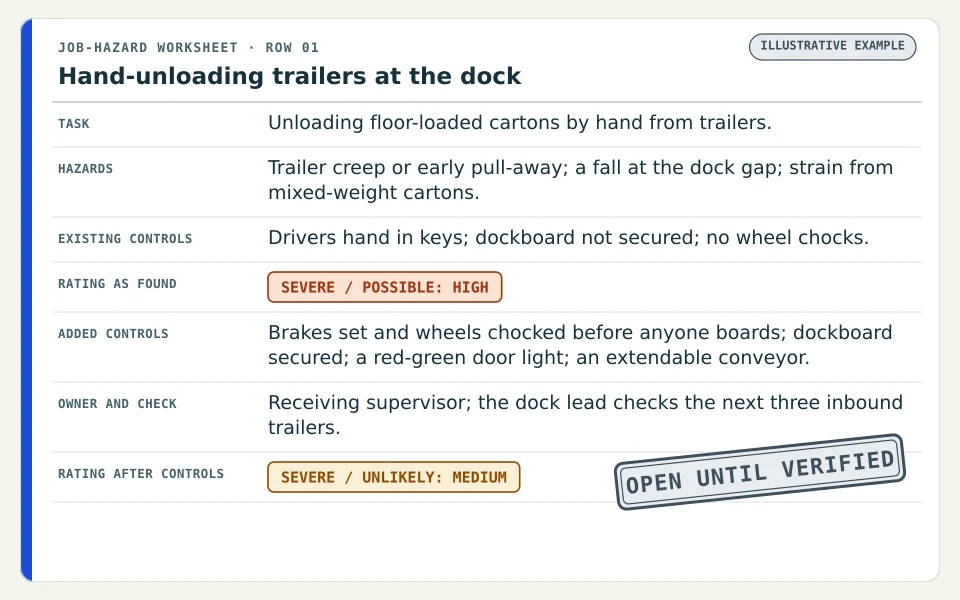
A fictional receiving team unloads floor-loaded cartons by hand at one dock door. Here is how the worksheet entry reads.
| Worksheet field | Entry |
|---|---|
| Task | Unloading floor-loaded cartons by hand from trailers at the receiving dock. |
| Hazards | Trailer creep or early pull-away while a pallet jack is inside; a fall into the gap between dock and trailer; back and shoulder strain from lifting mixed-weight cartons. |
| Existing controls | Drivers asked to hand in their keys; dockboard placed by hand and not secured; no wheel chocks at the door. |
| Rating as found | Severe / Possible: High |
| Added controls | Brakes set and wheels chocked before anyone boards; dockboard secured; a red-green door light the dock lead switches; an extendable conveyor so cartons are not carried; team rotation between trailers. |
| Owner and check | Receiving supervisor sets it up; the dock lead checks chocks and the door light on the next three inbound trailers. |
| Rating after controls | Severe / Unlikely: Medium |
The chocks and the door light deal with the severe outcome; the conveyor and rotation deal with strain. Each control gets its own check, because one can fail while the other works.
Which states regulate warehouse quotas and injury prevention?
Several states now set rules for large warehouse distribution centers. Thresholds count employees at one site or across the state:
- California: employers with 100 or more employees at a single warehouse distribution center, or 1,000 or more across the state, must give each employee a written description of every quota they are subject to, including the possible adverse action for missing it (Labor Code 2100–2101).
- Washington: chapter 49.84 RCW applies quota rules at 100 employees at one site or 1,000 statewide, counting agency and affiliate workers.
- Minnesota: the warehouse distribution worker law (Minn. Stat. 182.6526) applies at 250 employees at one site or 1,000 statewide. Separately, warehouse distribution centers with 100 or more employees in the listed industry codes need a written ergonomics program that is evaluated every year (Minn. Stat. 182.677).
- New York: the Warehouse Worker Protection Act applies at 100 employees at one site or 1,000 statewide, and since June 1, 2025 covered employers must run an injury reduction program aimed at work-related musculoskeletal disorders.
Where a quota law applies, the safety assessment should look at pace as a hazard: how quotas interact with lifting frequency, breaks and the time people need to use walkways instead of shortcuts.
Questions about the free Workplace Safety Assessment
Is this a forklift inspection?
The assessment reviews forklift-related tasks and interactions. Required truck examinations, operator training and equipment procedures remain separate.
Should night shifts be included?
Yes. Review relevant differences in staffing, lighting, delivery patterns, maintenance and communication across shifts.
Can a distribution center use the checklist?
Yes. Adapt it for the actual conveyors, picking methods, automation, handling intensity and workforce.
What if a hazard needs an immediate correction?
Use appropriate immediate controls and involve the responsible people. Do not leave a serious danger unaddressed while waiting for a later assessment appointment.
Where does a job hazard analysis (JHA) fit in a warehouse?
A job hazard analysis (JHA) breaks one task, such as replenishing a high rack location, into its steps and looks at the hazard in each. The Workplace Safety Assessment reviews the warehouse jobs together and points to the tasks that need a JHA of their own.
Ask for your free Workplace Safety Assessment
Tell us the jobs involved and the concerns you want reviewed. Our team will call you to arrange your free assessment.
Sources: OSHA warehousing; OSHA powered industrial trucks; OSHA Small Business Safety and Health Handbook (self-inspection checklists); OSHA Job Hazard Analysis booklet; 29 CFR 1910.178 powered industrial trucks; 29 CFR 1910.26 dockboards; 29 CFR 1910.176 materials handling and storage; 29 CFR 1910.23 ladders; 29 CFR 1910.37 exit routes; California Labor Code 2100 (warehouse quotas); California Labor Code 2101 (quota descriptions); Chapter 49.84 RCW (Washington warehouse employees); Minn. Stat. 182.6526 (warehouse distribution workers); Minn. Stat. 182.677 (ergonomics programs); New York Warehouse Worker Protection Act.
Related tools for specific tasks
These go deeper on one task or hazard. They support the broader job review; they do not replace it.
Workplace Safety Assessment for other industries
Each guide lists common jobs, hazard prompts and a printable worksheet for that kind of workplace.
- Manufacturing Workplace Safety AssessmentProduction, setup, jam clearing, maintenance and shutdowns.
- Restaurant Workplace Safety AssessmentPrep, hot cooking, dishwashing, cold storage and closing shifts.
- Retail and Grocery Workplace Safety AssessmentDeliveries, stocking, box cutting, checkout and spill response.
- Office Workplace Safety AssessmentScreen work, storage, equipment, reception and office moves.
- Healthcare Workplace Safety AssessmentPatient handling, sharps, disinfection, equipment and shift work.
- Auto Repair Workplace Safety AssessmentVehicle lifts, tires, batteries, solvents, exhaust and refinishing.
- Cleaning and Janitorial Workplace Safety AssessmentCleaning chemicals, wet floors, floor machines, waste and lone work.
- Hotel Workplace Safety AssessmentHousekeeping, laundry, kitchens, maintenance and guest contact.
Published by OSHAMap, a product of GetAgenticApps LLC · 131 Continental Dr, Suite 305, Newark, DE 19713, United States.
OSHAMap is an independent service and is not affiliated with OSHA or any government agency. The review and worksheets are not an OSHA inspection, government approval or compliance certification. Spotted something to correct? Contact us.