
Free Manufacturing Workplace Safety Assessment
Request a free Workplace Safety Assessment for the work at your plant, the review some plants call a workplace risk assessment. Send the form and our team will call you to arrange it. Identify job hazards, review existing controls and organize practical corrective actions across routine and nonroutine tasks.
Free assessment. No credit card required. Send the form and our team will call you to arrange it.
- Production and machine operation
- Setup and changeover
- Cleaning and jam clearing
- Maintenance and contractors
- Materials and finished goods
- Chemical and process work
- Packing and repeated tasks
- Shutdowns and abnormal conditions
Request your free Workplace Safety Assessment
Six quick fields. Our team will call the number you give to arrange your free assessment.
- A call from our team to arrange your free assessment
- A review of your jobs, including cleaning and maintenance, and the controls that need attention
- Free printable job-hazard worksheets with your account
What happens after you send the form
- You send the form. No credit card is needed.
- Our team calls the phone number you give.
- Together we arrange your free Workplace Safety Assessment.
Meanwhile, you can print the job-hazard worksheet with your free account.
Plant jobs and machine hazards we help you review
| Job or task | Hazards to review |
|---|---|
| Production and machine operation | Moving parts, material ejection, pinch points, noise and operator access. |
| Setup and changeover | Tool changes, altered guards, stored energy and unexpected movement. |
| Cleaning and jam clearing | Access to danger zones, energy control and chemical contact. |
| Maintenance and contractors | Isolation, electrical work, elevated access and coordination. |
| Materials and finished goods | Lifting, pushing, vehicle traffic and unstable loads. |
| Chemical and process work | Dust, fumes, liquids, heat and exposure information needing review. |
| Packing and repeated tasks | Force, reach, repetition, workstation setup and shift duration. |
| Shutdowns and abnormal conditions | Restarts, faults, spills, emergencies and who authorizes the work. |
Use the job list as a starting point. Include workers, contractors and shifts that encounter different conditions. Add tasks or hazards that are missing, and keep unreviewed items open.
Review the whole operating cycle
A line that appears guarded during normal production can expose people differently during setup or fault finding. Describe each operating mode and the people who enter the area. Keep guarding and hazardous-energy decisions connected to the applicable procedures and authorized people. Record when noise, dust, fumes or other exposures need measurement instead of treating a visible walkthrough as sufficient.
What the manufacturing assessment looks at for each job
For each job, identify who could be injured or exposed, how the harm could occur and what controls are already in place. Consider the severity and likelihood of harm and the people exposed when prioritizing actions. Record the basis for the priority instead of treating a number as an OSHA pass.
Use the review to build a job-hazard summary and action list. Record additional controls, owners, target dates and how the result will be checked. Where information is missing, identify the verification or specialist input needed.
Manufacturing Workplace Safety Assessment example
Operators report recurring jams at a packaging line. The team lists the jam-clearing steps, access points and energy sources that need verification. It reviews the cause of the jams, the applicable procedure and the correction with the workers doing the task. The action remains open until the responsible person verifies the revised arrangement under the relevant operating conditions.
Free. Tell us the jobs and the concern you want reviewed, and our team will call you.
What to gather before the plant review
List your main processes, machines and nonroutine tasks. Bring relevant operating instructions, existing procedures, maintenance concerns and any available exposure results. Include temporary workers and contractors when their work interacts with the plant.
The free request starts the review process: our team calls the number you give to arrange the assessment. Describe the main concern and the work involved so that call can cover it. Address immediate serious dangers through the responsible people without waiting for the appointment.
Record each plant job on the job-hazard worksheet
Record the workplace, task, people exposed, existing controls and further actions. The accompanying hazard screen covers fifteen categories, including equipment, chemicals, physical demands, health exposures, work organization and emergencies. Add other job-specific hazards and record why a category does not apply. Review findings after relevant changes and verify actions under actual working conditions.
Detailed machine design, energy-isolation verification and exposure measurements may need separate qualified work. Record these follow-ups in the assessment.
Looking for an OSHA self-inspection checklist for the plant floor? OSHA’s Small Business Safety and Health Handbook provides self-inspection checklists as a starting point for identifying hazards, and this worksheet follows that approach for each machine job. It is OSHAMap’s own worksheet, not an OSHA form.
Free account needed. It opens a printable page; use your browser's Print or Save as PDF.
- Identified
- Not yet reviewed
- Not applicable + reason
- Machinery and energy
- Vehicles and mobile equipment
- Slips, trips and falls
- Electricity
- Chemicals
- Physical demands
- Noise and vibration
- Heat, cold and physical agents
- Biological hazards
- Fire and emergencies
- Restricted spaces
- Violence and lone work
- Work organization
- PPE gaps
- Additional job-specific hazards
Plus a job register and an additional-hazards field. A category left blank stays open; it never counts as a pass.
How do you carry out a workplace safety assessment in a manufacturing plant?
A plant review goes faster when it follows the product rather than the org chart. A workable sequence for a single line or a whole site:
- Sketch the process flow from receiving to shipping, and mark every machine, conveyor, robot cell, oven and chemical point along it.
- List each machine's operating modes: normal running, setup and changeover, jam clearing, cleaning, inspection and maintenance. The nonproduction modes are where guards come off.
- Name every energy source a machine holds: electrical, hydraulic, pneumatic, gravity, spring tension, heat and anything stored after shutdown.
- Watch a setup or changeover from start to finish with the person who does it, and note each point where hands or bodies go past a guard.
- Add the health side: noise near presses and grinders, dust and fumes from welding, cutting or finishing, coolant mist, solvents and manual handling of parts and dies.
- Rate each hazard, fix the high ones first, and give every action an owner and a date. Re-rate only after the change has been watched during real production.
Bring the machine manuals and the existing energy control procedures to the walk. Any gap between what the paper says and what the operator does is a finding in its own right.
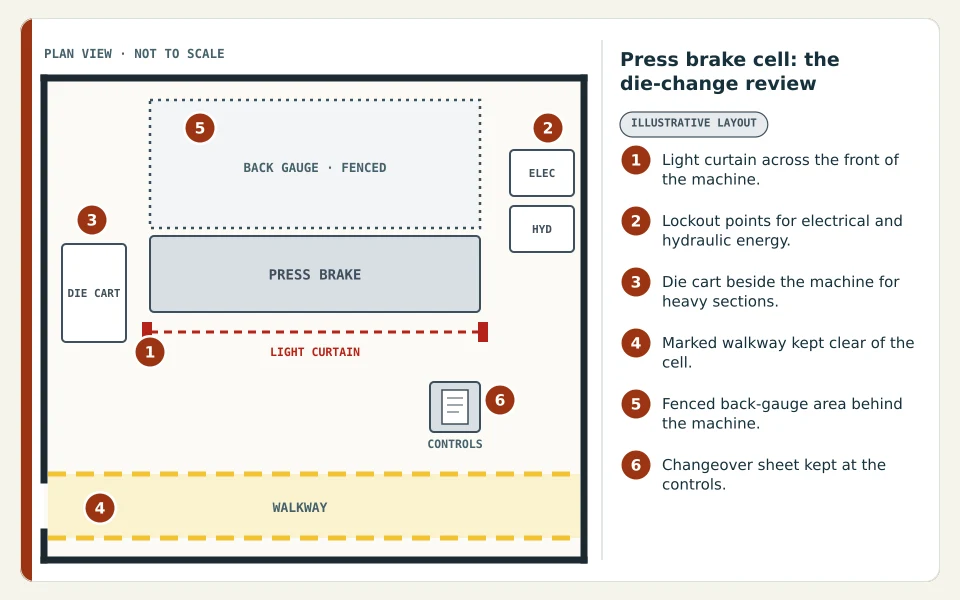
What belongs on a machine guarding and lockout checklist?
Machine guarding and hazardous energy control belong together in a plant review: one covers normal running, the other servicing and maintenance. These checks are taken from the federal text:
- Guards cover the point of operation, ingoing nip points, rotating parts, flying chips and sparks (29 CFR 1910.212(a)(1)).
- The point-of-operation guard keeps any part of the operator's body out of the danger zone during the operating cycle (29 CFR 1910.212(a)(3)(ii)).
- Machines designed for a fixed location are securely anchored so they cannot walk or move (29 CFR 1910.212(b)).
- A written energy control program exists, with machine-specific procedures for servicing and maintenance (29 CFR 1910.147(c)(1) and (c)(4)).
- Each lockout follows the standard's order: preparation, shutdown, isolation, applying locks or tags, releasing stored energy and verifying isolation before work starts (29 CFR 1910.147(d)).
- Every energy control procedure gets a periodic inspection at least once a year (29 CFR 1910.147(c)(6)(i)).
- Minor tool changes during production are exempt only when they are routine, repetitive and integral to production and other measures give effective protection (exception to 29 CFR 1910.147(a)(2)(ii)).
One scope point catches plants out: the mechanical power press standard excludes press brakes and hydraulic or pneumatic presses (29 CFR 1910.217(a)(5)), so those machines are judged under the general guarding rule instead.
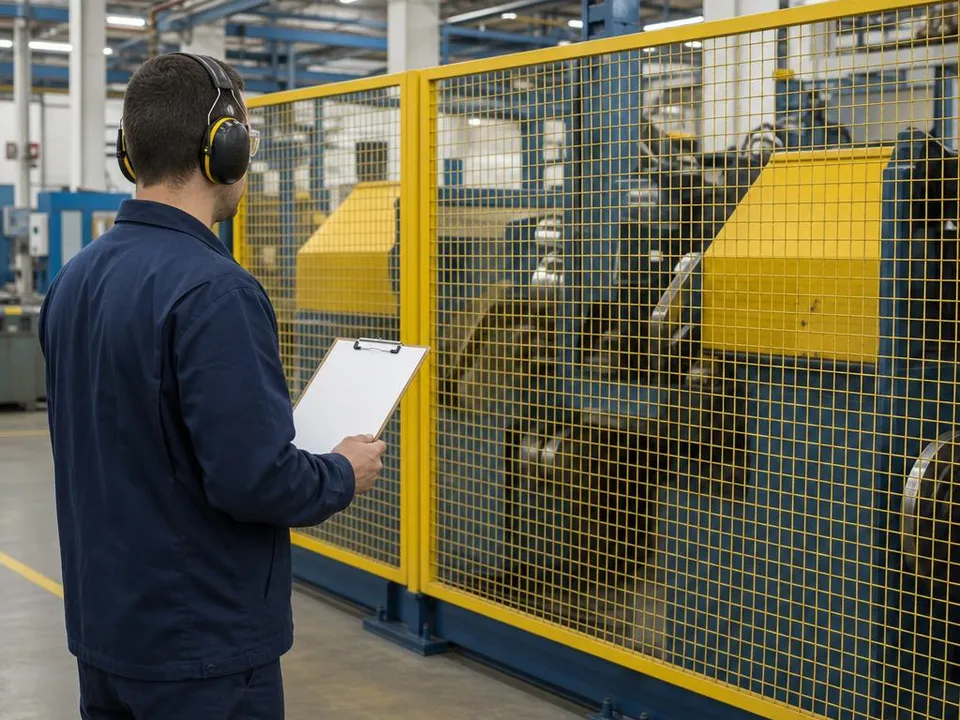
Which OSHA standards should a manufacturing safety assessment check?
The standards that apply depend on the processes you run. These come up in a broad range of plants:
| Hazard area | Federal rule | What the review confirms |
|---|---|---|
| Machine guarding | 29 CFR 1910.212 | Guards in place, secure and not bypassed in every operating mode. |
| Hazardous energy | 29 CFR 1910.147 | Written procedures per machine, trained authorized employees and the yearly inspection. |
| Mechanical power presses | 29 CFR 1910.217 | Applies to mechanical presses only; press brakes fall back on 1910.212. |
| Noise | 29 CFR 1910.95 | Monitoring once exposure may reach an 85 dBA eight-hour average, and a hearing program at that level. |
| Chemicals | 29 CFR 1910.1200 | A written program, a chemical inventory, labels and safety data sheets for coolants, solvents and coatings. |
| Respirators | 29 CFR 1910.134(c)(1) | A written program with worksite-specific procedures wherever respirators are necessary. |
| Forklifts | 29 CFR 1910.178(l)(4)(iii) | Each operator evaluated at least once every three years. |
| PPE | 29 CFR 1910.132(d) | A hazard assessment for each work area, verified in a written certification that names the workplace, the assessor and the date. |
For a wider overview of plant requirements, see the manufacturing safety guide; shops running press brakes, shears and welding bays can also use the metal fabrication guide.
What does a manufacturing safety assessment example look like for a press brake?
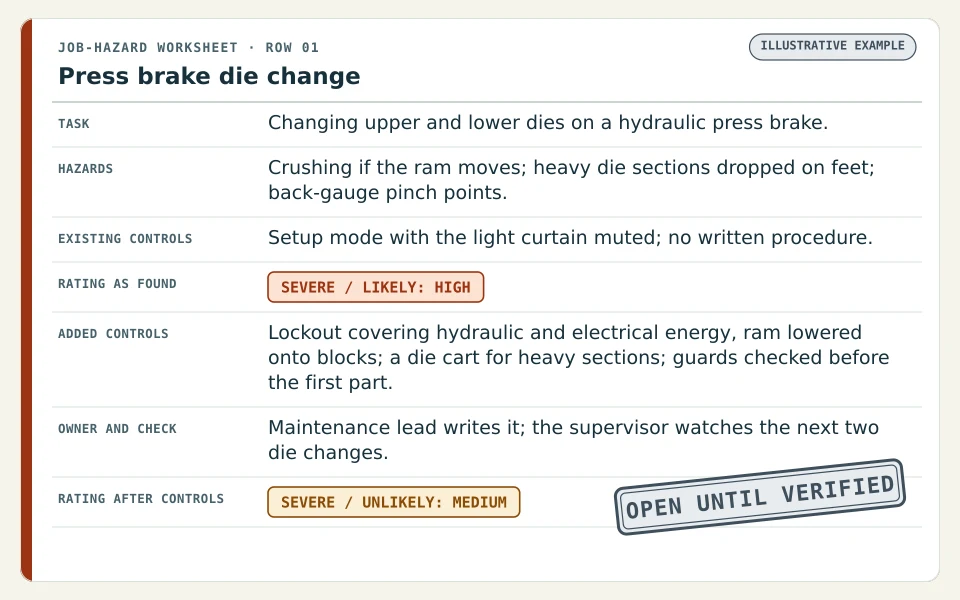
This fictional entry follows one job at a small sheet-metal shop: swapping the upper and lower dies on a hydraulic press brake between runs.
| Worksheet field | Entry |
|---|---|
| Task | Changing upper and lower dies on a hydraulic press brake between production runs. |
| Hazards | Crushing or amputation if the ram moves while hands are between the dies; heavy die sections dropped on feet; pinch points at the back gauge. |
| Existing controls | Machine switched to setup mode with the light curtain muted; no written procedure for the change. |
| Rating as found | Severe / Likely: High |
| Added controls | Machine-specific lockout procedure covering hydraulic and electrical energy, with the ram lowered onto blocks; a die cart for heavy sections; guards and light curtain checked before the first part runs. |
| Owner and check | Maintenance lead writes the procedure; the production supervisor watches the next two die changes and adds the procedure to the yearly inspection. |
| Rating after controls | Severe / Unlikely: Medium |
Severity stays Severe because a skipped step could still cost a hand; only the likelihood falls. That residual Medium is why the die change stays on the inspection list instead of being closed and forgotten.
When should a manufacturing safety assessment be updated?
A plant assessment ages each time the line changes. Reopen the affected entries when any of these happen:
- A machine is installed, moved, rebuilt or retrofitted with new controls or safety devices.
- A guard, interlock or light curtain is found bypassed, muted or removed.
- A new product, material, coating or coolant arrives, along with its safety data sheet.
- An injury, near miss or recurring jam shows the existing controls are not working as planned.
- Staffing changes: a new shift, temporary workers or new operators on a machine.
- The yearly inspection of an energy control procedure finds a deviation or an inadequacy.
Record what changed and re-rate only the affected entries. A full re-walk is still worth doing on a fixed cycle so slow drift does not go unnoticed.
Do Minnesota and California require manufacturers to have a written safety program?
In Minnesota, employers in the industries listed by NAICS code in Minnesota Rules 5208.1500 need a written AWAIR program (Minn. Stat. 182.653, subd. 8). Check whether your plant's code is on the list. The program has to describe five things:
- How managers, supervisors and employees are responsible for carrying it out, and how management's continued participation is established, measured and maintained.
- The methods used to identify, analyze and control new or existing hazards, conditions and operations.
- How the program is communicated to all affected employees so they know the work-related hazards and controls.
- How workplace accidents are investigated and corrective action is put in place.
- How safe work practices and rules are enforced.
The program needs a documented review at least once a year. In California, plants fall under the same Injury and Illness Prevention Program rule as every other employer (8 CCR 3203), which also calls for hazard inspections whenever new equipment or processes bring a new hazard.
Questions about the free Workplace Safety Assessment
Does the assessment include maintenance and cleaning?
Yes. Include setup, servicing, cleaning, jam clearing, shutdown and restart where those tasks occur. Normal production is only one part of the job review.
Can a checklist confirm lockout/tagout compliance?
No. The actual energy sources, applicable procedure, authorized roles and required verification need review. A generic completed row does not establish effective isolation.
Can a small machine shop use this?
Yes. Start with the actual equipment and jobs rather than the size of the company. Add operations and hazards that are missing from the starter list.
What should be recorded after a control is selected?
Record the action owner, target date, implementation evidence and who will verify the result. Reassess when the process or operating conditions change.
When does a plant task need its own job hazard analysis (JHA)?
When a task such as a die change or jam clearing has several steps with different hazards, a job hazard analysis (JHA) walks through it one step at a time. The Workplace Safety Assessment covers the plant’s jobs together and flags which tasks need that closer look.
Ask for your free Workplace Safety Assessment
Tell us the jobs involved and the concerns you want reviewed. Our team will call you to arrange your free assessment.
Sources: OSHA machine guarding; OSHA control of hazardous energy; OSHA Small Business Safety and Health Handbook (self-inspection checklists); OSHA Job Hazard Analysis booklet; 29 CFR 1910.212 machine guarding; 29 CFR 1910.147 hazardous energy; 29 CFR 1910.217 mechanical power presses; 29 CFR 1910.95 occupational noise; 29 CFR 1910.1200 hazard communication; 29 CFR 1910.134 respiratory protection; 29 CFR 1910.178 powered industrial trucks; 29 CFR 1910.132 PPE general requirements; Minn. Stat. 182.653 (AWAIR); Minn. R. 5208.1500 AWAIR industries; Cal/OSHA 8 CCR 3203 injury and illness prevention program.
Related tools for specific tasks
These go deeper on one task or hazard. They support the broader job review; they do not replace it.
Workplace Safety Assessment for other industries
Each guide lists common jobs, hazard prompts and a printable worksheet for that kind of workplace.
- Warehouse Workplace Safety AssessmentReceiving, forklifts, racking, picking, docks and battery charging.
- Restaurant Workplace Safety AssessmentPrep, hot cooking, dishwashing, cold storage and closing shifts.
- Retail and Grocery Workplace Safety AssessmentDeliveries, stocking, box cutting, checkout and spill response.
- Office Workplace Safety AssessmentScreen work, storage, equipment, reception and office moves.
- Healthcare Workplace Safety AssessmentPatient handling, sharps, disinfection, equipment and shift work.
- Auto Repair Workplace Safety AssessmentVehicle lifts, tires, batteries, solvents, exhaust and refinishing.
- Cleaning and Janitorial Workplace Safety AssessmentCleaning chemicals, wet floors, floor machines, waste and lone work.
- Hotel Workplace Safety AssessmentHousekeeping, laundry, kitchens, maintenance and guest contact.
Published by OSHAMap, a product of GetAgenticApps LLC · 131 Continental Dr, Suite 305, Newark, DE 19713, United States.
OSHAMap is an independent service and is not affiliated with OSHA or any government agency. The review and worksheets are not an OSHA inspection, government approval or compliance certification. Spotted something to correct? Contact us.