
Free Hotel Workplace Safety Assessment
Request a free Workplace Safety Assessment for the work at your hotel, also known as a hotel workplace risk assessment. Send the form and our team will call you to arrange it. Identify job hazards, review existing controls and organize practical corrective actions across routine and nonroutine tasks.
Free assessment. No credit card required. Send the form and our team will call you to arrange it.
- Room cleaning and bed making
- Laundry and linen handling
- Cleaning products and waste
- Kitchens and food service
- Facilities and maintenance
- Reception and guest interaction
- Deliveries and event setup
- Pools, grounds or other services
Request your free Workplace Safety Assessment
Six quick fields. Our team will call the number you give to arrange your free assessment.
- A call from our team to arrange your free assessment
- A review of your jobs, including cleaning and maintenance, and the controls that need attention
- Free printable job-hazard worksheets with your account
What happens after you send the form
- You send the form. No credit card is needed.
- Our team calls the phone number you give.
- Together we arrange your free Workplace Safety Assessment.
Meanwhile, you can print the job-hazard worksheet with your free account.
Housekeeping, laundry and guest-facing jobs we help you review
| Job or task | Hazards to review |
|---|---|
| Room cleaning and bed making | Force, repeated reaching, awkward posture and work pace. |
| Laundry and linen handling | Loads, carts, heat, machinery and repeated movements. |
| Cleaning products and waste | Chemical contact, exposure, sharp objects and contaminated material. |
| Kitchens and food service | Burns, cuts, wet surfaces and powered equipment. |
| Facilities and maintenance | Electrical work, energy control, access and unfamiliar repairs. |
| Reception and guest interaction | Aggression concerns, lone work, communication and response. |
| Deliveries and event setup | Handling, temporary layouts, vehicle interfaces and contractor work. |
| Pools, grounds or other services | Task-specific chemicals, heat, equipment and specialist follow-up where relevant. |
Use the job list as a starting point. Include workers, contractors and shifts that encounter different conditions. Add tasks or hazards that are missing, and keep unreviewed items open.
Review each department’s actual jobs
Housekeeping, laundry, food service, reception and maintenance are different work activities. Include outsourced services and shifts that do not overlap with daytime management. Ask workers about difficult handling and repeated strain, and record changing tasks during busy check-in periods, events or room turnover. Separate employee-safety findings from guest-service and accommodation-quality checks.
What the hotel assessment looks at in each department
For each job, identify who could be injured or exposed, how the harm could occur and what controls are already in place. Consider the severity and likelihood of harm and the people exposed when prioritizing actions. Record the basis for the priority instead of treating a number as an OSHA pass.
Use the review to build a job-hazard summary and action list. Record additional controls, owners, target dates and how the result will be checked. Where information is missing, identify the verification or specialist input needed.
Hotel Workplace Safety Assessment example
Room attendants report difficulty moving heavily loaded linen carts over a threshold during peak turnover. The assessment records the load, route, frequency and affected workers. The team reviews the threshold, cart condition, handling arrangement and work organization, assigns changes and checks the result during the next turnover period.
Free. Tell us the jobs and the concern you want reviewed, and our team will call you.
What to gather before the property review
List departments, outsourced services, shifts and specialist facilities. Bring worker concerns, cleaning-product information, equipment instructions and details of changes to events, staffing or maintenance. Include unusual tasks assigned to employees outside their normal department.
The free request starts the review process: our team calls the number you give to arrange the assessment. Describe the main concern and the work involved so that call can cover it. Address immediate serious dangers through the responsible people without waiting for the appointment.
Record each hotel department’s tasks on the worksheet
Record the workplace, task, people exposed, existing controls and further actions. The accompanying hazard screen covers fifteen categories, including equipment, chemicals, physical demands, health exposures, work organization and emergencies. Add other job-specific hazards and record why a category does not apply. Review findings after relevant changes and verify actions under actual working conditions.
This is an employee workplace assessment. Pool operations, building systems, guest safety and specialist maintenance may need additional applicable reviews.
Each department head can use the worksheet as an OSHA self-inspection checklist for their area. OSHA’s Small Business Safety and Health Handbook describes self-inspection checklists as a starting point for identifying hazards; this worksheet takes that approach and is not an OSHA form.
Free account needed. It opens a printable page; use your browser's Print or Save as PDF.
- Identified
- Not yet reviewed
- Not applicable + reason
- Machinery and energy
- Vehicles and mobile equipment
- Slips, trips and falls
- Electricity
- Chemicals
- Physical demands
- Noise and vibration
- Heat, cold and physical agents
- Biological hazards
- Fire and emergencies
- Restricted spaces
- Violence and lone work
- Work organization
- PPE gaps
- Additional job-specific hazards
Plus a job register and an additional-hazards field. A category left blank stays open; it never counts as a pass.
How do you carry out a workplace safety assessment for a hotel?
A hotel combines several workplaces under one roof, each with its own rhythm. Work through them department by department:
- List the departments: front desk and night audit, housekeeping, laundry, engineering and maintenance, kitchen and banquets, pool and grounds, and parking.
- For each one, note the tasks, the shifts and who works alone, including overnight and in remote parts of the building.
- Follow a housekeeper through a run of rooms, a laundry attendant through a full load, and an engineer through a typical work order.
- Read the injury log and incident reports for patterns such as back strains in housekeeping, burns in the kitchen and guest confrontations at the desk.
- Check the building-wide items once: exit routes and signs, the fire alarm and evacuation plan, chemical storage, and how staff call for help.
- Rate each department's hazards, involve the staff who do the work in picking fixes, and re-check them during a full-occupancy weekend.
What do California and Washington require for hotel housekeepers?
California's hotel housekeeping standard (8 CCR 3345) requires a written Musculoskeletal Injury Prevention Program for housekeepers. Its worksite evaluation, designed and carried out with housekeepers and their union representative, must address at least ten injury risks:
- Slips, trips and falls.
- Prolonged or awkward static postures.
- Extreme reaches and repeated reaches above shoulder height.
- Lifting or forceful whole-body or hand exertions.
- Bending, twisting, kneeling and squatting.
- Pushing and pulling.
- Falling and striking objects.
- Pressure points where part of the body presses against an object or surface.
- An excessive work rate.
- Too little recovery time between housekeeping tasks.
The evaluation is updated at least once a year and whenever new equipment, practices or room renovations could change the hazards; the program itself is also reviewed every year with housekeepers and their union representative, including the Cal/OSHA 300 and 301 records. In Washington, hotels and motels with housekeepers or room service attendants who work alone must give each of them a panic button, keep records of the buttons' purchase and use, and train managers and supervisors to respond when one is pressed, alongside the harassment policy, training and resource list the same law requires (RCW 49.60.515).
What should a hotel housekeeping safety checklist include?
Walk a run of rooms with a housekeeper and check:
- Carts roll easily, are loaded so the attendant can see over them, and are not overfilled with linen.
- Long-handled tools reach tubs, showers and high surfaces without kneeling in the tub or standing on fixtures.
- Bed-making aids such as fitted sheets or mattress lifters are available, so mattress corners are lifted less often, and heavy mattresses are moved by two people.
- Spray bottles are labeled and match the products on the cart, and the safety data sheets are reachable on the floor.
- There is a routine for needles, broken glass and blood found in rooms, and a check of whether bloodborne pathogens exposure is reasonably anticipated for housekeepers.
- Housekeepers know how to call for help, and when a panic button is issued, it is tested and someone answers it.
Count rooms per shift and room types together: a run of suites with extra beds is a different workload from the same number of standard rooms.
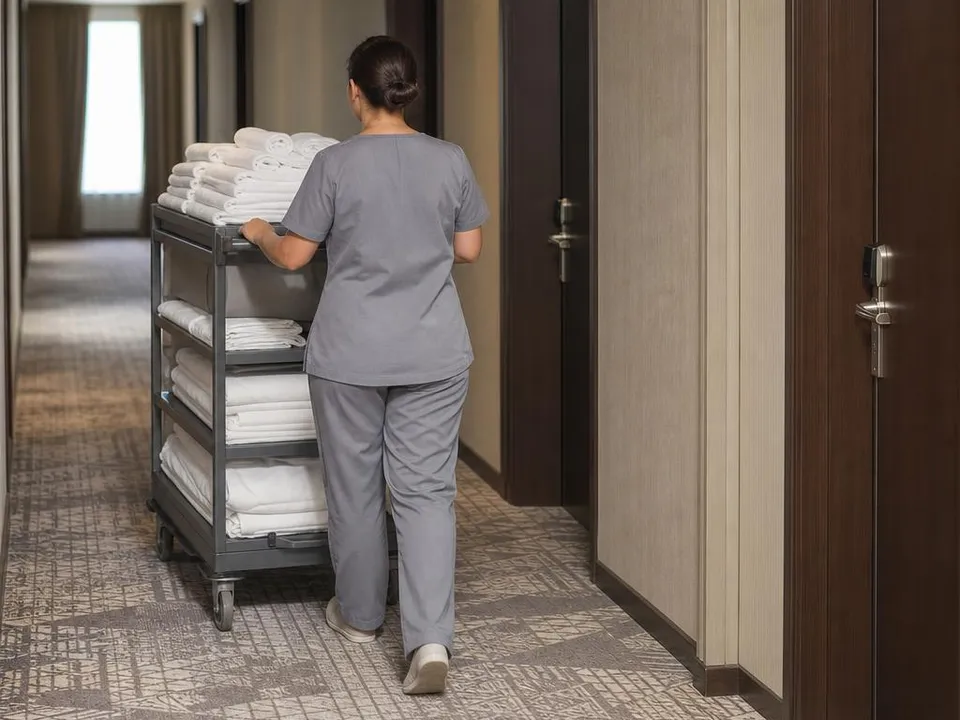
Which OSHA rules cover an on-site hotel laundry?
OSHA's laundry machinery standard (29 CFR 1910.264) covers the moving parts of laundry equipment and conditions particular to laundries, but not dry cleaning. Its main checks for a hotel laundry room:
| Item | What to check | Paragraph |
|---|---|---|
| Washers | A means of holding the doors or covers of the inner and outer cylinders open while loading and unloading. | (c)(1)(ii)(b) |
| Drying tumblers | The same hold-open means on dryer doors and covers. | (c)(2)(iii)(b) |
| Steam pipes | Pipes within 7 feet of the floor or platform that staff could touch are insulated, covered or guarded. | (c)(4)(iii)(a) |
| Soiled linen | Staff who handle soiled linen are warned not to touch their eyes, mouth or broken skin, and not to touch or eat food until they have washed their hands thoroughly. | (d)(1)(iii) |
| Instruction | Staff are taught the hazards and safe practices through bulletins, printed rules and verbal instruction. | (d)(1)(v) |
| Guards | Safeguards on machines are removed only for immediate repairs or adjustments and replaced as soon as the work is done. | (d)(2)(i)(a) |
Laundry staff also handle detergents and other chemicals, so add the laundry room to the hazard communication program and check the machines' lockout procedures for maintenance work.
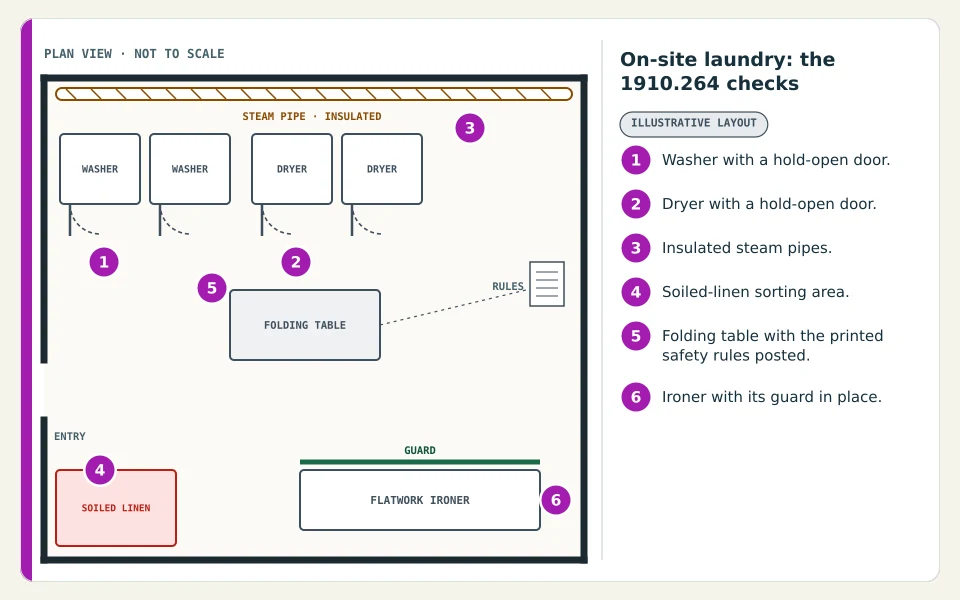
What does a hotel safety assessment example look like for the overnight front desk?
A fictional 80-room roadside hotel has one night auditor on duty from 11 p.m. to 7 a.m. Here is the worksheet entry for that shift.
| Worksheet field | Entry |
|---|---|
| Task | Running the front desk and night audit alone overnight, including late check-ins and cash handling. |
| Hazards | Robbery or assault at the desk; aggressive guests or visitors; no one nearby to help after an incident or a fall. |
| Existing controls | A camera at the desk; the main door left unlocked all night; cash counted at the counter. |
| Rating as found | Severe / Possible: High |
| Added controls | Lobby door on access control after midnight with a buzzer and a view of the entrance; a drop safe and a cash limit at the desk; a panic button connected to the monitoring company; scheduled check-ins with the on-call manager; training on calming tense situations. |
| Owner and check | General manager installs the equipment; tests the panic button and reviews the check-in record monthly. |
| Rating after controls | Severe / Unlikely: Medium |
An assault can still be severe, so only the likelihood falls. The hospitality safety guide covers more of what lodging and food service operations need to have in place.
Questions about the free Workplace Safety Assessment
Which hotel departments can be included?
Include employee job hazards across housekeeping, laundry, food service, maintenance, reception, events and other relevant work.
Can a small motel use it?
Yes. Include all jobs employees perform, especially where one person handles several roles or works alone.
Should outsourced housekeeping be included?
Review how the work interacts with the premises and clarify relevant responsibilities with the employer providing the service.
Does the assessment include handling and repeated strain?
Yes. Review force, posture, repetition, push or pull tasks, equipment and work organization in the actual job.
Is room turnover a good fit for a job hazard analysis (JHA)?
It can be. Turning over a guest room involves lifting mattresses, using chemicals and pushing a cart, so a job hazard analysis (JHA) that walks through each step can help. The Workplace Safety Assessment reviews every hotel department and shows where that detail is needed.
Ask for your free Workplace Safety Assessment
Tell us the jobs involved and the concerns you want reviewed. Our team will call you to arrange your free assessment.
Sources: NIOSH hotel worker safety; OSHA ergonomics; OSHA Small Business Safety and Health Handbook (self-inspection checklists); OSHA Job Hazard Analysis booklet; Cal/OSHA 8 CCR 3345 hotel housekeeping injury prevention; RCW 49.60.515 isolated employees; 29 CFR 1910.264 laundry machinery and operations; 29 CFR 1910.1030 bloodborne pathogens.
Related tools for specific tasks
These go deeper on one task or hazard. They support the broader job review; they do not replace it.
Workplace Safety Assessment for other industries
Each guide lists common jobs, hazard prompts and a printable worksheet for that kind of workplace.
- Manufacturing Workplace Safety AssessmentProduction, setup, jam clearing, maintenance and shutdowns.
- Warehouse Workplace Safety AssessmentReceiving, forklifts, racking, picking, docks and battery charging.
- Restaurant Workplace Safety AssessmentPrep, hot cooking, dishwashing, cold storage and closing shifts.
- Retail and Grocery Workplace Safety AssessmentDeliveries, stocking, box cutting, checkout and spill response.
- Office Workplace Safety AssessmentScreen work, storage, equipment, reception and office moves.
- Healthcare Workplace Safety AssessmentPatient handling, sharps, disinfection, equipment and shift work.
- Auto Repair Workplace Safety AssessmentVehicle lifts, tires, batteries, solvents, exhaust and refinishing.
- Cleaning and Janitorial Workplace Safety AssessmentCleaning chemicals, wet floors, floor machines, waste and lone work.
Published by OSHAMap, a product of GetAgenticApps LLC · 131 Continental Dr, Suite 305, Newark, DE 19713, United States.
OSHAMap is an independent service and is not affiliated with OSHA or any government agency. The review and worksheets are not an OSHA inspection, government approval or compliance certification. Spotted something to correct? Contact us.