
Free Healthcare Workplace Safety Assessment
Request a free Workplace Safety Assessment for the work performed by your healthcare team, the employee-focused review also called a workplace risk assessment. Send the form and our team will call you to arrange it. Identify job hazards, review existing controls and organize practical corrective actions across routine and nonroutine tasks.
Free assessment. No credit card required. Send the form and our team will call you to arrange it.
- Patient or material handling
- Sharps and potential blood exposure
- Cleaning and disinfection
- Medication or specialist preparation
- Equipment and maintenance
- Reception and care interaction
- Walking routes and storage
- Shifts and nonroutine situations
Request your free Workplace Safety Assessment
Six quick fields. Our team will call the number you give to arrange your free assessment.
- A call from our team to arrange your free assessment
- A review of your jobs, including cleaning and maintenance, and the controls that need attention
- Free printable job-hazard worksheets with your account
What happens after you send the form
- You send the form. No credit card is needed.
- Our team calls the phone number you give.
- Together we arrange your free Workplace Safety Assessment.
Meanwhile, you can print the job-hazard worksheet with your free account.
Staff jobs and exposures we help you review
| Job or task | Hazards to review |
|---|---|
| Patient or material handling | Force, awkward posture, equipment availability and actual handling arrangements. |
| Sharps and potential blood exposure | Exposure tasks, handling methods and applicable control procedures. |
| Cleaning and disinfection | Product identity, contact, airborne exposure and work methods. |
| Medication or specialist preparation | Task-specific substances and controls requiring appropriate specialist review. |
| Equipment and maintenance | Moving equipment, electricity, servicing and contractor interfaces. |
| Reception and care interaction | Worker violence concerns, escalation and communication. |
| Walking routes and storage | Spills, carts, cords, difficult storage and access. |
| Shifts and nonroutine situations | Staffing changes, unusual tasks, emergency roles and coordination. |
Use the job list as a starting point. Include workers, contractors and shifts that encounter different conditions. Add tasks or hazards that are missing, and keep unreviewed items open.
Keep the focus on employee occupational safety
A clinic, dental practice, care service and hospital department have different tasks. Include reception, housekeeping, maintenance and agency workers where relevant. Review actual exposure tasks and the employer’s applicable programs. Record when bloodborne-pathogens, respiratory, hazardous-drug or other specialist requirements need separate attention; a broad worksheet cannot establish those matters by itself.
What the healthcare workplace assessment looks at for staff
For each job, identify who could be injured or exposed, how the harm could occur and what controls are already in place. Consider the severity and likelihood of harm and the people exposed when prioritizing actions. Record the basis for the priority instead of treating a number as an OSHA pass.
Use the review to build a job-hazard summary and action list. Record additional controls, owners, target dates and how the result will be checked. Where information is missing, identify the verification or specialist input needed.
Healthcare Workplace Safety Assessment example
Staff report difficult handling of mobile equipment between a storage area and treatment rooms. The assessment records the route, pushing forces, turning space and workers involved. The team reviews storage, suitable handling arrangements and maintenance issues, then verifies the change during normal work. Any related patient-care decisions remain with the responsible clinical team.
Free. Tell us the jobs and the concern you want reviewed, and our team will call you.
What to gather before the clinic or facility review
Describe the facility type, employee jobs and the concern you want reviewed. Bring nonconfidential task information and relevant procedures. Include cleaning, maintenance and support roles. Keep patient identifiers and clinical records out of a general assessment request.
The free request starts the review process: our team calls the number you give to arrange the assessment. Describe the main concern and the work involved so that call can cover it. Address immediate serious dangers through the responsible people without waiting for the appointment.
Record each staff task on the job-hazard worksheet
Record the workplace, task, people exposed, existing controls and further actions. The accompanying hazard screen covers fifteen categories, including equipment, chemicals, physical demands, health exposures, work organization and emergencies. Add other job-specific hazards and record why a category does not apply. Review findings after relevant changes and verify actions under actual working conditions.
This service focuses on employee safety. Clinical risk, patient treatment, HIPAA, cybersecurity and specialist exposure programs require their applicable processes.
The worksheet doubles as an OSHA self-inspection checklist for staff areas, sharps handling and cleaning rooms. OSHA’s Small Business Safety and Health Handbook presents self-inspection checklists as a starting point for identifying hazards; ours follows that approach but is not an OSHA form or an exposure control plan.
Free account needed. It opens a printable page; use your browser's Print or Save as PDF.
- Identified
- Not yet reviewed
- Not applicable + reason
- Machinery and energy
- Vehicles and mobile equipment
- Slips, trips and falls
- Electricity
- Chemicals
- Physical demands
- Noise and vibration
- Heat, cold and physical agents
- Biological hazards
- Fire and emergencies
- Restricted spaces
- Violence and lone work
- Work organization
- PPE gaps
- Additional job-specific hazards
Plus a job register and an additional-hazards field. A category left blank stays open; it never counts as a pass.
How do you carry out a workplace safety assessment in a clinic or care facility?
This assessment is about the staff, not patient care decisions. Work through the facility in this order:
- List every job class, including front desk, clinical staff, environmental services, laundry, maintenance, transport and contractors.
- For each job, note contact with blood or other potentially infectious materials, sharps, patient handling, chemicals such as disinfectants, and contact with aggressive patients or visitors.
- Walk exam and treatment rooms, corridors, soiled utility rooms, storage and waiting areas during a normal clinic session.
- Read the recent injury records and sharps injury entries, and ask staff about near misses and verbal threats that may not have been written up.
- Check the written programs that apply, such as the bloodborne pathogens exposure control plan, against what happens in the rooms.
- Rate each hazard, involve the frontline staff who do the task in choosing fixes, and re-check during a busy session.
What should a bloodborne pathogens checklist cover in a medical or dental office?
Where employees have occupational exposure, the federal bloodborne pathogens standard (29 CFR 1910.1030) drives much of the assessment. Five checks from the text:
- An exposure determination that lists the job classifications and tasks with occupational exposure, made without taking PPE into account (paragraph (c)(2)).
- The exposure control plan reviewed and updated at least once a year, and whenever tasks, procedures or positions with exposure change (paragraph (c)(1)(iv)).
- A yearly, documented consideration of commercially available safer medical devices, such as safety-engineered needles and needleless systems (paragraph (c)(1)(iv)(B)).
- Input sought from non-managerial staff in direct patient care when choosing engineering and work practice controls, with the request for input documented in the plan (paragraph (c)(1)(v)).
- A sharps injury log, for employers that must keep OSHA injury records under 29 CFR Part 1904, showing the device type and brand, the work area and how each incident happened (paragraph (h)(5)).
Dental practices and senior living communities face the same standard wherever staff are exposed; see the dental and senior living guides for their wider requirements.
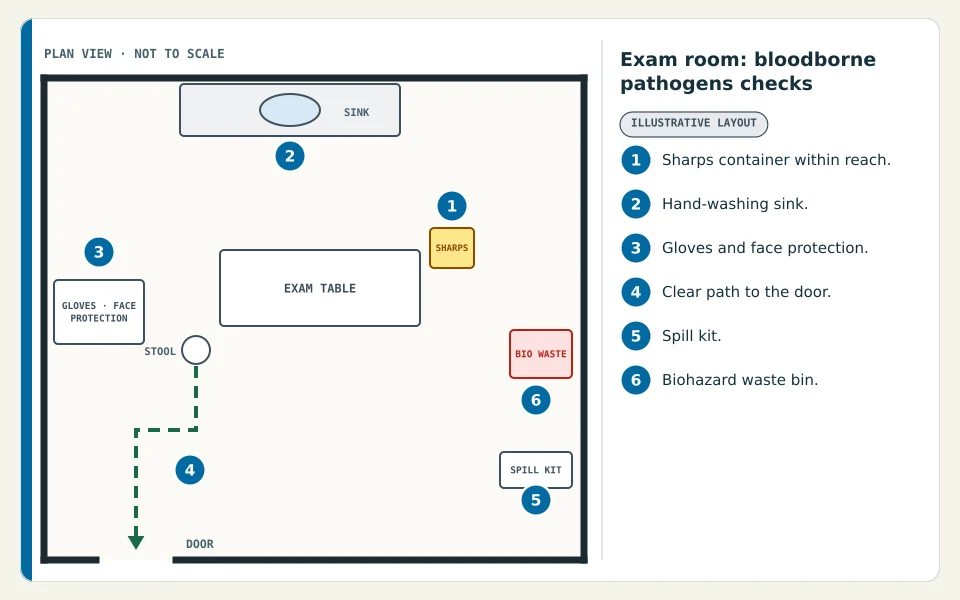
How should a facility assess safe patient handling risks?
OSHA's safe patient handling guidance attributes caregiver injuries in large part to overexertion from repeated manual patient handling, such as heavy lifting during transfers and repositioning, often in awkward postures. The assessment should list the high-risk tasks it names, for example moving a patient from toilet to chair, chair to bed or bathtub to chair, and repositioning or lifting a patient in bed.
Two states turn that into written requirements:
- California: general acute care hospitals need a patient protection and health care worker back and musculoskeletal injury prevention plan as part of their Injury and Illness Prevention Program, including a safe patient handling policy that replaces manual lifting and transferring with powered transfer devices, lifting devices and lift teams, as appropriate for the specific patient and consistent with the employer's safety policies and the registered nurse's professional judgment and clinical assessment (8 CCR 5120).
- Minnesota: hospitals, outpatient surgical centers and nursing homes need a written ergonomics program that is assessed every year (Minn. Stat. 182.677).
For each high-risk task, record which device or team is available, whether it reaches the room where it is needed, and whether staff have been trained on it.

What should a healthcare workplace violence assessment include?
OSHA's guidelines for preventing workplace violence for healthcare and social service workers (OSHA 3148) organize a program around five elements, each of which gives the assessment a question to answer:
- Management commitment and worker participation: who owns the program, and how frontline staff take part.
- Worksite analysis: where and when incidents and threats happen, from records and staff surveys.
- Hazard prevention and control: the physical and work-practice measures, such as alarms, room layout, staffing and visitor rules.
- Safety and health training: what staff learn about warning signs, de-escalation and getting help.
- Recordkeeping and program evaluation: how incidents are logged and the program is reviewed.
In California, health facilities, home health and home-based hospice, emergency medical and transport services, drug treatment programs and outpatient medical services for incarcerated people are covered by 8 CCR 3342, which requires a workplace violence prevention plan reviewed with employees at least once a year and refresher training at least once a year. Health facilities there are those that admit people for stays of 24 hours or more, plus hospital-based outpatient clinics; a stand-alone clinic outside that definition should check Labor Code 6401.9 instead.
What does a healthcare safety assessment example look like for needlesticks in a clinic?
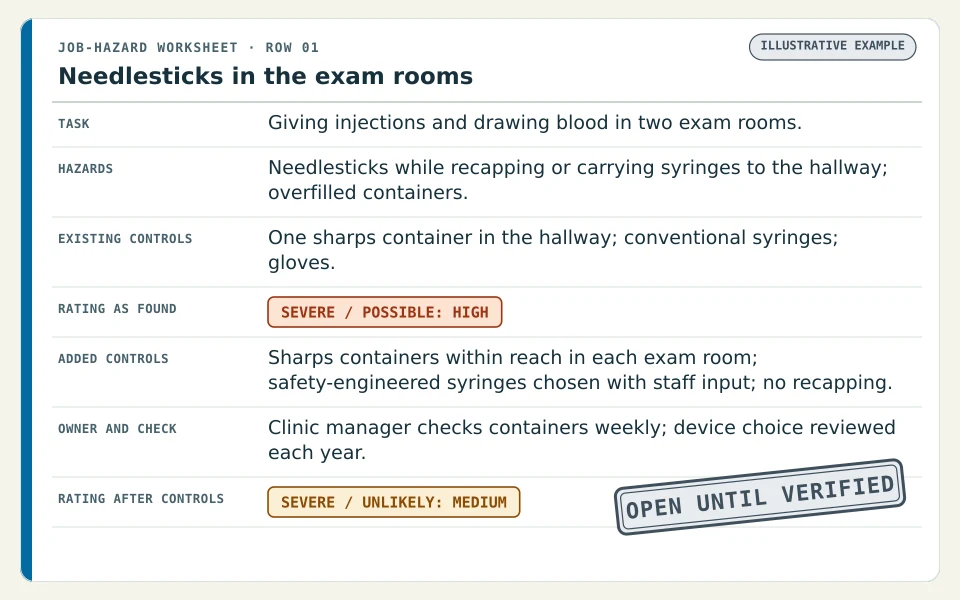
A fictional two-room family clinic draws blood and gives injections every day. The entry below shows the needlestick hazard before and after changes.
| Worksheet field | Entry |
|---|---|
| Task | Giving injections and drawing blood in two exam rooms. |
| Hazards | Needlesticks while recapping or while carrying used syringes to a container in the hallway; overfilled sharps containers. |
| Existing controls | One sharps container in the hallway; conventional syringes from the previous supplier; gloves. |
| Rating as found | Severe / Possible: High |
| Added controls | Wall-mounted sharps containers within reach in each exam room; safety-engineered syringes chosen with input from the nurses and medical assistants who use them, recorded in the exposure control plan; a no-recapping rule; containers swapped at the fill line. |
| Owner and check | Clinic manager checks containers weekly; the sharps injury log and device choice are reviewed at the yearly plan update. |
| Rating after controls | Severe / Unlikely: Medium |
A needlestick can still carry a serious infection risk, so severity does not move. The yearly safer-device review keeps the likelihood under watch. The healthcare safety guide has more on clinic requirements.
Questions about the free Workplace Safety Assessment
Is this a patient clinical risk assessment?
No. The focus is employee occupational safety during the work performed at the facility.
Can a dental or medical office use it?
Yes. Adapt the task list to your services, support work and actual employee exposures.
Does the worksheet replace an exposure control plan?
No. Employers subject to specific exposure-control or other program requirements must address those requirements separately.
Should cleaners and contractors be included?
Include their relevant tasks and how their work interacts with employees, equipment and the facility’s responsibilities.
Can a job hazard analysis (JHA) help with one staff task?
Yes. A job hazard analysis (JHA) can break a task such as sharps disposal or moving a supply cart into steps, with the hazard and the control at each one. The Workplace Safety Assessment looks at all staff tasks first and points to those that need that detail.
Ask for your free Workplace Safety Assessment
Tell us the jobs involved and the concerns you want reviewed. Our team will call you to arrange your free assessment.
Sources: OSHA healthcare workers; OSHA bloodborne pathogens; OSHA Small Business Safety and Health Handbook (self-inspection checklists); OSHA Job Hazard Analysis booklet; 29 CFR 1910.1030 bloodborne pathogens; OSHA safe patient handling; Cal/OSHA 8 CCR 5120 health care worker injury prevention; Minn. Stat. 182.677 (ergonomics programs); OSHA 3148 workplace violence guidelines for healthcare; Cal/OSHA 8 CCR 3342 workplace violence in health care; California Labor Code 6401.9 workplace violence prevention.
Related tools for specific tasks
These go deeper on one task or hazard. They support the broader job review; they do not replace it.
Workplace Safety Assessment for other industries
Each guide lists common jobs, hazard prompts and a printable worksheet for that kind of workplace.
- Manufacturing Workplace Safety AssessmentProduction, setup, jam clearing, maintenance and shutdowns.
- Warehouse Workplace Safety AssessmentReceiving, forklifts, racking, picking, docks and battery charging.
- Restaurant Workplace Safety AssessmentPrep, hot cooking, dishwashing, cold storage and closing shifts.
- Retail and Grocery Workplace Safety AssessmentDeliveries, stocking, box cutting, checkout and spill response.
- Office Workplace Safety AssessmentScreen work, storage, equipment, reception and office moves.
- Auto Repair Workplace Safety AssessmentVehicle lifts, tires, batteries, solvents, exhaust and refinishing.
- Cleaning and Janitorial Workplace Safety AssessmentCleaning chemicals, wet floors, floor machines, waste and lone work.
- Hotel Workplace Safety AssessmentHousekeeping, laundry, kitchens, maintenance and guest contact.
Published by OSHAMap, a product of GetAgenticApps LLC · 131 Continental Dr, Suite 305, Newark, DE 19713, United States.
OSHAMap is an independent service and is not affiliated with OSHA or any government agency. The review and worksheets are not an OSHA inspection, government approval or compliance certification. Spotted something to correct? Contact us.