
Free Auto Repair Shop Workplace Safety Assessment
Request a free Workplace Safety Assessment for the work in your repair shop, also known as an auto shop workplace risk assessment. Send the form and our team will call you to arrange it. Identify job hazards, review existing controls and organize practical corrective actions across routine and nonroutine tasks.
Free assessment. No credit card required. Send the form and our team will call you to arrange it.
- Vehicle intake and movement
- Lifting and working beneath vehicles
- Tire and wheel work
- Mechanical servicing
- Electrical and battery work
- Solvents, fluids and exhaust
- Body repair or refinishing
- Cleanup and unusual repairs
Request your free Workplace Safety Assessment
Six quick fields. Our team will call the number you give to arrange your free assessment.
- A call from our team to arrange your free assessment
- A review of your jobs, including cleaning and maintenance, and the controls that need attention
- Free printable job-hazard worksheets with your account
What happens after you send the form
- You send the form. No credit card is needed.
- Our team calls the phone number you give.
- Together we arrange your free Workplace Safety Assessment.
Meanwhile, you can print the job-hazard worksheet with your free account.
Service bay, lift and refinishing jobs we help you review
| Job or task | Hazards to review |
|---|---|
| Vehicle intake and movement | Reversing, pedestrians, visibility and work around moving vehicles. |
| Lifting and working beneath vehicles | Support arrangements, equipment condition and tasks under a raised load. |
| Tire and wheel work | Stored pressure, moving components, handling and equipment instructions. |
| Mechanical servicing | Moving parts, hot components, stored energy and unexpected startup. |
| Electrical and battery work | Electrical energy, battery chemistry and vehicle-specific procedures. |
| Solvents, fluids and exhaust | Product identity, skin contact, airborne exposure and ventilation questions. |
| Body repair or refinishing | Dust, welding fumes, coating products and specialist exposure controls. |
| Cleanup and unusual repairs | Spills, waste, sharp material, unfamiliar equipment and maintenance. |
Use the job list as a starting point. Include workers, contractors and shifts that encounter different conditions. Add tasks or hazards that are missing, and keep unreviewed items open.
Separate service jobs from refinishing work
A mechanical repair bay and a spray-refinishing task can present very different exposure questions. Identify the operations your shop actually performs. Bring equipment instructions and current manufacturer SDS for relevant products. Record when vehicle technology or a task requires specialist competence. Do not infer lift capacity, atmosphere safety or electrical isolation from a general checklist.
What the shop assessment looks at for each repair task
For each job, identify who could be injured or exposed, how the harm could occur and what controls are already in place. Consider the severity and likelihood of harm and the people exposed when prioritizing actions. Record the basis for the priority instead of treating a number as an OSHA pass.
Use the review to build a job-hazard summary and action list. Record additional controls, owners, target dates and how the result will be checked. Where information is missing, identify the verification or specialist input needed.
Auto repair and body shop Workplace Safety Assessment example
Technicians carry out an unfamiliar repair involving a raised vehicle and a new battery system. The assessment identifies the tasks, equipment information, energy sources and people who need to verify the arrangements. Work is referred to the appropriate responsible people before relying on a previous repair method. The record identifies the unresolved information and who will close it.
Free. Tell us the jobs and the concern you want reviewed, and our team will call you.
What to gather before the shop review
List the services offered, vehicle types, lifting or tire equipment, body work and products used. Include unfamiliar jobs and repairs performed outside routine procedures. Bring worker concerns, equipment instructions, maintenance records and relevant existing task analyses.
The free request starts the review process: our team calls the number you give to arrange the assessment. Describe the main concern and the work involved so that call can cover it. Address immediate serious dangers through the responsible people without waiting for the appointment.
Record each bay and refinishing task on the worksheet
Record the workplace, task, people exposed, existing controls and further actions. The accompanying hazard screen covers fifteen categories, including equipment, chemicals, physical demands, health exposures, work organization and emergencies. Add other job-specific hazards and record why a category does not apply. Review findings after relevant changes and verify actions under actual working conditions.
The review does not certify a vehicle lift, authorize high-voltage work or establish that airborne exposures are controlled. Record required technical verification separately.
Use the worksheet as an OSHA self-inspection checklist for bays, lifts, tire areas and the paint booth. OSHA’s Small Business Safety and Health Handbook describes self-inspection checklists as a starting point for identifying hazards; this one is OSHAMap’s own and is not an OSHA form.
Free account needed. It opens a printable page; use your browser's Print or Save as PDF.
- Identified
- Not yet reviewed
- Not applicable + reason
- Machinery and energy
- Vehicles and mobile equipment
- Slips, trips and falls
- Electricity
- Chemicals
- Physical demands
- Noise and vibration
- Heat, cold and physical agents
- Biological hazards
- Fire and emergencies
- Restricted spaces
- Violence and lone work
- Work organization
- PPE gaps
- Additional job-specific hazards
Plus a job register and an additional-hazards field. A category left blank stays open; it never counts as a pass.
How do you complete a workplace safety assessment for an auto repair shop?
Each bay runs different jobs through the day, so organize the review around the equipment and the jobs rather than the floor space. One approach:
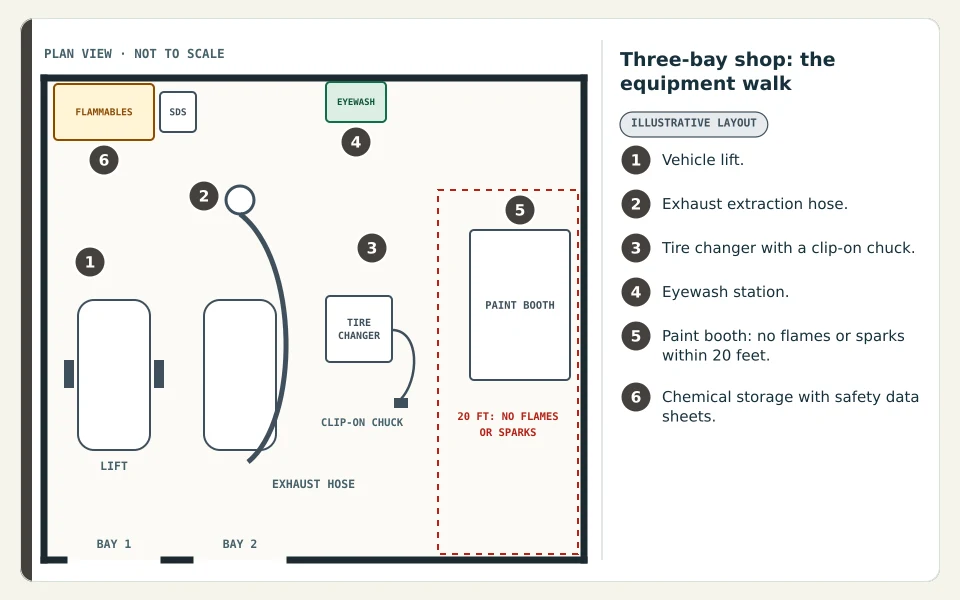
- List the equipment: lifts, jacks and stands, tire changers and balancers, compressors, grinders, welders, parts washers, the paint booth and any battery charging area.
- List the jobs the shop takes on, from oil changes and brakes to tires, exhaust, electrical, welding and refinishing, and note which ones are only done occasionally.
- Check how vehicles get in and out: running engines indoors, test drives across the lot, and customers wandering into the bays.
- Look at the chemicals: brake cleaner, solvents, used oil, antifreeze, battery acid and paint products, with their safety data sheets and storage.
- Ask each technician about near misses with lifts, tires and hot parts, and about the jobs they dislike doing.
- Rate the hazards, fix the high ones first, and confirm the changes on real jobs: the next lift set-up, tire job and paint run.
How should a repair shop control carbon monoxide and chemical exposure?
Engines running indoors bring carbon monoxide into the bays. OSHA's permissible exposure limit for carbon monoxide is 50 parts per million as an eight-hour time-weighted average (29 CFR 1910.1000, Table Z-1). Points to check on the walk:
- A tailpipe exhaust extraction hose reaches every bay where engines run, and staff actually connect it.
- Ventilation still works with the bay doors shut in cold weather; open doors are not the only control.
- Engine starts during diagnosis are kept short, and no vehicle idles while waiting in the bays.
- Every container is labeled, including bottles filled from bulk drums, unless it is only for the immediate use of the technician who filled it (29 CFR 1910.1200(f)(6) and (f)(8)).
- A safety data sheet is on hand for each product, and staff can get to them during their shift (29 CFR 1910.1200(g)(8)).
- Eyes or skin could meet battery acid or other corrosives, so a quick-drench or eye-flushing station sits within the work area (29 CFR 1910.151(c)).
A portable carbon monoxide monitor is a useful way to check that the extraction is working, but it does not replace the hose.
Which rules apply to spray painting in an auto body shop?
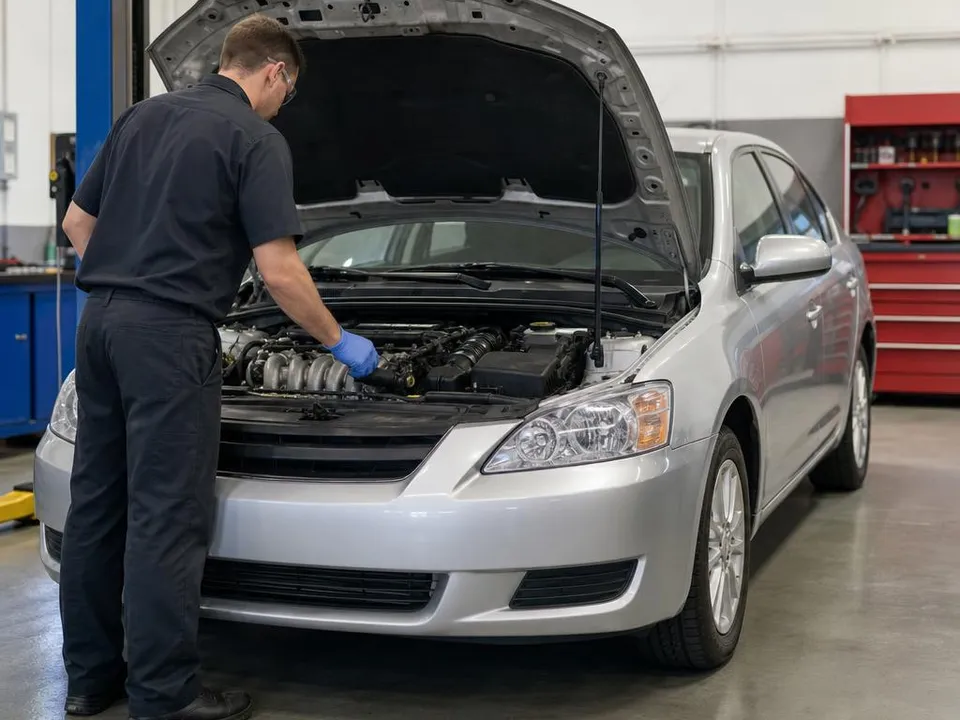
Refinishing pulls in both workplace safety rules and an environmental air rule, so the assessment should keep them apart:
| Rule | Agency | What it requires |
|---|---|---|
| 29 CFR 1910.107(c)(2) | OSHA | No open flame or spark-producing equipment in a spraying area or within 20 feet of it, unless separated by a partition. |
| 29 CFR 1910.107(c)(3) | OSHA | No space heaters, steam pipes or hot surfaces in a spraying area where combustible residues may build up. |
| 29 CFR 1910.134(c)(1) | OSHA | A written respiratory protection program with worksite-specific procedures wherever respirators are necessary. |
| 29 CFR 1910.132(d) | OSHA | A hazard assessment for PPE, with a written certification. |
| 40 CFR part 63, subpart HHHHHH (63.11173(e)) | EPA (environmental air rule) | Painters trained and certified; coatings sprayed in a booth, prep station or enclosure with filters that capture at least 98 percent of overspray; HVLP or equivalent spray guns; guns cleaned without atomizing solvent outside a collecting container. |
The EPA rule is about air emissions, not worker protection, and your state air agency may be the one that administers it. A shop can meet it and still have respirator or fire problems, so check both sets of rules.
How would an auto repair safety assessment rate seating and inflating tires?
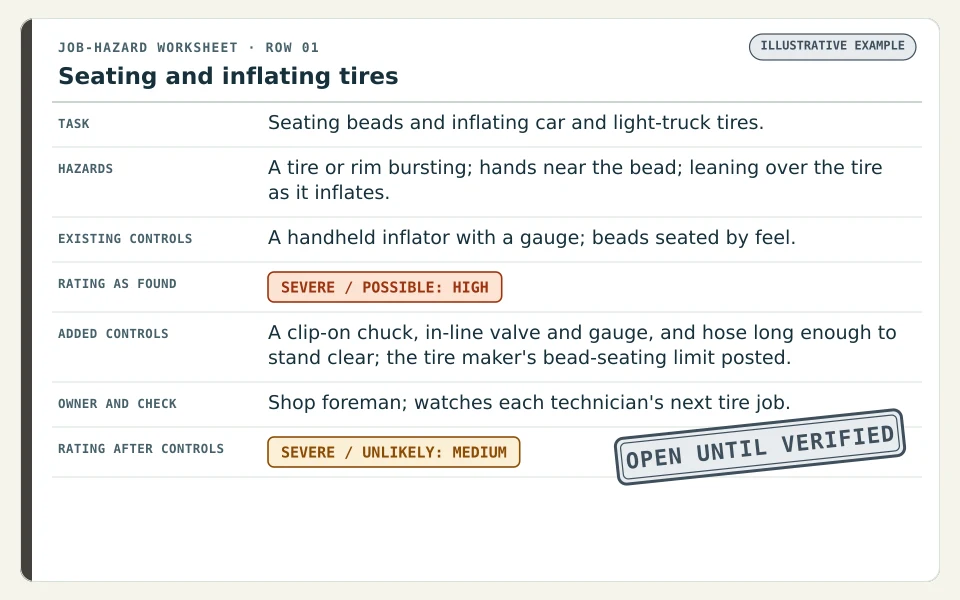
A fictional neighborhood garage fits tires on cars and light trucks. OSHA's rim wheel standard (29 CFR 1910.177) does not apply to automobile tires or LT-designated truck tires, but the burst hazard is still there, so it goes on the worksheet.
| Worksheet field | Entry |
|---|---|
| Task | Seating beads and inflating car and light-truck tires at the tire changer. |
| Hazards | A tire or rim bursting during bead seating or inflation; hands near the bead; a technician leaning over the tire while it inflates. |
| Existing controls | A handheld inflator with a gauge; technicians seat beads by feel. |
| Rating as found | Severe / Possible: High |
| Added controls | The air-line set-up 1910.177 requires for large-vehicle wheels, used here by choice: a clip-on chuck, an in-line valve with a gauge and enough hose to stand outside the trajectory; the tire maker's bead-seating limit posted at the changer; damaged tires and rims set aside rather than forced; large-vehicle rim wheels, which the standard does cover, turned away until the shop has its restraining device, charts or rim manuals and training. |
| Owner and check | Shop foreman fits the chuck and posts the limit; watches each technician on their next tire job. |
| Rating after controls | Severe / Unlikely: Medium |
Standing out of the trajectory of a burst is what moves the likelihood. The automotive safety guide covers more of what a shop is expected to have in place.
What do Washington and California require of a repair shop safety program?
In Washington, the accident prevention program includes a safety orientation for new staff (WAC 296-800-14005). For a shop that means walking each new technician through:
- A description of the whole safety and health program.
- What they need to know to do their first assignments safely, shown on the job.
- How and when to report injuries, and where the first-aid supplies are.
- How to report unsafe conditions and practices.
- Using and caring for the PPE the job requires.
- What to do in an emergency, including how to leave the building.
- Which hazardous gases, chemicals and materials they will handle, how to use them safely and what to do after an accidental exposure.
Washington also requires a safety committee or safety meetings: larger employers need a committee, while smaller ones can hold meetings with a management representative present (WAC 296-800-130). In California, the Injury and Illness Prevention Program (8 CCR 3203) calls for training for new employees, for anyone given a job they have not been trained for, and whenever new substances, processes, procedures or equipment bring a new hazard, such as a new lift or a change of paint system.
Questions about the free Workplace Safety Assessment
Does this include auto body and paint hazards?
Include those operations if the shop performs them. Refinishing may require additional exposure evaluation and specialist controls beyond a general repair checklist.
Can an independent garage use the assessment?
Yes. Adapt it to the actual services, equipment, vehicles and tasks performed by your employees.
Should electric or hybrid vehicle tasks be identified?
Yes. Identify vehicle-specific work, energy sources and the relevant competence and procedures for separate review.
Does a completed form approve a lift or tire machine?
No. Required equipment checks, instructions, condition and task suitability must be verified through the appropriate process.
Which shop jobs suit a job hazard analysis (JHA)?
Tasks with several hazardous steps, such as mounting a split-rim tire or replacing a hybrid battery, suit a job hazard analysis (JHA) that goes step by step. The Workplace Safety Assessment covers the whole shop and identifies those tasks.
Ask for your free Workplace Safety Assessment
Tell us the jobs involved and the concerns you want reviewed. Our team will call you to arrange your free assessment.
Sources: OSHA auto repair publications; OSHA autobody hazards; OSHA Small Business Safety and Health Handbook (self-inspection checklists); OSHA Job Hazard Analysis booklet; 29 CFR 1910.1000 Table Z-1 (carbon monoxide); 29 CFR 1910.1200 hazard communication; 29 CFR 1910.151 medical services and first aid; 29 CFR 1910.107 spray finishing; 29 CFR 1910.134 respiratory protection; 29 CFR 1910.132 PPE general requirements; 40 CFR 63.11173 (EPA auto body refinishing rule); EPA paint stripping and surface coating area source rule; 29 CFR 1910.177 servicing rim wheels; WAC 296-800-14005 accident prevention program elements; WAC 296-800-130 safety committees and meetings; Cal/OSHA 8 CCR 3203 injury and illness prevention program.
Related tools for specific tasks
These go deeper on one task or hazard. They support the broader job review; they do not replace it.
Workplace Safety Assessment for other industries
Each guide lists common jobs, hazard prompts and a printable worksheet for that kind of workplace.
- Manufacturing Workplace Safety AssessmentProduction, setup, jam clearing, maintenance and shutdowns.
- Warehouse Workplace Safety AssessmentReceiving, forklifts, racking, picking, docks and battery charging.
- Restaurant Workplace Safety AssessmentPrep, hot cooking, dishwashing, cold storage and closing shifts.
- Retail and Grocery Workplace Safety AssessmentDeliveries, stocking, box cutting, checkout and spill response.
- Office Workplace Safety AssessmentScreen work, storage, equipment, reception and office moves.
- Healthcare Workplace Safety AssessmentPatient handling, sharps, disinfection, equipment and shift work.
- Cleaning and Janitorial Workplace Safety AssessmentCleaning chemicals, wet floors, floor machines, waste and lone work.
- Hotel Workplace Safety AssessmentHousekeeping, laundry, kitchens, maintenance and guest contact.
Published by OSHAMap, a product of GetAgenticApps LLC · 131 Continental Dr, Suite 305, Newark, DE 19713, United States.
OSHAMap is an independent service and is not affiliated with OSHA or any government agency. The review and worksheets are not an OSHA inspection, government approval or compliance certification. Spotted something to correct? Contact us.