Are Evacuation Drills Required?
OSHA does not explicitly mandate a specific drill frequency for most general industries. However, OSHA 1910.38 requires employers to train employees on emergency procedures, and drills are the most effective training method. Many state OSHA programs, fire codes (NFPA), and industry-specific standards DO require regular drills. Best practice is at least one drill per year.
Who Explicitly Requires Drills
- Healthcare facilities (Joint Commission requires annual drills)
- Schools and daycares (state requirements vary)
- High-rise buildings (local fire codes)
- HAZMAT facilities (29 CFR 1910.120)
- Construction sites with specific hazards
- Many state fire codes require annual drills for all businesses
Evacuation Drill Best Practices
- Announce the first drill; make subsequent drills unannounced
- Time the evacuation and record results
- Designate observers to identify problems
- Test alarm systems during drills
- Include all shifts and all employees
- Practice accounting for all personnel at assembly point
- Debrief after drill and document lessons learned
- Test alternate exit routes periodically
Drill Documentation Requirements
- Date and time of drill
- Type of drill (announced/unannounced)
- Total evacuation time
- Number of participants
- Problems observed
- Corrective actions taken
- Names of drill coordinators
- Weather conditions (for outdoor assembly)
How Maps Support Effective Drills
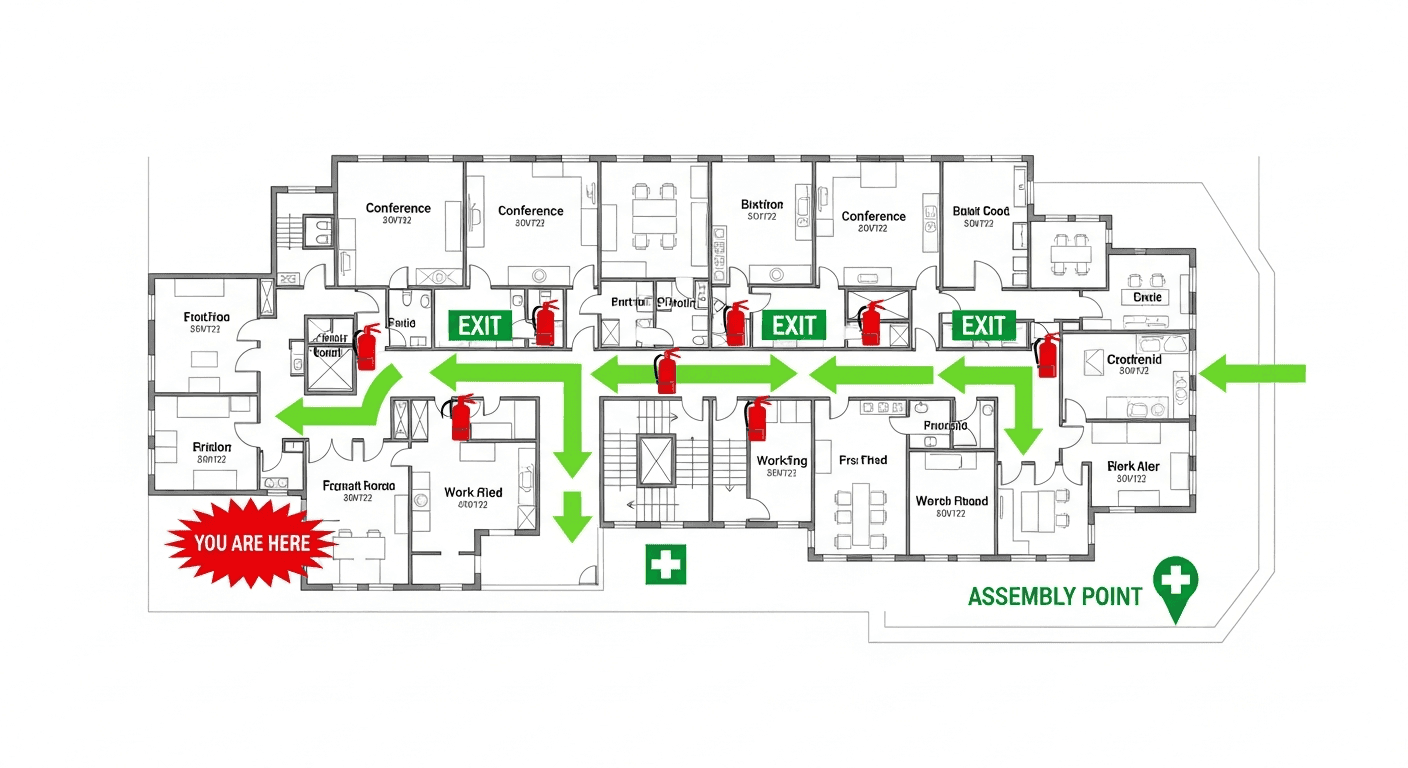
Evacuation maps are essential for effective drills. Before drills, review maps with employees to reinforce route knowledge. During drills, observers can compare actual evacuee paths to mapped routes. After drills, update maps if better routes are identified. Maps also help new employees prepare for drills by studying routes beforehand.
Evacuation Drill Statistics
Industry best practice is to evacuate any floor within 3 minutes
First-time drills typically improve by 40% after identifying bottlenecks
Two-thirds of small businesses fail to document their evacuation drills
Best practice recommends at least 2 drills per year: 1 announced, 1 surprise
Case Study: Drill Program Transformation
Challenge
A 500-employee office building had never conducted a full evacuation drill. When a small kitchen fire required actual evacuation, it took 18 minutes for full clearance, with employees using elevators and congregating in the parking garage blocking emergency vehicle access.
Solution
Management implemented quarterly drills with floor wardens, updated evacuation maps with clear stairwell assignments, designated a proper assembly point 150 feet from the building, and used stopwatch timing with floor-by-floor reporting.
Result
Evacuation time dropped from 18 minutes to 4 minutes 30 seconds over 4 drills. During a subsequent false alarm, the building evacuated in under 5 minutes with zero confusion. The company avoided potential liability and their insurance carrier reduced premiums.
Drill Documentation Warning
Undocumented drills provide ZERO legal protection. In the event of an injury or fatality during an actual emergency, you may need to prove that employees were properly trained. Courts and OSHA investigators will request drill records. If you cannot produce dated documentation showing drill times, participant counts, and corrective actions taken, you may face willful violation charges. Always document: date, time, duration, total participants, evacuation time, problems observed, and follow-up actions. Keep these records for at least 5 years.