⭐ Authority ContentEssential Guide

NFPA Evacuation Map Requirements

Master NFPA 101 Life Safety Code requirements for evacuation maps including means of egress, travel distances, exit capacity, and occupancy-specific standards.

0Life Safety Code
0Means of Egress
0Widely Adopted
View NFPA Checklist

Create maps meeting NFPA 101 and OSHA standards

πŸ›‘οΈOSHA Compliant
⭐10,000+ Maps Created
βœ…100% Satisfaction
πŸ”
You searched:"What are the NFPA requirements for evacuation maps?"

πŸ“„What is NFPA 101 Life Safety Code?

NFPA 101, the Life Safety Code, is the most widely adopted building safety standard in the United States. Published by the National Fire Protection Association since 1913, it establishes minimum requirements for means of egress, fire protection features, and emergency evacuation procedures. Unlike federal OSHA regulations, NFPA 101 is adopted at the state and local level, with all 50 states incorporating some version. The code is updated every three years, with the 2024 edition being the most current. Chapter 7 specifically addresses means of egress requirements that directly impact evacuation map design.

⚑NFPA 101 Chapter 7: Means of Egress

πŸ“–
7.2Egress Components

Defines doors, stairs, ramps, corridors, and exit passageways

πŸ“
7.3Capacity of Egress

Calculation methods for exit width and occupant load

🚢
7.4Number of Exits

Minimum exit requirements based on occupant load

πŸ“
7.5Arrangement of Exits

Remoteness and accessibility requirements

βœ“Required Elements on NFPA-Compliant Evacuation Maps

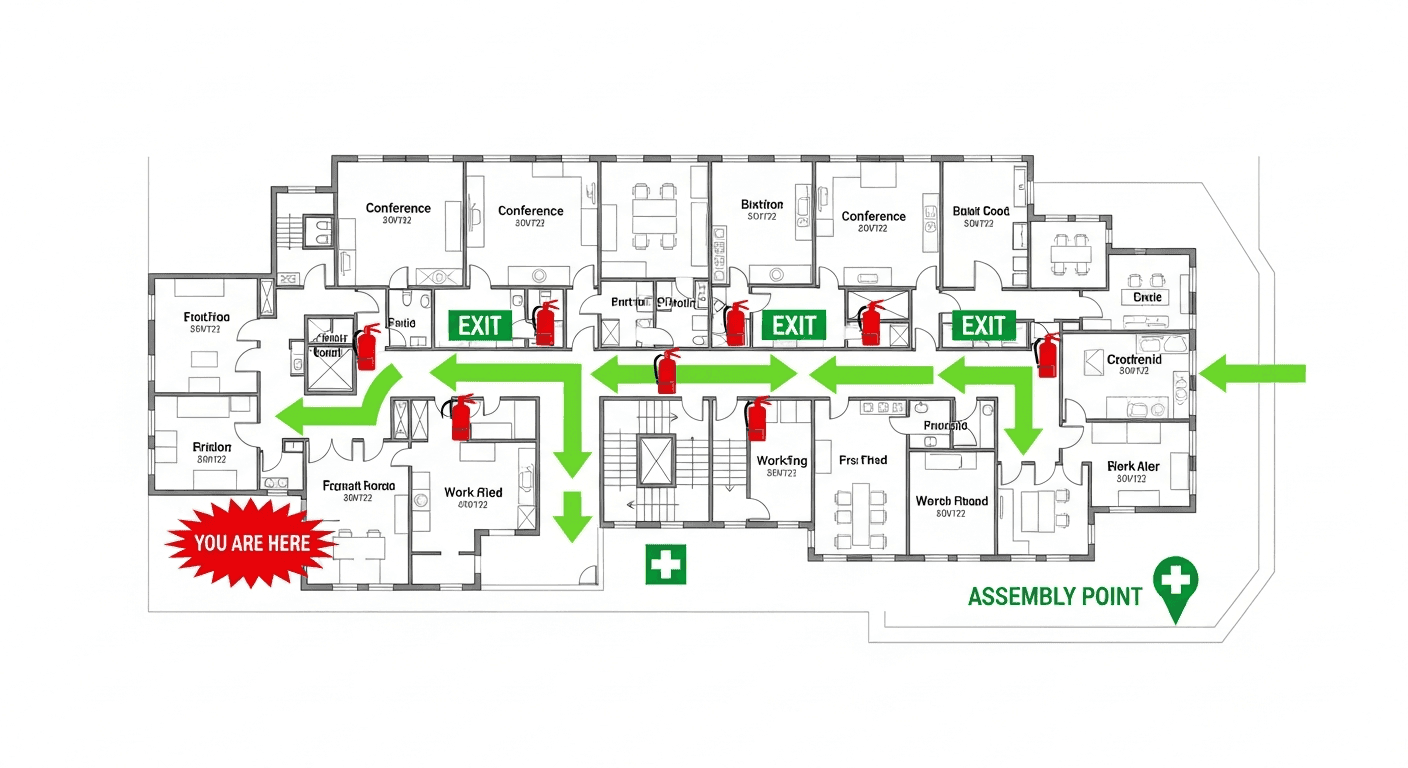
  • βœ“Primary and secondary means of egress routes (NFPA 101 Β§7.4)
  • βœ“Exit discharge locations to public way or area of refuge
  • βœ“Illuminated exit sign locations (NFPA 101 Β§7.10)
  • βœ“Emergency lighting coverage areas (90-minute backup required)
  • βœ“Fire extinguisher locations with type classification
  • βœ“Manual fire alarm pull station locations
  • βœ“Area of refuge locations for persons with disabilities
  • βœ“Assembly point designation at safe dispersal area
  • βœ“"You Are Here" marker at each posting location
  • βœ“Stairwell and elevator locations (elevators marked DO NOT USE)
  • βœ“Occupant load calculation for each space
  • βœ“Travel distance measurements to nearest exit

βš–οΈNFPA vs OSHA Requirements Comparison

FeatureType
Legal AuthorityNFPA: State/local adoption | OSHA: Federal law (29 CFR 1910)
Primary FocusNFPA: Building occupant safety | OSHA: Employee workplace safety
Enforcement AgencyNFPA: Fire marshal/AHJ | OSHA: Department of Labor inspectors
Scope of ProtectionNFPA: All building occupants | OSHA: Employees only
Travel DistanceNFPA: Specific by occupancy | OSHA: General guidance
Exit CapacityNFPA: Calculated per Β§7.3 | OSHA: Adequate for occupants
Emergency LightingNFPA: 90-min battery backup | OSHA: Required but less specific
Map PostingBoth require posted evacuation routes and diagrams

⚠️Travel Distance Requirements by Occupancy Type (NFPA 101)

ViolationMax Fine
Assembly (Sprinklered)250 ft max
Assembly (Non-sprinklered)200 ft max
Business (Sprinklered)300 ft max
Business (Non-sprinklered)200 ft max
Educational (Sprinklered)200 ft max
Healthcare (Sprinklered)200 ft max
Industrial (Sprinklered)250 ft max
Mercantile/Retail (Sprinklered)250 ft max
Storage (Sprinklered)400 ft max
High-Hazard75 ft max

πŸ“„Exit Capacity Calculations (NFPA 101 Β§7.3)

NFPA 101 Section 7.3 establishes minimum egress widths based on occupant load. For level egress components (doors, corridors), calculate 0.2 inches per person. For stairs, calculate 0.3 inches per person. Minimum door width is 32 inches clear; minimum corridor width is 44 inches. Example: A business occupancy with 200 occupants requires minimum total exit width of 40 inches (200 Γ— 0.2) for doors. Your evacuation map should reflect these calculations to ensure routes can accommodate your occupant load during emergency evacuation.

πŸ“‹NFPA 101 Occupancy-Specific Requirements (Chapters 10-42)

  • πŸ“‹Chapter 12-13: Assembly occupancies (theaters, restaurants, arenas) - strictest requirements
  • πŸ“‹Chapter 14-15: Educational occupancies (K-12 schools, daycare)
  • πŸ“‹Chapter 16-17: Day-care occupancies with specific child safety provisions
  • πŸ“‹Chapter 18-19: Healthcare occupancies with defend-in-place strategies
  • πŸ“‹Chapter 20-21: Ambulatory healthcare centers
  • πŸ“‹Chapter 22-23: Detention and correctional facilities
  • πŸ“‹Chapter 24-25: One and two-family dwellings
  • πŸ“‹Chapter 26-31: Residential occupancies (hotels, apartments, dormitories)
  • πŸ“‹Chapter 36-37: Mercantile (retail) occupancies
  • πŸ“‹Chapter 38-39: Business occupancies (offices)
  • πŸ“‹Chapter 40-42: Industrial and storage occupancies

πŸ“„Who Must Comply with NFPA 101?

NFPA 101 applies to virtually all occupied buildings when adopted by the local Authority Having Jurisdiction (AHJ). Specific compliance triggers include: all commercial buildings, multi-family residential properties, healthcare facilities (required by CMS/Joint Commission), educational institutions, places of assembly with occupant loads over 50, industrial and manufacturing facilities, and any building undergoing renovation or change of occupancy. Even if your local jurisdiction hasn't fully adopted NFPA 101, many insurance carriers require compliance for coverage. Federal agencies including HHS, VA, and GSA mandate NFPA 101 compliance for their facilities.

⚑NFPA 101 Key Facts

πŸ“…
1913First Published

Over 110 years as the building safety standard

πŸ›οΈ
50 StatesAdoption

All states adopt NFPA 101 in some form

πŸšͺ
32"Min Door Width

Minimum clear width for most egress doors

⏱️
90 minEmergency Lighting

Battery backup duration required

πŸ‘¨β€πŸ’Ό
Expert Tip

Expert Advice: Navigating NFPA Compliance

Robert Martinez, P.E., CFPSFire Protection Engineer, 20+ Years

The biggest compliance gap I see is businesses assuming OSHA compliance equals NFPA compliance. While they overlap, NFPA 101 often has stricter requirements, especially for assembly occupancies (restaurants, theaters), healthcare facilities, and high-rise buildings. Always check your local adopted edition - many jurisdictions still use 2018 or 2021 editions, not the latest 2024 version. Your evacuation maps should reference specific NFPA sections when documenting travel distances and exit capacities. Our AI tool automatically incorporates both OSHA and NFPA requirements, ensuring compliance with both standards.

πŸ’°NFPA-Compliant Map Cost Comparison

Traditional Consultant

$800-3,000 per map
2-4 weeks with revisions
⚠️

Important: Jurisdiction Variations

NFPA 101 adoption varies by jurisdiction. Some states adopt the code directly, others modify specific sections, and some adopt older editions. Always verify which edition applies by contacting your local fire marshal or building department. Your Authority Having Jurisdiction (AHJ) has final say on requirements. When in doubt, comply with the stricter standard between OSHA, NFPA, and local fire codes. Healthcare facilities must also meet CMS and Joint Commission requirements which reference NFPA 101.

❓

Frequently Asked Questions

NFPA 101 requires that means of egress be clearly identified and accessible to all building occupants. Evacuation maps must show primary and secondary exit routes, exit discharge locations, emergency lighting areas, fire equipment locations, areas of refuge, and assembly points. Maps should also reflect travel distance requirements and exit capacity calculations specific to your occupancy type as defined in Chapters 10-42.

While NFPA 101 doesn't use the specific word "map," it requires that means of egress be identified and that occupants can readily locate exits. Posted evacuation diagrams are the standard method for meeting these requirements. Section 7.1.10 requires emergency evacuation diagrams in certain occupancies, and fire marshals universally expect to see posted evacuation routes during inspections.

OSHA (29 CFR 1910.38) is federal law focused on employee workplace safety, while NFPA 101 is a model code adopted by states focusing on all building occupants. NFPA provides more specific requirements for travel distances, exit capacity calculations, and occupancy-specific provisions. Most facilities must comply with both - OSHA for employees and NFPA for the building itself.

Per NFPA 101 Section 7.3, calculate exit capacity using 0.2 inches per person for level components (doors, corridors) and 0.3 inches per person for stairs. Example: 200 occupants require minimum 40 inches total exit width for doors (200 Γ— 0.2). Minimum single door width is 32 inches clear. Your total exit capacity must accommodate your calculated occupant load.

Travel distances vary by occupancy and sprinkler status. Business occupancies allow 300 ft (sprinklered) or 200 ft (non-sprinklered). Assembly occupancies: 250 ft (sprinklered) or 200 ft (non-sprinklered). Healthcare: 200 ft (sprinklered). High-hazard occupancies: 75 ft maximum. Always verify your specific occupancy classification in NFPA 101 Chapters 10-42.

NFPA 101 organizes requirements by occupancy type in Chapters 10-42. Assembly (12-13), Educational (14-15), Healthcare (18-19), Residential (26-31), Mercantile/Retail (36-37), Business/Office (38-39), Industrial (40), and Storage (42). Mixed-use buildings must comply with the most restrictive requirements from all applicable chapters. Your local AHJ determines final classification.

NFPA 101 requires that egress information remain current. Update your evacuation maps immediately after any layout changes, renovations, or equipment relocations. Best practice is a quarterly review walk-through comparing maps to actual conditions. Many jurisdictions require annual re-certification. Maps must reflect the current adopted edition of NFPA 101 in your jurisdiction.

Yes. NFPA 101 Section 11.8 defines high-rise buildings (typically over 75 feet) and requires additional provisions: voice/alarm communication systems, automatic sprinkler protection, emergency lighting with extended duration, stairwell pressurization, areas of refuge on every floor, and elevator recall. Your evacuation maps must show all these features and floor-specific evacuation procedures.

πŸ“š
🎁Register for 5 Maps - Unlimited Revisions Free

Create Your OSHA-compliant Safety Map Now

Upload any floor plan and get a professional, OSHA-compliant evacuation map in under 60 seconds.

⚑Instant Results
πŸ“‹Print-Ready
βœ…OSHA Compliant
πŸ’°Save $1,000+

No credit card β€’ No account needed β€’ Unlimited revisions

Generate Your OSHA-Compliant Evacuation Map

Upload your floor plan and get a professional, compliant evacuation map in minutes.

πŸ“Š 5 of 5 Free Maps Left

Create Your Evacuation Map

πŸ“·
Clear ImageUse a clean, high-quality scan or photo
↔️
Correct OrientationImage should be right-side up, not rotated or sideways
πŸ”
No ZoomCapture the entire floor plan, avoid zooming in on sections
πŸ’‘
Good LightingThe clearer and less blurry, the better results
πŸ“

Drag & drop your floor plan here

or

PNG, JPG, PDF - Hand-drawn sketches work too!

πŸ”’Your files are private: never shared, stored temporarily, deleted automatically.

Compliance Options

Generate bilingual map with English + Spanish labels

ℹ️Adds Spanish translations (EspaΓ±ol) to all text on the map
πŸ”₯ NEW✨

Customize Your Map

Add special requests for your safety map - tell our AI exactly what you need!

  • 🎯Add specific details like "Mark fire extinguisher near kitchen"
  • πŸ“Request specific zones: "Highlight assembly point in parking lot"
  • πŸ₯Add safety equipment: "Include AED location near reception"
0/2000

Quick Add: