Understanding Evacuation Map Requirements
Evacuation maps are essential safety documents that guide employees and visitors to safety during emergencies. While OSHA and NFPA have different regulatory approaches, both require clear visualization of escape routes. OSHA focuses on workplace employee safety through 29 CFR 1910.38, while NFPA 101 (Life Safety Code) addresses building occupant safety more broadly. Meeting both standards ensures comprehensive protection and helps you pass inspections from fire marshals and OSHA compliance officers alike.
What OSHA Requires for Evacuation Maps
- Emergency escape routes and procedures clearly documented
- Posted evacuation diagrams in visible, high-traffic locations
- Routes that account for employees who remain for critical operations
- Designated assembly areas shown outside the building
- Procedures for accounting for all employees after evacuation
- Maps updated whenever floor layout or exit routes change
- Employee training on evacuation routes and map locations
What NFPA Requires for Evacuation Maps
- Primary and secondary means of egress clearly marked
- Travel distance to nearest exit indicated (varies by occupancy)
- Exit discharge locations shown to public way
- Illuminated exit sign placements documented
- Emergency lighting coverage areas identified
- Areas of refuge for persons with disabilities marked
- Occupant load calculations reflected in route capacity
What Must Appear on Every Evacuation Map
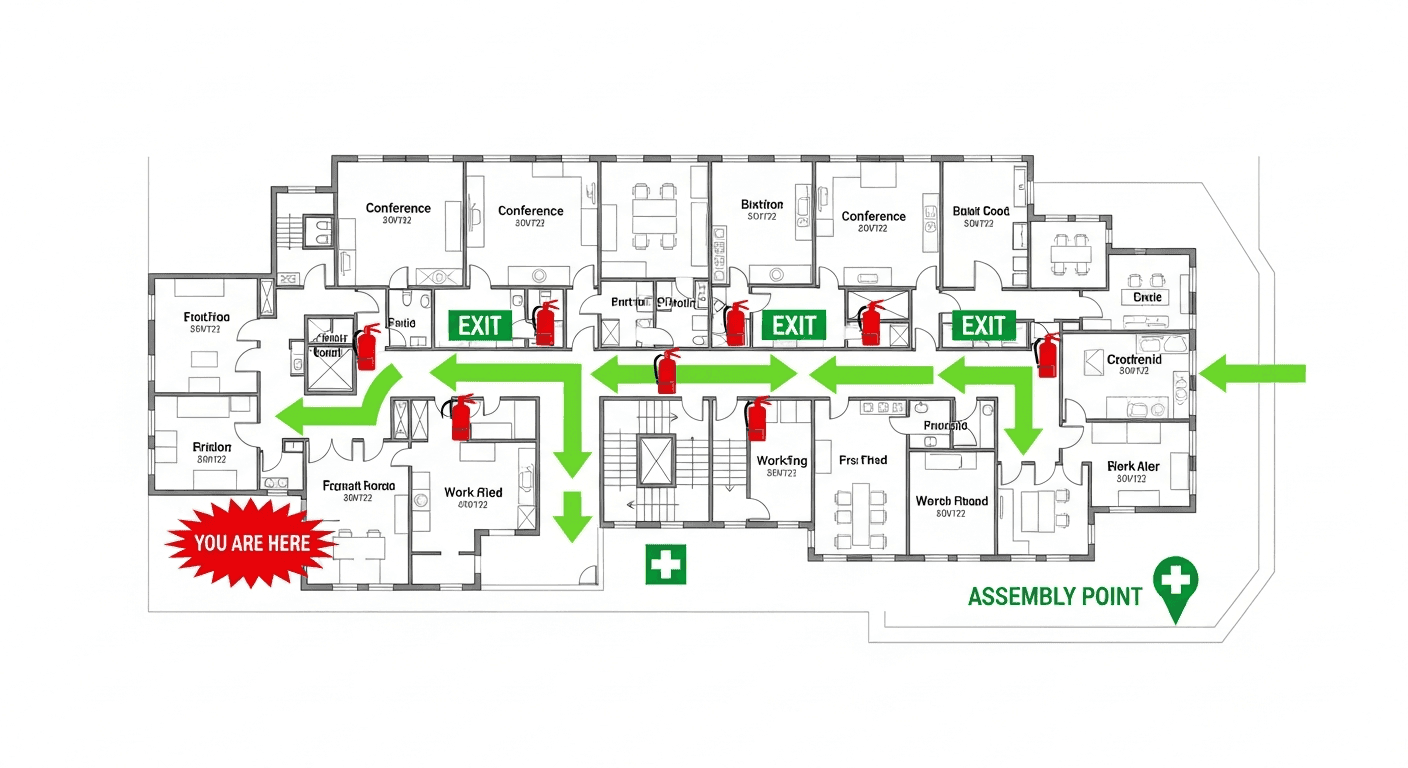
- "You Are Here" indicator at each posting location
- Primary evacuation routes with directional arrows
- Secondary or alternate evacuation routes
- All emergency exit doors with proper door symbols
- Fire extinguisher locations with red markers
- Fire alarm pull station locations
- First aid kit and AED locations
- Emergency assembly point outside building
- Stairwell locations (with floor numbers for multi-story)
- Elevators marked "DO NOT USE DURING FIRE"
- Legend explaining all symbols used
- Building name, floor number, and revision date
Requirements by Facility Type
Office Buildings
- Post maps at elevator lobbies and near break rooms
- Include conference rooms and common areas in route planning
- Mark ADA-accessible routes from all workstations
- Show multiple exits per floor (minimum 2 for most occupancies)
Warehouses
- Account for changing inventory blocking routes
- Mark forklift and equipment staging during evacuation
- Include loading dock exits where accessible
- Show chemical storage areas as potential hazards
Retail Stores
- Separate customer routes from employee-only paths
- Mark checkout areas that may cause bottlenecks
- Include stockroom evacuation through sales floor
- Post maps near fitting rooms and restrooms
Common Evacuation Map Mistakes
Avoid these frequent compliance failures: Using outdated floor plans that no longer match your layout. Missing the "You Are Here" marker at each posting location. Forgetting to mark ADA-accessible routes for employees with disabilities. Placing maps too high or low (should be 54-60 inches from floor). Using non-standard colors or unclear symbols. Never updating maps after renovations or furniture moves.
Evacuation Map Compliance Facts
Maps should be readable from at least 10 feet away
Recommended minimum for standard office areas
Best practice for walking routes and verifying accuracy
OSHA serious violation penalty for non-compliance
Set a calendar reminder for quarterly walk-throughs of your facility. Physically trace each evacuation route on your map to verify nothing has changed. This 15-minute investment can prevent costly OSHA citations and, more importantly, ensures your employees can evacuate safely when it matters most.