Did the Fire Marshal Ask You for an Evacuation Map?
If a fire inspection left you with a correction notice, you can fix it fast. Upload your inspection notice, floor plan, PDF, or a quick sketch and OSHAMap helps you build an editable evacuation map — exits, primary and alternate routes, the outside assembly point, and the "You Are Here" marker — so you have a clear draft to review and post before your reinspection.
No credit card. A photo of your floor plan or the posted map works too.
Got a fire inspection correction? Fix the evacuation map now.
Upload your inspection notice, floor plan, PDF, or sketch and generate an editable, print-ready evacuation map draft to review before your reinspection.
Built for businesses with a correction notice, a reinspection date, and not much time.
What Did Your Inspector Ask You to Correct?
Pick the line item that matches your correction notice. Each one jumps straight to the generator so you can start fixing it now. Not sure which applies? Choose "I am not sure" and build a complete draft to compare.
Build Your Correction Map Now
Upload your inspection notice, floor plan, PDF, or sketch — place your exits, routes, assembly point, and "You Are Here" marker — and export a print-ready draft to review before reinspection.
What OSHAMap Can Help You Put on the Map
A correction notice usually names a few missing items. A complete evacuation diagram addresses all of them at once, so you are not back for a third inspection.
Room & corridor layout
A clean plan of the floor — rooms, corridors, doors — that a person can read at a glance during an alarm.
Exits
Every usable exit marked and labeled, so the diagram matches the doors people will actually use.
Primary + alternate route
The nearest route to an exit plus a backup path in case the primary way out is blocked.
Assembly location
A designated outside meeting point, placed away from the building and out of the fire-apparatus lane.
You Are Here
An orientation marker matched to each posting spot so the routes read intuitively from that wall.
Extinguishers
Portable fire extinguisher locations marked for quick reference and to satisfy the cited line item.
Pull stations
Manual fire-alarm pull-station locations shown near exits and along egress paths.
AED / first aid
AED and first-aid station markers added when applicable to your occupancy.
Address + floor designation
Building address and floor label so the right map is posted on the right floor.
Legend
A symbol key so every marker on the map is unambiguous to a reader — and to the inspector.
Emergency instructions
Short, plain-language emergency steps that pair with your Emergency Action Plan.
Revision date
A dated draft you can regenerate after a remodel so the posted map never falls out of date again.
From Marked-Up Sketch to a Map an Inspector Can Read
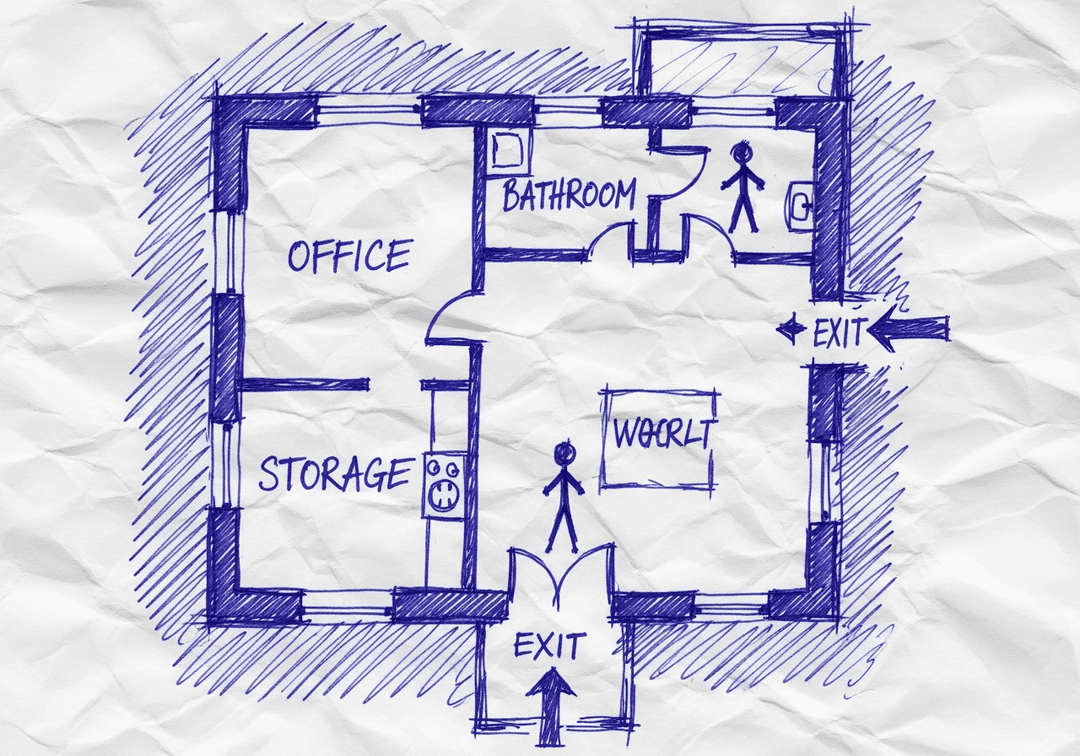
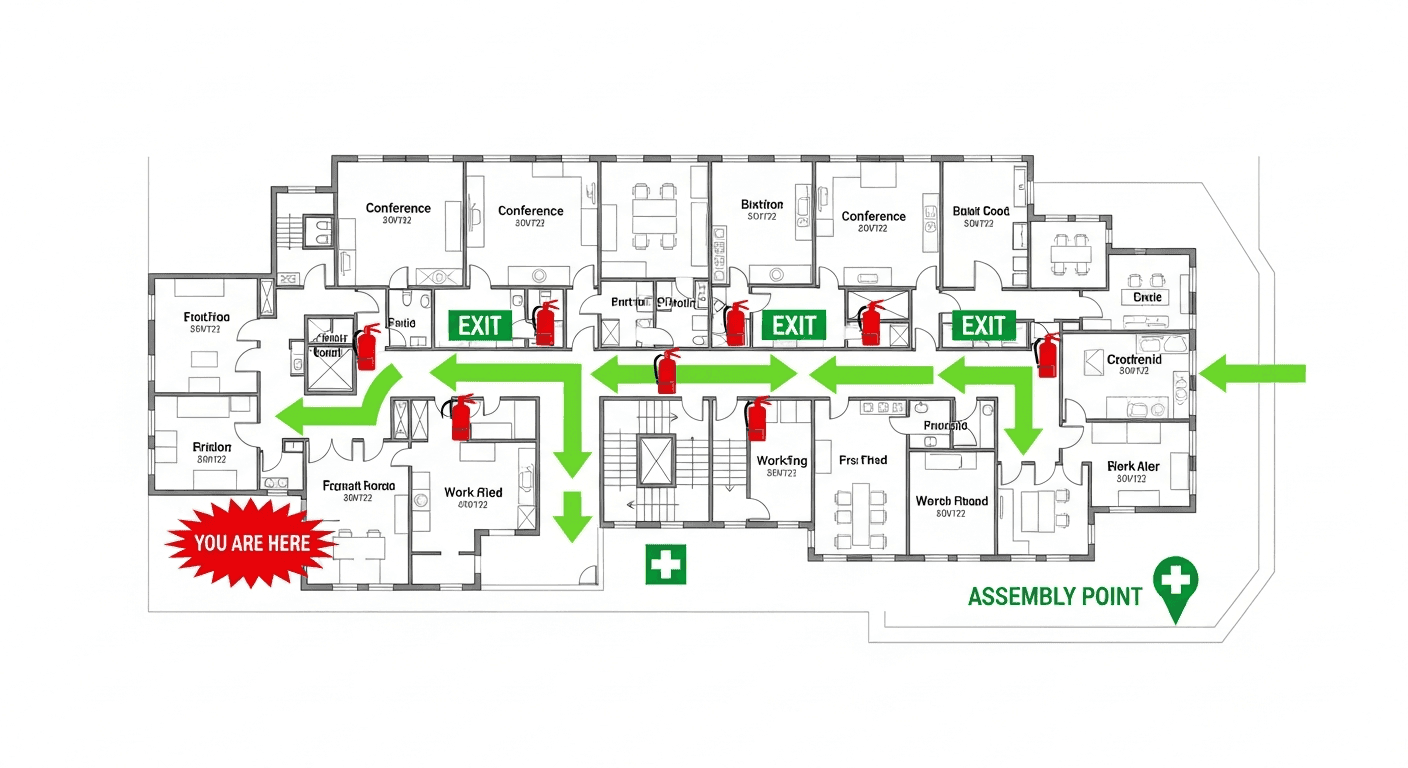
Concept illustration of the change you are making — the diagram below is a representation, not your actual file.
- Old tenant's layout still posted
- No "You Are Here" marker
- One route drawn, no alternate
- Extinguishers and pull stations missing
- No assembly point shown
- Current floor layout, correct doors
- Oriented "You Are Here" marker
- Primary + alternate routes drawn
- Extinguishers, pull stations, AED marked
- Assembly point and legend included
Three Steps to a Reinspection-Ready Draft
Upload your notice or floor plan
Upload the inspection correction notice, a floor plan, a PDF lease drawing, a photo of the existing posted map, or a hand sketch. The clearer the input, the closer the draft starts.
Place exits, routes, and equipment
Add or adjust the exits, the primary and alternate routes, the You Are Here marker, the outside assembly point, extinguishers, pull stations, and AED/first aid. Edit everything before you export.
Export, post, and verify for reinspection
Download a print-ready map, post it at the locations your AHJ expects with the marker matched to each spot, walk the building to confirm it matches reality, and have it ready for the reinspection.
Pre-Reinspection Checklist
Walk the building with this list before the inspector returns. Copy or print it, then confirm the posted map matches what is actually on the floor — that is what gets cited.
Tip: keep a dated copy of the final map and a photo of each posting location — documentation of the correction is useful for the reinspection and for your insurer and records.
What the Standards Actually Say (and What They Don't)
Knowing where the requirement comes from helps you read your correction notice — and helps you ask the inspector the right follow-up question.
OSHA 29 CFR 1910.38
Requires a written Emergency Action Plan for employers when an OSHA standard mandates one. The plan must cover evacuation procedures and emergency escape route assignments. A posted map is the practical way to communicate those routes, even though 1910.38 describes the plan rather than dictating one universal map format.
OSHA 29 CFR 1910.36 & 1910.37
Set the design and maintenance rules for means of egress — exit routes must be permanent, unobstructed, and exit doors must be unlocked from the inside along the path of egress, with proper signage and lighting. Your routes on the map should reflect these real, usable paths.
NFPA 101 / IFC (as locally adopted)
The Life Safety Code and the International Fire Code drive most fire-marshal expectations for diagrams, posting, and equipment. Crucially, local adoption and amendments control what is enforced in your area — your AHJ's interpretation is the one that counts.
What is not a universal rule
There is no single nationwide mounting height or a blanket federal rule that a map must hang at every entrance and exit. Posting locations, heights, and required content vary by jurisdiction and occupancy. When in doubt, follow the exact wording on your correction notice and ask the inspector directly.
Designed to help you prepare a clear evacuation-map draft for local review. OSHAMap produces an OSHA-aligned evacuation-map draft based on the information you provide. It is not legal advice and does not guarantee any inspection outcome. Final review by your employer and the local authority having jurisdiction (AHJ) — or a qualified safety professional — may be required before the map is posted.
Why People Under a Correction Deadline Use OSHAMap
Same-day draft
Upload, place markers, and export without waiting on a draftsperson or a consultant's schedule.
Editable before you commit
Adjust exits, routes, and markers and preview the result before you download or print anything.
Print-ready output
Export at common poster sizes so you can print, laminate, and post the same day.
Standards-referenced content
Content references 29 CFR 1910.38, 1910.36/37, NFPA 101, and the IFC — and is clear that the local AHJ controls enforcement.
Reviewed by a fire protection engineer
This page is reviewed by Sarah Chen, P.E., CFPS — a licensed Professional Engineer and Certified Fire Protection Specialist.
Regenerate after changes
Keep the file and update it after a remodel so the posted map does not drift out of date and trigger another correction.
Fire Marshal Evacuation Map Correction — FAQ
The fire marshal said I need an evacuation map — what exactly are they asking for?
In most jurisdictions the inspector is asking for a posted diagram of your floor that shows where a person is standing ("You Are Here"), the primary and alternate routes to the nearest exits, the outside assembly point, and the locations of fire extinguishers, manual pull stations, and (when applicable) an AED or first-aid station. The expectation usually traces back to OSHA 29 CFR 1910.38 (the written Emergency Action Plan), the means-of-egress rules in 1910.36/1910.37, and the locally adopted fire code (often based on NFPA 101 or the IFC). Read the wording on your correction notice carefully — it almost always lists the specific items the inspector flagged.
How fast can I create an evacuation map before my reinspection?
You can produce a draft in a single sitting. Upload a floor plan, a PDF lease drawing, a photo of the posted plan, or even a hand sketch, place the markers, and export a print-ready file the same day. The slow part of a correction is usually waiting for a draftsperson or consultant — generating the draft yourself removes that wait so you can spend your remaining time walking the building and confirming the map matches reality before the inspector returns.
Does the map have to be drawn by an architect or licensed professional?
For a posted evacuation diagram, most authorities having jurisdiction (AHJs) do not require a stamped architectural drawing — they require a clear, accurate diagram that a person can understand during an emergency. That said, some jurisdictions, occupancy types, or building permits do require professional drawings, and the AHJ has the final say. Use the generated map as your working draft, then confirm with your local fire marshal whether a professionally prepared plan is needed for your occupancy.
What is a "You Are Here" marker and why did the inspector flag mine?
The "You Are Here" marker shows the reader exactly where they are standing relative to the rest of the floor. Inspectors flag it when it is missing, when a single generic map is posted in several locations without changing the marker, or when the map's orientation does not match the wall it is posted on (for example, the exit that is to your left in real life is drawn on the right). Each posting location should have a map oriented to that spot so the routes read intuitively under stress.
My inspector said my exit routes are wrong — how do I fix the routes on the map?
Walk the building first and trace the real path a person would take to each exit, then re-draw the primary route to the nearest usable exit and an alternate route in case the primary is blocked. Make sure no route passes through a door that is locked from the egress side, ends at a window or storage room, or crosses a space that is now walled off after a remodel. The generator lets you place and adjust both routes before you export, so you can match the diagram to what you verified on the floor.
Will this map guarantee I pass my reinspection?
No tool can guarantee a pass — your local fire marshal (the AHJ) makes that decision, and local code adoptions and amendments control what is enforced in your area. What you can control is showing up with a clear, accurate, correctly posted map that addresses every item written on your correction notice. Treat the generated file as an OSHA-aligned draft based on the information you provide, then verify it against your building and your notice before the reinspection.
Where do I have to post the corrected map?
Posting locations are set by your AHJ and the adopted fire code, not by a single universal rule. Common expectations include high-traffic and decision points such as near exits, by elevators or stairwells, in corridors, and in break or common areas, with the map oriented to each spot. Check the exact wording on your correction notice and ask the inspector where they expect maps; then post a version with the "You Are Here" marker matched to each location.
What is the difference between an evacuation map and an Emergency Action Plan?
The evacuation map is the posted diagram people read during an emergency. The Emergency Action Plan (EAP) under OSHA 29 CFR 1910.38 is the broader written program — it covers reporting procedures, evacuation procedures and routes, how to account for employees, rescue and medical duties, and who to contact. The map supports the EAP but does not replace it. If your correction notice references the written plan as well as the posted map, you will need both.
Fix the cited item — then fix the whole map
Upload your floor plan, book a free expert map review, or grab the free template pack. No credit card required.
Fix My Evacuation Map Before Reinspection
Upload your inspection notice or floor plan, build the corrected map, and walk into the reinspection with a clear, posted, up-to-date evacuation diagram.
Free to start · editable before download · final local review recommended
Important Legal Disclaimer
The Occupational Safety and Health Administration (OSHA) does not approve, endorse, recommend, or certify any commercial products or software. This platform is a compliance assistance tool only and is not affiliated with or endorsed by OSHA or any government agency.
All AI-generated evacuation maps, safety plans, and compliance documents must be reviewed, verified, and approved by a qualified safety professional, fire marshal, licensed engineer, or appropriate authority before being posted, distributed, or used for emergency planning purposes.
Employers retain full legal responsibility for workplace safety under the Occupational Safety and Health Act of 1970 (OSH Act). Users are solely responsible for ensuring compliance with all applicable local, state, and federal regulations. This software does not guarantee OSHA compliance.
This software does not constitute legal, safety consulting, engineering, or professional advice. Content is for informational purposes only. Users should consult qualified safety professionals and legal counsel for compliance guidance specific to their operations.
While we strive for accuracy, workplace safety regulations change frequently. We make no warranties regarding the accuracy, completeness, or current validity of any information. Users must independently verify all regulatory requirements applicable to their specific circumstances.
To the maximum extent permitted by law, OSHAMap, its owners, operators, affiliates, and licensors shall not be liable for any direct, indirect, incidental, special, consequential, or punitive damages arising from use of this service, including but not limited to workplace injuries, OSHA violations, regulatory fines, property damage, or any other losses.
Cost comparisons and savings estimates are based on industry averages for professional safety consultant fees and are provided for informational purposes only. Actual costs, savings, and results may vary significantly based on your specific situation.
By using OSHAMap, you acknowledge that you have read, understood, and agree to be bound by these terms. For complete terms, see our Terms of Service and Privacy Policy.