Create the Evacuation Map for Your Emergency Action Plan
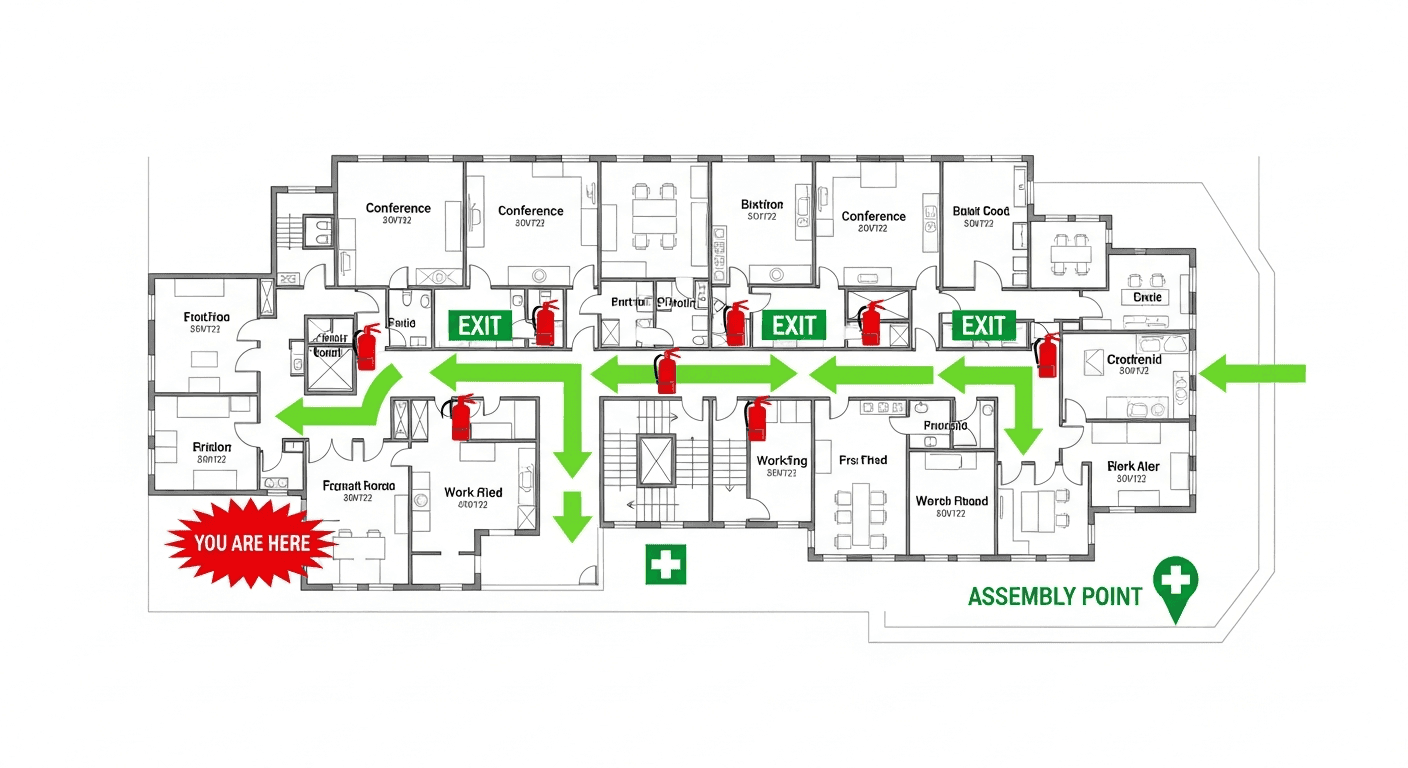
The written plan describes the emergency. The map shows people where to go. Upload your floor plan and OSHAMap drafts the evacuation-map section of your Emergency Action Plan — primary and alternate routes, exit doors, stairways, assembly points, and emergency-equipment locations — as an OSHA-aligned draft. Final local/employer review may be required. Free to start, no credit card.
Pair the map with the written companion at /osha-emergency-action-plan-template.
Building an Emergency Action Plan? Start with the map.
Upload a floor plan and OSHAMap drafts the evacuation-map section (element 2 of your 1910.38 EAP) — routes, exits, and assembly points — in under 60 seconds.
The written EAP companion lives at /osha-emergency-action-plan-template — this tool builds the map that goes inside it.
Does OSHA require an evacuation map in every workplace?
Not universally — not as a separately posted graphic. Under 29 CFR 1910.38, covered employers must have an Emergency Action Plan, and that plan must include evacuation procedures and emergency escape route assignments. OSHA does not require one specific posted map at every location, but its guidance recommends clear floor plans or workplace maps as the best way to communicate routes and assembly points. What gets enforced on the wall is ultimately set by your local Authority Having Jurisdiction (AHJ) and the fire/building codes it has adopted (IFC, NFPA 101). Treat anything you generate here as an OSHA-aligned draft; final local/employer review may be required.
Pick the Scenario, Then Build That Map
Each emergency moves people differently. Generate a separate, clearly labeled map per scenario — do not combine conflicting actions (for example, "get out" and "shelter in place") on one route map. Click a card to jump to the generator.
Generate Your EAP Evacuation Map
Upload one floor at a time, choose the scenario, and get a print-ready draft to attach to element 2 of your plan.
The Six OSHA EAP Elements — and Where This Tool Fits
29 CFR 1910.38(c) lists the minimum elements your Emergency Action Plan must include. OSHAMap is the map-maker, not the whole plan.
Reporting Emergencies
Procedures for reporting a fire or other emergency — pull stations, who to call, and how alarms are raised.
Evacuation Procedures & Route Assignments
Emergency escape procedures and route assignments. This is the element OSHAMap drafts for you as a clear, posted-ready map.
Critical-Operation Shutdown
Procedures for employees who stay to operate critical equipment before they evacuate. Authored in your written plan.
Employee Accountability
How you account for all employees after evacuation — head counts at assembly points. The map shows the muster zones.
Rescue & Medical Duties
Procedures for employees performing rescue or medical duties. Mark AED/first-aid on the map; assign duties in the plan.
Responsible Contacts
Names or job titles of people who can be contacted for more information about the plan or specific duties.
What OSHAMap does and does not do. We primarily help with element 2 — turning your floor plan into clear route assignments — and we support visual communication for the others (mark equipment, assembly zones, and a place to print contact names and shutdown notes). We do not write your entire Emergency Action Plan. For the written sections, use the written EAP template companion.
What the Evacuation-Map Section Should Show
A useful EAP map answers "where do I go, what do I avoid, and what can I grab" at a glance. Confirm capacity/travel-distance specifics with your AHJ.
Primary & Alternate Routes
At least two ways out from each area where layout allows — the primary route plus a backup if it is blocked.
Exit Doors
Every required exit clearly marked and numbered, opening in the direction of egress travel where applicable.
Stairways
Stair locations with a clear "in a fire, do not use elevators" reminder. Stairs are the fire route; elevators are not.
Assembly / Muster Points
Outdoor assembly areas placed clear of the building and fire-apparatus lanes, where head counts happen.
Hazardous Areas to Avoid
Chemical storage, electrical rooms, or process zones occupants should route around during an emergency.
Emergency Equipment
Extinguishers, pull stations, AED, first-aid, and spill kits where relevant — so responders find them fast.
You Are Here
A single orientation marker matched to the viewer's perspective so the map reads correctly where it is posted.
Accessible-Route Info
Accessible egress routes and areas of refuge where provided, supporting ADA-aligned planning.
Floor / Building ID
The floor number and building name so a multi-floor or multi-building program never mixes up route assignments.
Two Paths: Just the Map, or the Whole Plan
Be honest about what you need today. The map is fast and free; the full written plan is a bigger lift.
I Only Need the Map
You already have (or are writing) the EAP text and just need a clean, posted-ready evacuation map for element 2. Upload your floor plan and generate it now — free to start.
- Routes, exits, stairways, assembly points
- Emergency equipment + You Are Here
- One scenario per map, print-ready
- Re-generate after renovations
I Need the Full Emergency Action Plan
You want the complete written program — all six 1910.38 elements drafted, reviewed, and ready to roll out across your site or portfolio. Start with the written template companion or talk to our team.
- All six EAP elements, written
- Map(s) attached to element 2
- Multi-site standardization available
- Reviewed against the standards that apply to you
Get your EAP evacuation map — free
Upload a floor plan, book a free expert map review, or grab the free template pack. The written EAP companion is one click away. No credit card required.
Printable Employee Training Acknowledgment
Element 4 (accountability) and 1910.38(e)/(f) expect employees to be trained on the plan. Print this block, attach it behind the posted map, and keep signed copies in your EAP binder. This is a record-keeping aid, not legal advice — adapt it to your site and review with your safety lead.
I acknowledge that I have reviewed the Emergency Action Plan evacuation map for the area above. I understand my primary and alternate evacuation routes, the nearest exits and stairways, the outdoor assembly point where head counts are taken, the hazardous areas to avoid, and the location of emergency equipment. I know who to contact for more information about the plan and my assigned duties.
| Employee Name | Signature | Date | Trainer Initials |
|---|---|---|---|
Retain with your written Emergency Action Plan (29 CFR 1910.38). Re-train and re-sign after any route change, drill finding, or plan revision.
Three Steps to the Map That Goes Inside Your EAP
From floor plan to attachable draft in minutes.
Upload Your Floor Plan
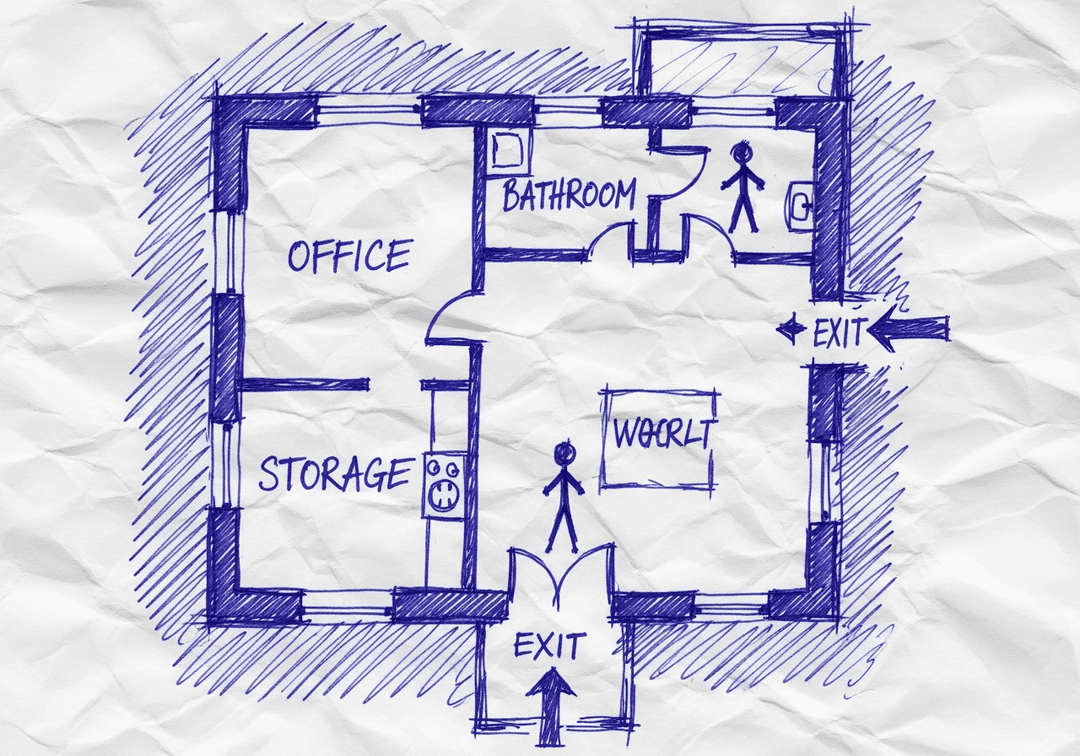
PDF, image, CAD export, or hand sketch — one floor at a time so route assignments stay clear.
Pick the EAP Scenario
Fire, chemical, severe-weather shelter, general, partial, or full-building. One action per map — no conflicting arrows.
Review & Attach
Get an OSHA-aligned draft, review it with your safety lead and AHJ where required, then attach it to element 2.
Emergency Action Plan Map — FAQ
Does OSHA require an evacuation map in every workplace?
Not universally as a separately posted graphic. Under 29 CFR 1910.38, employers who are required to have an Emergency Action Plan must put it in writing (or communicate it verbally for very small employers), and that plan must include evacuation procedures and emergency escape route assignments. OSHA does not mandate a single posted map at every location, but its guidance and eTools recommend clear floor plans or workplace maps as the most effective way to communicate routes and assembly points. Final expectations are set by your local Authority Having Jurisdiction (AHJ) and adopted fire/building codes — so the map is best treated as an OSHA-aligned draft, with final local/employer review where required.
What is the difference between an Emergency Action Plan and an evacuation map?
The Emergency Action Plan (EAP) is the written program required by 29 CFR 1910.38 — it covers how emergencies are reported, evacuation procedures and route assignments, critical-operation shutdown, employee accountability after evacuation, rescue/medical duties, and the names or job titles of people to contact for more information. The evacuation map is the visual companion that shows the routes, exits, and assembly points described in element 2. The map alone is not a complete EAP, and a written EAP without a clear map often fails to communicate routes effectively. OSHAMap builds the map; pair it with our written EAP template companion to cover the whole plan.
Which of the six OSHA EAP elements does this tool actually help with?
OSHAMap primarily helps with element 2 — evacuation procedures and emergency escape route assignments — by turning your floor plan into a clear map of primary and alternate routes, exits, and assembly points. It also supports visual communication for the other elements: you can mark emergency equipment, accountability/assembly zones, and a place to print contact names and shutdown notes. It does not write the entire EAP for you. Reporting procedures, critical-operation shutdown steps, rescue/medical duty assignments, and the responsible-contact list still need to be authored in your written plan.
Should one map show fire evacuation and severe-weather sheltering together?
No. Fire evacuation moves people out of and away from the building, while severe-weather sheltering (tornado, for example) moves people into interior, windowless areas of the building. Putting both sets of arrows on one route map confuses occupants at the worst possible moment. Generate a separate map per scenario — fire evacuation, chemical release, severe-weather shelter, general evacuation, partial evacuation, full-building — and post each clearly labeled. Never combine conflicting actions on a single route diagram.
What should the evacuation-map section of an EAP actually show?
At minimum: primary and alternate evacuation routes, exit doors, stairways (with "in a fire, do not use elevators" guidance), outdoor assembly/muster points, hazardous areas to avoid, the location of emergency equipment (extinguishers, pull stations, AED, first aid, spill kits where relevant), a clear "You Are Here" marker oriented to the viewer, accessible-route information and areas of refuge where provided, and the floor or building identifier. Travel-distance and exit-capacity details are governed by adopted codes such as the IFC and NFPA 101, so confirm specifics with your AHJ.
Who has to have a written Emergency Action Plan under 1910.38?
A written EAP is required whenever an OSHA standard requires one (for example, certain fixed extinguisher, process safety, or hazardous-material standards trigger it). As a practical baseline, 29 CFR 1910.38(b) allows employers with 10 or fewer employees to communicate the plan orally rather than in writing — most employers above that threshold maintain a written plan. Because several substance-specific standards can require an EAP regardless of headcount, the safest approach is to maintain a written plan with a clear map and have it reviewed against the standards that apply to your operation.
How often should the EAP map be reviewed or updated?
Update the map whenever the conditions that drive routes change: renovations or wall/door changes, relocated exits or stairwell access, new hazardous storage, moved emergency equipment, a new assembly point, or any finding from a fire-marshal or insurance walkthrough. Many employers review annually and after every drill. Because OSHAMap stores your generated maps, you can re-upload a revised floor plan and regenerate an updated draft instead of starting from scratch — then route it through your local/employer review again.
Can I use these maps for a multi-building or multi-location organization?
Yes — generate a distinct map for each floor and each building so route assignments and assembly points are accurate per location, then keep them under one program. For organizations managing many sites, our multi-location evacuation map software workflow helps standardize the legend and revision dates across the portfolio while each site still posts its own site-specific map. Each location should still be reviewed against its local AHJ and adopted codes.
Ready to Draft the Map Inside Your EAP?
Generate the evacuation-map section now, or get help with the full written plan.
Important Legal Disclaimer
The Occupational Safety and Health Administration (OSHA) does not approve, endorse, recommend, or certify any commercial products or software. This platform is a compliance assistance tool only and is not affiliated with or endorsed by OSHA or any government agency.
All AI-generated evacuation maps, safety plans, and compliance documents must be reviewed, verified, and approved by a qualified safety professional, fire marshal, licensed engineer, or appropriate authority before being posted, distributed, or used for emergency planning purposes.
Employers retain full legal responsibility for workplace safety under the Occupational Safety and Health Act of 1970 (OSH Act). Users are solely responsible for ensuring compliance with all applicable local, state, and federal regulations. This software does not guarantee OSHA compliance.
This software does not constitute legal, safety consulting, engineering, or professional advice. Content is for informational purposes only. Users should consult qualified safety professionals and legal counsel for compliance guidance specific to their operations.
While we strive for accuracy, workplace safety regulations change frequently. We make no warranties regarding the accuracy, completeness, or current validity of any information. Users must independently verify all regulatory requirements applicable to their specific circumstances.
To the maximum extent permitted by law, OSHAMap, its owners, operators, affiliates, and licensors shall not be liable for any direct, indirect, incidental, special, consequential, or punitive damages arising from use of this service, including but not limited to workplace injuries, OSHA violations, regulatory fines, property damage, or any other losses.
Cost comparisons and savings estimates are based on industry averages for professional safety consultant fees and are provided for informational purposes only. Actual costs, savings, and results may vary significantly based on your specific situation.
By using OSHAMap, you acknowledge that you have read, understood, and agree to be bound by these terms. For complete terms, see our Terms of Service and Privacy Policy.